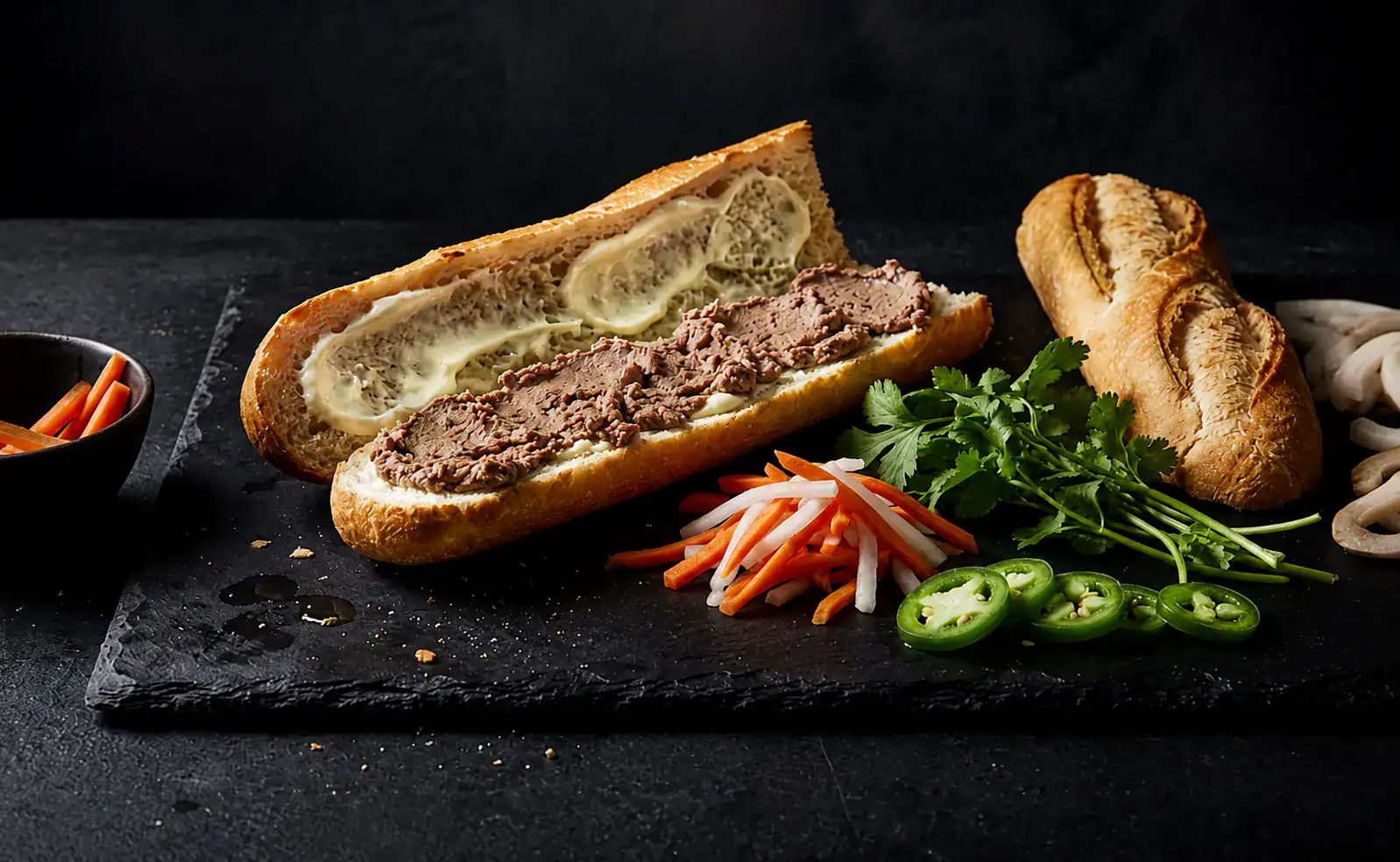
HOW TO MAKE BÁNH MÌ
Making homemade bánh mì is easier than most people think and harder than it looks when someone else is doing it. The sandwich has five elements. Each one has a specific job. Get all five right and you will make one of the best sandwiches you have ever eaten. Miss one and you will wonder what went wrong.
This is not a recipe where you approximate and hope for the best. The bread has to shatter. The fat barrier has to seal. The pickles have to be sharp enough to cut through the pâté without overpowering the chicken or cold cuts. The jalapeño has to arrive last. When all of that happens at once the bánh mì does something no other sandwich does. It balances.
This guide covers how to make bánh mì at home from start to finish. Every element in order. Every reason explained. Every component links to a full recipe. Read it once before you start. The sandwich rewards preparation and punishes improvisation.
[ THE BREAD ]
The bread is where most homemade bánh mì fails. A standard French baguette has a thick, chewy crust designed to be eaten with butter or cheese. That crust fights the fillings. It compresses them instead of shattering around them.
The correct bread is a Vietnamese demi-baguette made with a blend of bread flour and rice flour. The rice flour changes how the outer layer sets in the oven, producing a thin brittle crust that shatters on the first bite. This is called the Glass Crust. It is the defining quality marker of an authentic bánh mì.
Vietnamese baguettes are available at Vietnamese bakeries and most Asian grocery stores. If you cannot find them, a standard French baguette works as a starting point. The crust will be thicker and chewier but the five-element logic still applies. For the authentic result at home, the Glass Crust Bánh Mì Baguette recipe on this site uses a specific flour ratio and steam injection method that produces the correct bread from scratch.
[ THE FAT BARRIER ]
The bánh mì is a wet sandwich. Pickled vegetables. Fresh herbs. Marinated protein. Without a fat barrier between the bread and the wet ingredients, the bread goes soft within minutes.
Think of it as waterproofing. Without it you are racing against the clock from the moment you close the sandwich. With it you have thirty minutes before the bread starts to soften. That is enough time to wrap it, walk somewhere, and eat it the way it was meant to be eaten.
Vietnamese street cart vendors solved this problem decades ago with two layers of fat applied before any filling goes in.
First: Vietnamese mayonnaise on both inner surfaces of the bread. The mayonnaise is an emulsion that waterproofs the bread against moisture. It goes on both the top and bottom halves without exception.
Second: pork liver pâté on the bottom half only, on top of the mayonnaise. The pâté adds a second fat layer and a deep savoury base note that anchors the whole sandwich.
Both layers are non-negotiable. Skip either one and the bread starts absorbing moisture the moment the fillings go in. The sandwich stays structurally sound for up to 30 minutes with both layers in place. Without them it softens in under five minutes.
The Vietnamese mayonnaise recipe on this site takes five minutes to make and keeps for five days refrigerated. Make it the day before.
[ THE PROTEIN ]
The protein sits on top of the pâté. It should cover the full length of the bread without being stacked too high. Height is the enemy of a bánh mì. A sandwich that cannot close properly loses its structural integrity on the first bite.
The classic protein is thịt nguội. Vietnamese cold cuts. Chả lụa (steamed pork sausage), chả bì (shredded pork skin), and head cheese layered in a specific order. This is the sandwich that established the template. It is the version every other bánh mì is measured against.
Modern versions use grilled pork, lemongrass chicken, tofu, or other proteins. These variations work when they respect the five-element architecture. The Classic Bánh Mì Thịt Nguội and the Bánh Mì Gà recipes on this site are both built on the same logic.
Whatever protein you use, slice it thin and layer it flat. Do not pile it.
If this is your first bánh mì, start with the Classic Bánh Mì Thịt Nguội. It is the sandwich that established the template. Make it once and every variation you try after it will make more sense.
[ THE ACID ]
Pickled daikon and carrot is the acid component. In Vietnamese it is called đồ chua. It is the element that cuts through the fat of the pâté and mayonnaise and keeps the sandwich from becoming too heavy. The daikon and carrot need to be julienned at 1.5mm. A mandoline slicer produces that cut consistently in under two minutes.
The brine is a 1:1 ratio of rice vinegar to water with 25% sugar by weight. That ratio is precise. Too much vinegar and the pickles overpower everything else. Too little and they taste flat.
The pickles need at least two hours in the brine before they are ready. Make them the day before you need them. They keep for two weeks refrigerated.
The Đồ Chua recipe on this site covers the full method including the salt and sugar pre-treatment that produces the correct crunch and depth of flavour.
Fresh cucumber sliced lengthwise goes in alongside the pickles. It adds a clean, cool note that the pickled vegetables alone do not provide. For a quick pickled version that takes that cool note even further, see the Quick Pickled Cucumber recipe.
[ THE FINISH ]
The finish is what separates a good bánh mì from a great one. Three elements applied in a specific order after the protein and pickles are in place.
Fresh cilantro added whole, not chopped. The whole sprigs distribute flavour more evenly than chopped cilantro and hold up better against the moisture of the pickles.
Jalapeño sliced thin on a bias. Two or three slices per sandwich. The jalapeño adds heat that arrives late, after everything else has landed. It is the last thing you taste on each bite.
Three drops of Maggi Seasoning Sauce directly onto the filling. Not soy sauce. Maggi contains wheat-fermented glutamates that produce a more complex umami signal. It ties all the other flavours together without adding its own identifiable taste.
Close the sandwich. Wrap it in parchment paper and press for 30 seconds before serving. That thirty seconds is not optional. It is the difference between a sandwich that holds together and one that falls apart on the first bite. Press it. Wrap it. Eat it immediately.
[ THE ASSEMBLY SEQUENCE ]
Order matters. Here is the correct sequence:
1. Split the baguette lengthwise, three-quarters through using a 10-inch offset serrated bread knife. Do not cut completely. The hinge holds the sandwich together. 2. Open the bread. Apply Vietnamese mayonnaise to both cut surfaces using an offset spatula. 3. Spread pâté on the bottom half only, on top of the mayonnaise. 4. Layer protein on the pâté. Flat, not piled. 5. Add cucumber strips across the protein. 6. Add drained pickled daikon and carrot. Drain them first. Excess brine soaks the bread. 7. Add cilantro sprigs whole. 8. Add jalapeño slices. 9. Three drops of Maggi Seasoning Sauce. 10. Close. Wrap. Press for 30 seconds. Serve immediately.
The sandwich does not keep. A fully assembled bánh mì softens within 30 minutes. Build it when you are ready to eat it.
[ WHERE TO START ]
If you are making bánh mì for the first time start with the components. The Vietnamese mayonnaise and the pickled daikon and carrot can both be made in advance and keep for days in the refrigerator. Having both ready means the sandwich assembles in under five minutes.
The bread is the most involved component. The Glass Crust Bánh Mì Baguette recipe requires planning. The dough needs time to rise and the oven needs 45 minutes to preheat properly. Read the full recipe before you start.
Once the components are in place make the Classic Bánh Mì Thịt Nguội first. It is the original. It establishes what the sandwich is supposed to taste like.
Make the classic first. Then make it again. By the third time you will understand exactly why every element is there and exactly what happens when one of them is wrong. That understanding is what separates a good bánh mì from a great one.