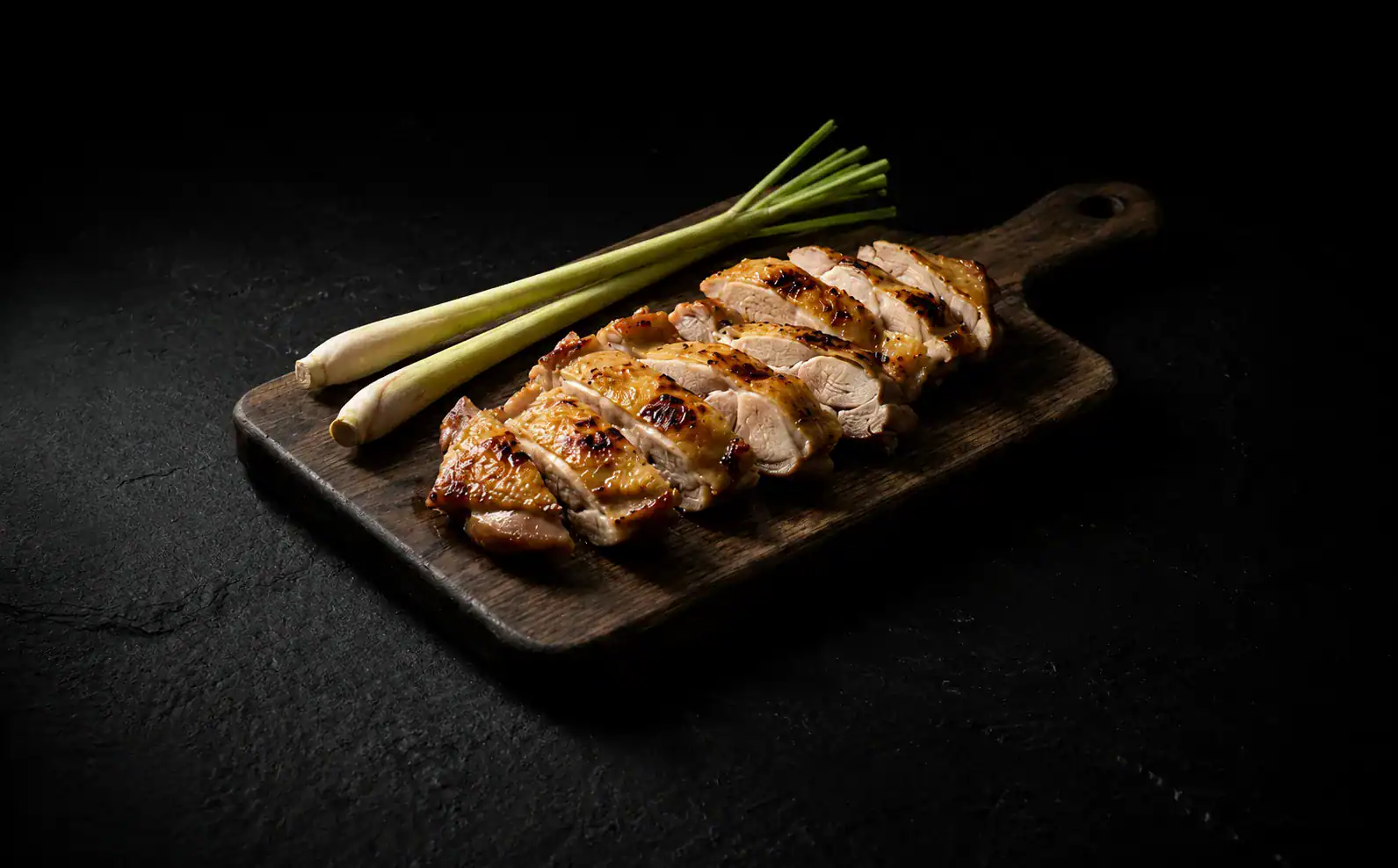
Lemongrass chicken thighs sliced on a wooden cutting board with dark slate background

BÁNH MÌ GÀ (LEMONGRASS CHICKEN)

Bánh mì gà is a chicken bánh mì built on the same five-element architecture as every other bánh mì worth eating. The bread shatters. The fat barrier goes on first. The pickled daikon and carrot cut through. The cilantro lifts. The jalapeño finishes.

What changes is the protein logic. Chicken works in this sandwich when it has two things: char and fat. A skinless chicken breast, steamed or poached, produces neither. The version here uses boneless, skin-on chicken thighs marinated in lemongrass, fish sauce, and a small amount of sugar, then cooked in a cast iron pan until the skin renders and the edges blacken slightly.

The result is a bánh mì that holds up to the bread. Not a lighter option. Not a simpler option. A different expression of the same logic.

L. Nguyen

Bánh Mì Gà — Lemongrass Chicken

Boneless skin-on chicken thighs marinated in lemongrass and fish sauce. Cast iron sear until the skin renders and chars slightly. Built on the five-element architecture. [ INTERMEDIATE ]
Prep Time 30 minutes
Cook Time 15 minutes
Marinade Time 2 hours
Total Time 2 hours 45 minutes
Servings: 4 bánh mì
Course: Sandwich
Cuisine: Vietnamese

Ingredients
  

The Marinade
  • 700 g boneless skin-on chicken thighs (approximately 4 thighs)
  • 2 stalks lemongrass, white and pale green parts only, finely minced (approximately 3 tbsp)
  • 3 cloves garlic, minced
  • 2 tbsp fish sauce (Red Boat 40°N preferred)
  • 1 tbsp sugar
  • 1 tsp neutral oil
  • ½ tsp white pepper
  • ½ tsp turmeric
The Pickles
  • 200 g carrot, julienned 3mm wide
  • 120 ml unseasoned rice vinegar
  • 120 ml water
  • 30 g sugar
  • 8 g kosher salt
The Assembly
  • 4 Vietnamese demi-baguettes (Glass Crust standard)
  • 4 tbsp Vietnamese mayonnaise (recipe on this site) or Kewpie if using store-bought
  • 60 g pork liver pâté
  • 1 small cucumber, sliced lengthwise into thin strips
  • 1 bunch fresh cilantro, stems trimmed
  • 2 jalapeños, sliced thin on a bias
  • 1 Maggi Seasoning Sauce, for finishing

Equipment

  • Cast iron skillet
  • Mandoline slicer
  • Instant-read thermometer
  • Bread knife

Method
 

Make the Pickles
  1. Combine rice vinegar, water, sugar, and salt in a small saucepan over medium heat. Stir until sugar and salt dissolve completely, 2 to 3 minutes. Do not boil. Remove from heat and let cool to room temperature, 15 minutes.
  2. Pack daikon and carrot into a clean jar. Pour brine over vegetables. The brine should cover the vegetables completely. Seal and refrigerate for a minimum of 1 hour. Two hours produces a better result. The pickles will keep for 2 weeks refrigerated.
Marinate the Chicken
  1. Combine lemongrass, garlic, fish sauce, sugar, oil, white pepper, and turmeric in a bowl. Mix until sugar dissolves. Add chicken thighs and work the marinade into the meat with your hands, separating the skin from the flesh slightly to push marinade underneath. Cover and refrigerate for 2 hours minimum. Overnight is the correct choice.
  2. The turmeric is not decoration. It drives the Maillard reaction, accelerating surface browning at the temperatures a home cast iron pan produces.
Cook the Chicken
  1. Remove chicken from refrigerator 20 minutes before cooking. Cold protein in a hot pan drops pan temperature and steams rather than sears.
  2. Heat a cast iron skillet over medium-high heat for 3 minutes. No oil. The chicken skin will render its own fat.
  3. Place thighs skin-side down. Press flat with a spatula or a second heavy pan. Do not move them. Cook 7 to 8 minutes until skin is deeply golden and releases cleanly from the pan. Flip. Cook 4 to 5 minutes on the second side until internal temperature reaches 74°C / 165°F.
  4. Rest on a cutting board for 5 minutes. Slice against the grain at a 45-degree angle, 6mm thick. The bias cut increases surface area. More surface area means more marinade contact per bite.
Assemble
  1. Split each baguette lengthwise, cutting three-quarters through. Do not cut completely. The hinge holds the sandwich together.
  2. Open the bread. Apply Vietnamese mayonnaise to both cut surfaces. This is the fat barrier. It seals the bread against moisture from the vegetables and the chicken.
  3. Spread pâté on the bottom half only.
  4. Layer chicken slices on the pâté. Overlap them slightly. Do not pile them. The bread cannot handle height.
  5. Add cucumber strips across the chicken.
  6. Add pickled daikon and carrot. Drain them first. Excess brine soaks the bread.
  7. Add cilantro in whole sprigs. Do not chop it.
  8. Finish with jalapeño slices. Two or three per sandwich is the correct amount.
  9. Three drops of Maggi Seasoning Sauce across the top. No more. Close the sandwich. Wrap in parchment paper and press for 30 seconds before serving. The compression sets the layers.

Notes

Vietnamese mayonnaise is the correct choice here. The recipe is on this site. If you do not have time to make it from scratch, Kewpie is the correct store-bought substitute. Do not use standard mayonnaise. The flavour profile is different enough to affect the finished sandwich.
The pickles in this recipe follow the same formula as the Đồ Chua recipe on this site. If you have a jar already made, use those. If not, the brine in the ingredients list produces the correct result.
Chicken breast can be substituted for thighs but the result will be drier and less flavourful. If using breast, butterfly it to an even 1.5cm thickness, reduce cook time to 3 to 4 minutes per side, and pull at 71°C. Do not skip the fat barrier on the bread.
The marinade can sit for up to 24 hours refrigerated. Beyond that the fish sauce begins to break down the protein structure, producing a slightly mushy texture on the surface.
A charcoal grill produces a result that is arguably better than cast iron. Cook skin-side down over direct medium-high heat, lid open, 6 to 7 minutes. Flip and finish 4 to 5 minutes.

[ THE SCIENCE ]

Why lemongrass and not ginger. Both are aromatic rhizomes used throughout Southeast Asian cooking. The difference is structural. Ginger’s heat is sharp and immediate. It reads as a top note. Lemongrass builds from the base. In a marinade cooked over high heat, ginger volatilizes quickly, losing most of its aromatic compounds before the chicken finishes cooking. Lemongrass contains citral, the same compound that gives lemon its character, which is more heat-stable and survives the sear. The result is fragrance that lingers in the finished sandwich rather than cooking off in the pan.

Why skin-on thighs and not breast. Chicken breast contains less than 2% intramuscular fat. Chicken thigh contains 8 to 10%. Fat carries flavor compounds and keeps the meat from drying during high-heat cooking. The skin adds a third function: it renders under direct heat, basting the meat in its own fat during the cook. A skinless breast cooked to 74°C in a hot pan produces a drier, less flavorful result at the same internal temperature. This is not preference. It is the difference in fat content doing its job.

Why rest before slicing. Muscle fibers contract during cooking, pushing moisture toward the center of the meat. Resting allows those fibers to relax and reabsorb the moisture. A chicken thigh sliced immediately after cooking loses 20 to 25% more juice on the cutting board than one rested for 5 minutes. In a sandwich with this much layering, every drop of juice that stays in the meat stays out of the bread.

[ THE FAQ ]

Q: Can I use chicken breast instead of thighs? You can. The result will be drier and less flavourful. If using breast, butterfly it to an even 1.5cm thickness before marinating, reduce cook time to 3 to 4 minutes per side, and pull at 71°C. You will still need to rest it. Do not skip the fat barrier on the bread.

Q: How long can the marinated chicken sit? Up to 24 hours refrigerated. Beyond that the fish sauce begins to break down the protein structure, producing a slightly mushy texture on the surface. Two hours is the minimum. Eight hours is the sweet spot.

Q: Can I grill the chicken instead of pan-searing? Yes. A charcoal grill produces a result that is arguably better. The smoke adds a dimension the cast iron cannot. Cook skin-side down over direct medium-high heat, lid open, 6 to 7 minutes. Flip and finish 4 to 5 minutes.

Q: What if I cannot find Vietnamese demi-baguettes? The bread is non-negotiable to the character of the sandwich. A standard French baguette has a thicker, chewier crust that compresses the fillings rather than shattering around them. If Vietnamese baguettes are unavailable, the Glass Crust Bánh Mì Baguette recipe on this site produces the correct bread at home.

Q: Why Maggi and not soy sauce? Maggi Seasoning Sauce contains wheat-fermented glutamates that produce a more complex umami signal than straight soy sauce. The difference in a finished sandwich is subtle. The difference in 50 sandwiches is not. Use Maggi.

[ THE EQUIPMENT ]

A cast iron skillet is the only pan that holds the temperature needed for proper skin rendering. A mandoline slicer produces the consistent 3mm julienne the pickles require. An instant-read thermometer takes the guesswork out of the cook. A bread knife splits the baguette without crushing the Glass Crust.

The full equipment list with specific recommendations is on the Equipment page.

[ WHAT TO READ NEXT ]

The Classic Bánh Mì Thịt Nguội is the sandwich that established the template. The cold cut standard that every variation including this one is measured against.

The Glass Crust Bánh Mì Baguette is the bread this recipe depends on. The flour ratio and steam method that produces the crust this sandwich needs.

The Đồ Chua recipe is the pickle used in this sandwich. Make a full batch and keep it in the refrigerator. It is ready whenever you need it.