Best Bread Knife for Bánh Mì
Most people building a bánh mì kitchen spend money on the right ingredients and the right bread and then grab whatever knife is sitting in the drawer. That is where the sandwich falls apart. Not in the assembly. In the cut.
The Glass Crust baguette has a thin, brittle exterior under tension and a cloud-light crumb underneath. The wrong knife compresses the crust before it cuts through it. The crust cracks unevenly. The crumb collapses. The sandwich you spent an hour building loses its structure before it reaches the plate. The right knife goes through that crust in one clean pass and leaves everything intact.
You need a 10-inch offset serrated blade. Nothing else works as well for this specific job. This page covers the three best options at every price point, why the offset handle matters more than most people realize, and exactly what to look for when you are buying.
[ WHY THE KNIFE MATTERS FOR BÁNH MÌ SPECIFICALLY ]
Most bread knives are designed for slicing sandwich loaves or sourdough rounds. The Glass Crust Vietnamese baguette is a different challenge entirely. The crust is thinner and more brittle than any Western bread style. It shatters rather than compresses. And the cut runs lengthwise along the full 30cm of the loaf rather than straight across, which means the blade needs to stay level and controlled for the entire stroke.
A straight-edge knife fails immediately. It applies pressure across the full blade width before any cutting happens, which causes the crust to crack and crumble rather than slice cleanly. A short serrated knife requires multiple strokes to cover the length of the baguette, and each additional stroke adds another opportunity for the crust to tear.
A 10-inch wavy serrated blade with an offset handle is the correct tool because it grips the crust on first contact, cuts through the full length in a single stroke, and keeps your hand in a natural position throughout. That combination is specific to this knife category and this bread style.
[ THE RECOMMENDATION ]
The Mercer Culinary M23210 Millennia 10-Inch Offset Bread Knife is the correct knife for this job. It is one of the most popular bread knives sold today. It is used in professional kitchens and culinary schools across the United States. And at under $20 it is one of the best value kitchen tools available at any price point.
The blade is high-carbon Japanese steel with a wavy serrated edge that grips the glass crust on first contact. The offset handle raises your hand above the cutting board by about 2 inches, which means your knuckles never touch the surface and the blade travels the full length of the cut without interruption. The handle itself is a Santoprene and polypropylene composite that is comfortable, non-slip, and dishwasher safe.
This is not a compromise recommendation. It is the knife professional bakers reach for and the knife that makes the most sense for a home kitchen built around the bánh mì standard.
[ THE THREE OPTIONS ]
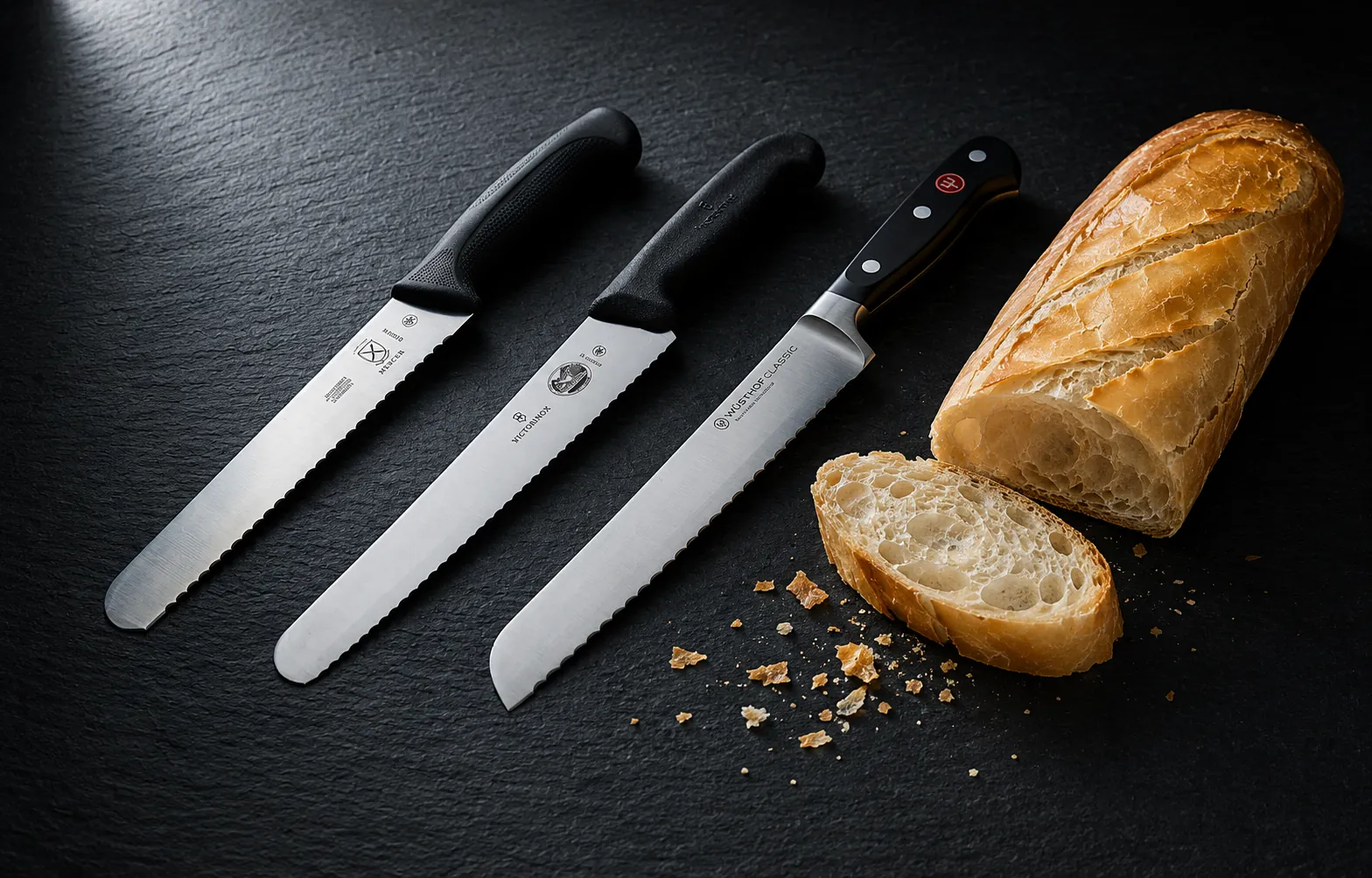
[ BEST OVERALL ] Mercer Culinary M23210 Millennia — under $20 The recommendation above. Professional grade, 21,000+ reviews, 4.8 stars. The correct knife for most home kitchens. Buy this one.
[ ALTERNATIVE ] Victorinox Fibrox Pro 10-Inch Serrated — around $75 Victorinox makes the Swiss Army knife and applies the same engineering precision to their kitchen line. The Fibrox Pro has a slightly thinner blade profile that performs exceptionally well on glass crust baguettes. The ergonomic handle is one of the most comfortable in the category and the blade geometry is optimized for clean cuts on artisan bread. A strong step up if you want to invest slightly more in a knife that will see daily use.
[ PREMIUM ] Wüsthof Classic 10-Inch Bread Knife — around $120 to $150 Wüsthof is the gold standard of German kitchen knives and the Classic bread knife reflects everything that reputation is built on. Full-tang forged blade. Precision ground serration that holds its edge significantly longer than stamped alternatives. Triple-riveted handle that is as comfortable after ten years as it was on day one. This is the knife you buy once and use for the rest of your life. If you are building a serious kitchen and the investment is not a barrier, the Wüsthof is the answer.
[ THE SCIENCE ]
The Glass Crust baguette presents a specific cutting problem that most bread knives are not designed to solve. The exterior is thin, brittle, and under tension. The interior is soft and airy with almost no structural resistance. Those two properties in the same loaf require a blade that cuts rather than compresses.
A straight edge concentrates the cutting force at a single line of contact. On a crusty loaf that means the blade pushes the crust inward before it breaks through, which causes the crust to crack unevenly and the crumb underneath to compress. The result is a flattened sandwich that looks nothing like what you built.
A wavy serrated edge works on a completely different principle. Each tooth makes a small independent cut on contact, distributing the cutting force across multiple points rather than concentrating it at one edge. The teeth grip the surface immediately and begin cutting before any compression can occur. The crust opens cleanly. The crumb stays intact.
The offset handle is solving a different problem. When you cut a baguette lengthwise, the blade needs to travel at a slight downward angle to follow the curve of the loaf. A straight handle forces your wrist into an awkward position at the far end of that cut, which causes most people to lift the blade slightly and lose contact with the board. The offset design keeps your hand in a natural position throughout so the blade stays level from the first millimeter to the last. On a 30cm baguette that difference between a level cut and a lifted cut determines whether the sandwich opens evenly or tears on one side.
[ THE FAQ ]
Does knife length actually matter for bánh mì? Yes and the reason is specific. A standard bánh mì baguette is 25 to 30cm long. A 10-inch blade covers that length in a single stroke. A shorter blade requires two or more strokes to complete the cut and each additional stroke increases the chance of tearing the crust. One stroke is always cleaner than two. Always use a 10-inch blade minimum.
Can I use a regular chef’s knife? Not effectively. A chef’s knife has a straight edge that compresses the glass crust before cutting through it. The crust cracks, the crumb flattens, and the sandwich loses its structure before you have even added the filling. A serrated bread knife is not optional for this application. It is the correct tool for this specific bread.
How do I know when my bread knife needs sharpening? Serrated knives dull much more slowly than straight-edge blades because the teeth do the cutting rather than a single edge. A quality serrated bread knife used for home baking can go two to five years before needing attention. The sign that it needs sharpening is when it starts tearing rather than cutting. When that happens take it to a professional. Home sharpeners cannot handle serrated blades properly.
Is the offset handle really necessary or is it just a nice extra? For bánh mì specifically it is necessary. The lengthwise cut on a round baguette requires the blade to travel at a downward angle across the full length of the loaf. The offset handle makes that cut natural and controlled. A straight handle makes it awkward and increases the chance of an uneven cut. If you are buying a bread knife specifically for bánh mì, offset is not optional.
Can the same knife slice cold cuts and other sandwich ingredients? The serrated bread knife is optimized for bread. It will cut cold cuts and vegetables but a straight-edge knife gives cleaner, thinner slices on chả lụa and chả bì. Keep the bread knife for the bread and use a chef’s knife or slicing knife for the fillings.
Is the Mercer really as good as more expensive knives? For this specific application, yes. The Mercer M23210 performs at a level that justifies its place in professional kitchens regardless of its price. The Victorinox and Wüsthof options offer better materials and longer-term durability, but in terms of cutting performance on a glass crust baguette the Mercer is not meaningfully behind either of them. At under $20 versus $120 to $150 the question is not which cuts better today. It is whether you want a knife that lasts a lifetime.
[ WHAT TO READ NEXT ]
The bread knife matters most when the bread is right. For the Glass Crust Baguette recipe that this knife was built for, see the Glass Crust Baguette recipe.
For the complete sandwich assembly where the cut matters most, see the Classic Bánh Mì Thịt Nguội recipe.
The Why Is My Bánh Mì Soggy guide covers how the cut affects the structural window of the sandwich and why getting it right matters more than most people realize.