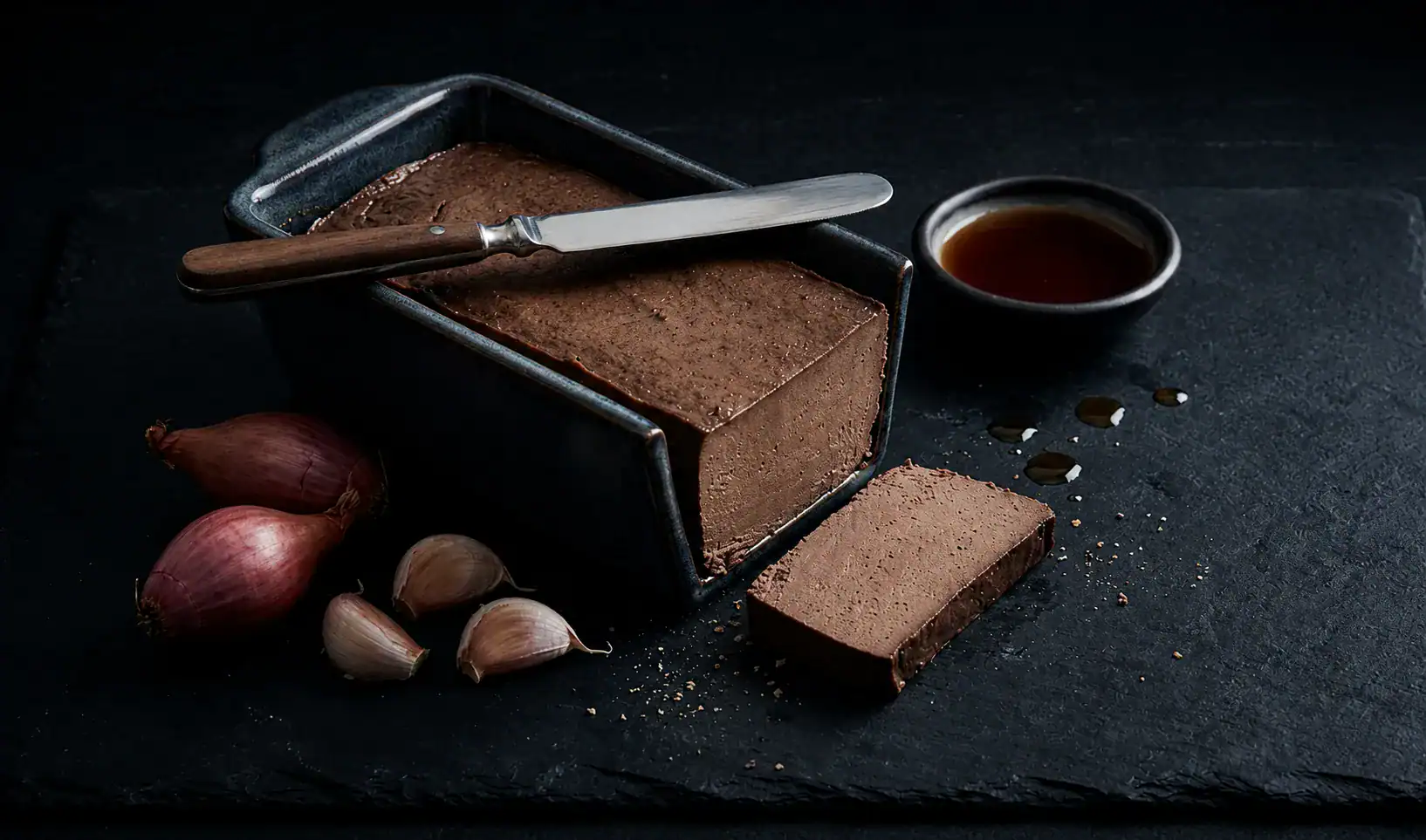
Pork liver pâté in a dark loaf pan with a slice cut beside it, shallots, garlic, and fish sauce on dark slate

PORK LIVER PÂTÉ FOR BÁNH MÌ

Pork liver pâté is the ingredient most home cooks skip. They buy a tin, spread it on the bread, and move on. That is fine. Store-bought pâté works. But the version you make at home is different in a way that is immediately obvious the first time you taste them side by side. Smoother. Richer. More depth. The liver flavour is present but not aggressive. It tastes like the foundation of a sandwich rather than an afterthought.

This recipe produces a classic Vietnamese-style pork liver pâté. Pork liver, pork fatback, shallots, garlic, fish sauce, and a small amount of sugar. No fancy equipment beyond a food processor and a loaf pan. The active time is 30 minutes. The result keeps for one week refrigerated and freezes well for up to three months.

Make it once. You will not go back to the tin.

L. Nguyen

Pork Liver Pâté for Bánh Mì

Vietnamese-style pork liver pâté made from scratch. Pork liver, fatback, fish sauce, and five spice. Water bath method produces a smooth silky result. The fat barrier every bánh mì depends on. [ INTERMEDIATE ]
Prep Time 30 minutes
Cook Time 1 hour
Chill Time 4 hours
Total Time 5 hours 30 minutes
Servings: 20 bánh mì
Course: Condiment
Cuisine: Vietnamese

Ingredients
  

The Pâté
  • 300 g pork liver, cleaned and trimmed
  • 200 g pork fatback or unsalted butter, cut into cubes
  • 2 shallots, roughly chopped
  • 3 cloves garlic, roughly chopped
  • 2 tbsp fish sauce
  • 1 tbsp sugar
  • 1 tsp fine salt
  • ½ tsp white pepper
  • ½ tsp five spice powder
  • 2 tbsp neutral oil
The Seal
  • 60 g unsalted butter, melted

Equipment

  • Food processor
  • Fine mesh sieve
  • 450g loaf pan
  • Kitchen thermometer
  • Large baking dish (for water bath)

Method
 

Prepare the Liver
  1. Trim the pork liver of any visible connective tissue, bile ducts, and discoloured spots. If you are not sure what to remove, cut away anything that is tough, stringy, or a different colour from the main flesh. Cut into 3cm pieces.
  2. Place in a bowl and cover with cold water. Add 1 tsp salt. Soak for 30 minutes. You will see the water turn pink as the blood draws out. This is exactly what you want. It reduces the intensity of the liver flavour without removing it entirely. Drain and pat dry with a clean kitchen towel.
Cook the Aromatics
  1. Heat the neutral oil in a heavy pan over medium heat. Add the shallots and cook until soft and translucent, 3 to 4 minutes. Add the garlic and cook for 1 minute more. Do not let either brown. Transfer to a plate and set aside.
Cook the Liver
  1. In the same pan over medium-high heat, cook the liver pieces in batches. Do not crowd the pan or the liver will steam instead of sear. Cook 2 minutes per side. The liver is ready when it is just cooked through with no pink remaining in the centre. Cut a piece open to check. It should be pale brown throughout, firm but not hard when pressed.
  2. This is the most important step in the recipe. Overcooked liver turns grainy and bitter. Undercooked liver is unsafe. Two minutes per side at medium-high heat in a hot pan is the correct approach. Pull it the moment it is done.
Blend
  1. Add the cooked liver, shallots, garlic, fatback or butter, fish sauce, sugar, salt, white pepper, and five spice to a food processor. Blend on high for 3 to 4 minutes. Stop twice to scrape down the sides with a spatula and push any unblended pieces back toward the blade.
  2. Keep blending until the mixture is completely smooth with no visible chunks. Run a spoon through it. If you can feel any texture at all, blend for another 2 minutes. The smoother it is at this stage the better the finished pâté will be.
Strain
  1. Push the blended mixture through a fine mesh sieve using a rubber spatula. Work in small batches and press firmly. What comes through should look like thick smooth cream. What stays behind in the sieve is connective tissue that did not blend down completely.
  2. This step takes about 5 minutes and it is the difference between a pâté that spreads like silk and one that tears the bread. Do not skip it.
Bake
  1. Preheat oven to 160°C / 320°F.
  2. Pour the strained mixture into a lightly greased 450g loaf pan. Smooth the top with a spatula. Cover tightly with aluminium foil.
  3. Place the loaf pan in a larger baking dish. Fill the baking dish with hot water until it reaches halfway up the sides of the loaf pan. This is a water bath. It ensures the pâté cooks gently and evenly without drying out or cracking.
  4. Bake for 50 to 60 minutes until the internal temperature reaches 70°C / 158°F and the pâté is set but still slightly wobbly in the centre when the pan is gently shaken.
Seal and Chill
  1. Remove from the water bath. Let cool at room temperature for 20 minutes.
  2. Pour the melted butter over the top of the pâté in a thin even layer. The butter seal prevents oxidation and keeps the pâté fresh.
  3. Refrigerate for a minimum of 4 hours before serving. Overnight is better. The flavour develops significantly as it chills.
Serve
  1. Run a knife around the edges of the loaf pan. Turn out onto a cutting board. Slice as needed. Return the remainder to the loaf pan, cover, and refrigerate.

Notes

Flower Brand pork liver pâté is the correct store-bought substitute if you do not have time to make this from scratch. Any smooth French-style pork liver pâté from a reputable deli is also acceptable. Avoid rough country-style pâté with large chunks and avoid pâté with strong herbs like thyme or rosemary. Those flavours compete with the cilantro and jalapeño in the sandwich.
The pâté freezes well for up to 3 months. Slice it before freezing for easier portioning. Defrost overnight in the refrigerator before using.
The water bath temperature should not exceed 100°C during baking. If the water starts to boil, add a small amount of cold water to bring the temperature down.
This recipe produces enough pâté for 15 to 20 bánh mì. It is worth making a full batch and freezing half.

[ THE SCIENCE ]

Pork liver has a strong distinctive flavour that comes from its high concentration of blood and iron. The 30-minute salt water soak draws those compounds out, reducing the intensity without eliminating the flavour entirely. The fish sauce and five spice then build it back up in a different direction. Savoury and complex rather than sharp and metallic.

The water bath is what gives this pâté its texture. If you baked the pâté directly in the oven without the water bath, the intense dry heat would cause it to cook unevenly, puff up, and dry out. The water surrounding the loaf pan acts as a temperature buffer. It keeps the heat gentle and even. The pâté sets slowly from the outside in, producing a smooth silky result rather than a grainy crumbly one. Think of it the same way you would cook a crème brûlée. Same principle. Same result.

The butter seal does two things. It prevents the top layer from oxidising and turning grey. And it adds a final layer of richness to every spoonful.

[ THE FAQ ]

Q: Can I use chicken liver instead of pork liver? You can. Chicken liver produces a milder, slightly sweeter pâté. The texture is similar. Reduce the fish sauce to 1 tbsp as chicken liver is more delicate than pork. The soaking step is still important.

Q: Can I substitute butter for the fatback? Yes. Butter produces a slightly lighter, creamier result. Fatback produces a richer, more traditional Vietnamese flavour. Both work. If using butter, use cold cubed butter straight from the refrigerator.

Q: How long does it keep? One week refrigerated with the butter seal intact. Once the seal is broken use within 3 days. Freezes well for up to 3 months. Slice before freezing for easier portioning.

Q: My pâté has a grainy texture. What went wrong? The liver was overcooked or the water bath temperature was too high. Overcooked liver proteins tighten and expel moisture, producing a grainy result. Pull the liver at just cooked through and ensure the water bath does not boil during baking.

Q: Can I make this without a food processor? A high-powered blender works. A hand blender produces a less smooth result. A manual method is not practical for this recipe. The smooth texture requires mechanical blending.

Q: What is the best store-bought substitute? Flower Brand pork liver pâté is the standard Vietnamese grocery store option. Any smooth French-style pork liver pâté from a reputable deli is an acceptable substitute. Avoid rough country-style pâté with chunks and avoid pâté with strong herbs like thyme or rosemary.

[ THE EQUIPMENT ]

A food processor is the essential tool for this recipe. A fine mesh sieve is the second. A kitchen thermometer takes the guesswork out of both the liver cook and the bake. A 450g loaf pan produces the correct portion size for home use.

The full equipment list with specific recommendations is on the Equipment page.

[ WHAT TO READ NEXT ]

The Classic Bánh Mì Thịt Nguội is the sandwich this pâté belongs in. It is the recipe that uses every component on this site in the correct order. If you have made the pâté, the Vietnamese mayonnaise, and the pickled daikon and carrot, you are three steps away from one of the best sandwiches you will ever eat.

The Vietnamese Mayonnaise recipe is the other half of the fat barrier. Make both on the same day and the sandwich assembles in under ten minutes.

The What Goes in a Bánh Mì guide covers every ingredient including sourcing advice for store-bought pâté if you need it.