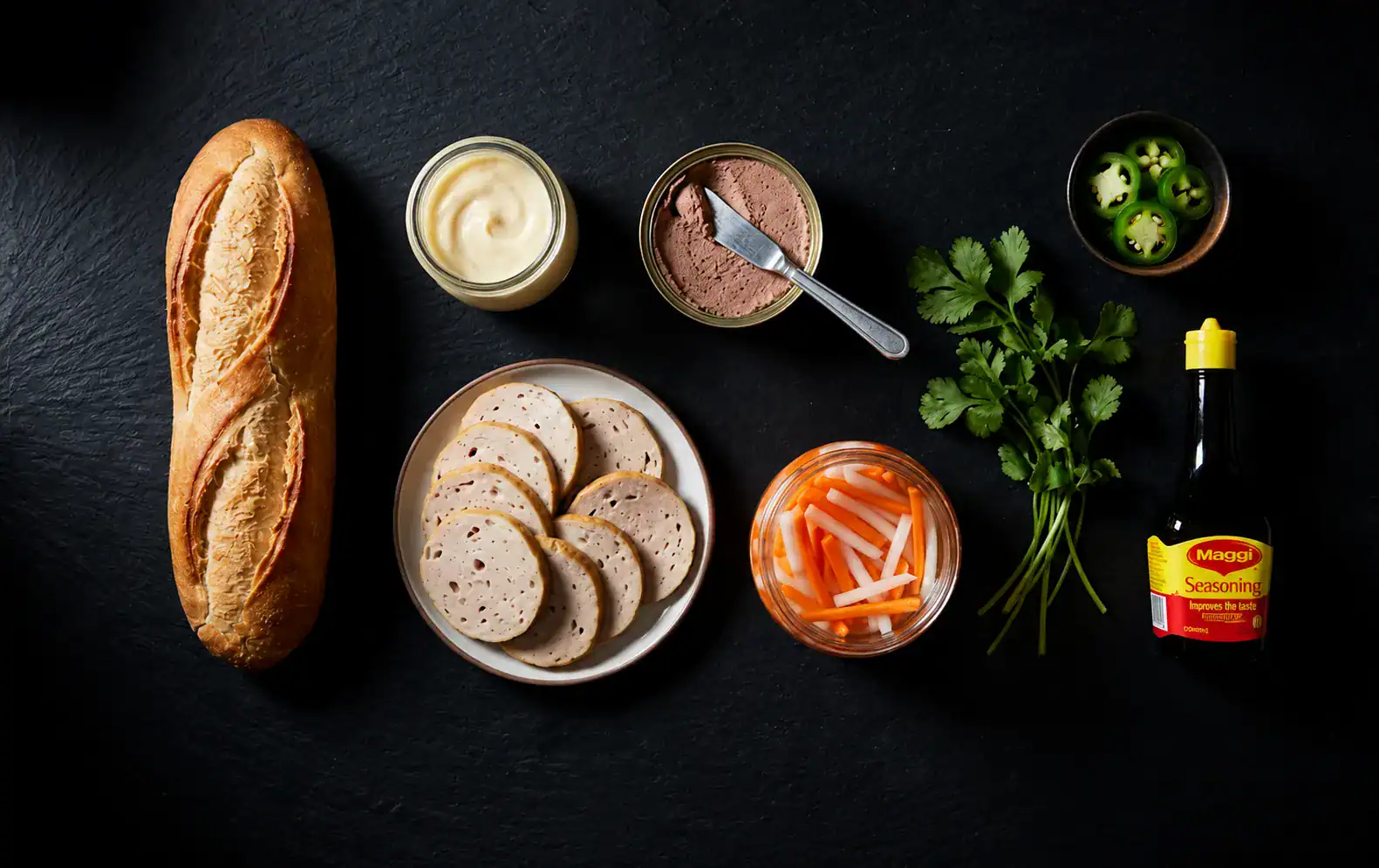
WHAT GOES IN A BÁNH MÌ
The first time most people eat a bánh mì they cannot quite explain why it is so good. The bread shatters. The filling is rich but never heavy. Something sharp cuts through at exactly the right moment. There is heat but it arrives last, after everything else has landed. It is one of the most precisely balanced sandwiches ever made and every single ingredient in it is responsible for part of that balance.
This guide covers what goes in a bánh mì, why each ingredient is there, where to find it, and what to use when you cannot. It is a sourcing guide as much as an ingredient list. Whether you are making bánh mì at home for the first time or trying to track down chả lụa in a city with no Vietnamese grocery store, this page has the answer.
[ THE BREAD ]
The bread is the first thing that separates a real bánh mì from a poor imitation. A Vietnamese demi-baguette looks like a French baguette but behaves completely differently. The rice flour in the dough changes how the outer crust sets in the oven, producing a thin brittle shell that shatters on the first bite rather than compressing the fillings. This is called the Glass Crust. Without it the sandwich is still good. With it the sandwich is extraordinary.
What you need: A Vietnamese demi-baguette made with a bread flour and rice flour blend.
Where to find it: Vietnamese bakeries and Asian grocery stores. Baked fresh daily at Vietnamese bakeries. Arrive early. They sell out by midday.
What to look for: Feels almost weightless for its size. Sounds hollow when tapped. Crust shatters when squeezed lightly.
What to avoid: Hoagie rolls, ciabatta, sourdough, and thick-crusted French baguettes. All compress the fillings instead of shattering around them.
Substitute: A standard French baguette works as a starting point. The crust will be thicker and chewier but the five-element logic still applies. For the authentic result at home the Glass Crust Bánh Mì Baguette recipe on this site produces the correct bread using a specific rice flour ratio and steam injection method.
[ PORK LIVER PÂTÉ ]
Pâté is the flavor anchor of the bánh mì. It goes on the bottom half before any other filling and does two jobs. It adds a deep savory base note that nothing else in the sandwich replicates, and it creates a second fat layer that protects the bread from the wet ingredients above it. A bánh mì without pâté is missing its foundation.
What you need: Pork liver pâté or pâté de campagne. Smooth and spreadable.
Where to find it: Vietnamese grocery stores carry it in cans or small tins. French-style pâté de campagne from a deli counter works well. Most large supermarkets carry some version in their charcuterie section.
What to look for: A pâté that spreads cleanly without being too loose. It should hold its shape on the bread rather than running into the pickles.
What to avoid: Chicken liver pâté is too mild. Rough country-style pâté with large chunks does not spread evenly. Avoid pâté with strong herbs like thyme or rosemary. Those flavors compete with the cilantro and jalapeño.
Brands to look for: Flower Brand pâté is the standard Vietnamese grocery store option. Any French-style pork liver pâté from a reputable deli is an acceptable substitute.
[ VIETNAMESE MAYONNAISE ]
Vietnamese mayonnaise is not Hellmann’s. It is not a substitute for store-bought Western mayonnaise. It is a specific condiment made with whole eggs and neutral oil that produces a lighter, slightly looser emulsion than standard Western mayonnaise. That lighter texture is exactly what the sandwich needs. It spreads thinly across both cut surfaces of the bread without competing with the pâté underneath or the fillings above.
What you need: Whole egg mayonnaise made with neutral oil and rice vinegar.
Where to find it: Make it. The Vietnamese mayonnaise recipe on this site takes five minutes with a stick blender and keeps for five days refrigerated.
What to look for in store-bought: Kewpie mayonnaise is the only correct store-bought option. The soft squeeze bottle with the baby on the label. Available at Asian grocery stores and increasingly at mainstream supermarkets in the Asian foods aisle.
What to avoid: Hellmann’s, Best Foods, and olive oil mayonnaise. The flavor profile is different enough to affect the finished sandwich.
Brands to look for: Kewpie. Nothing else comes close.
[ CHẢ LỤA ]
Chả lụa is the ingredient most people outside Vietnam have never heard of but immediately want more of once they try it. Vietnamese steamed pork sausage made from lean pork, fish sauce, and tapioca starch, wrapped in banana leaves and steamed until it sets into a smooth dense cylinder. The flavor is clean and mild with a subtle depth from the fish sauce. It slices cleanly and layers flat on the bread without fighting anything else in the sandwich. Every bánh mì cart in Vietnam has it. It is the ingredient that defines the classic sandwich.
What you need: Vietnamese steamed pork sausage, sliced 3 to 4mm thick.
Where to find it: Vietnamese grocery stores, refrigerated deli section. Sold in cylindrical rolls wrapped in banana leaves or plastic.
What to look for: Smooth uniform texture. Pale pink to white color. Clean smell with no sourness.
What to avoid: Rubbery texture. Sour smell. Cheap versions with visible fat pockets or preservative taste.
Substitute: Good quality mortadella is the closest Western substitute. Not bologna. Not processed deli ham. The flavor is wrong.
[ CHẢ BÌ ]
Chả bì is the ingredient that gives the classic bánh mì its textural complexity. Shredded pork skin mixed with roasted rice powder. Slightly chewy, slightly crispy, subtly nutty. It contrasts with the smooth chả lụa in a way that keeps each bite interesting. Most people cannot identify it in a sandwich but they notice immediately when it is missing.
What you need: Shredded pork skin mixed with roasted rice powder.
Where to find it: Vietnamese grocery stores, refrigerated deli section alongside chả lụa.
What to look for: Fine evenly shredded pork skin. Dry and loose, not wet or clumped. Subtle nuttiness from the rice powder.
What to avoid: Wet or greasy texture. Sour smell. Anything that looks like it has been sitting too long.
Substitute: Pulled roast pork. The texture is different but it fills the same structural role in the sandwich.
[ PICKLED DAIKON AND CARROT ]
Pickled daikon and carrot (đồ chua in Vietnamese) is the acid component. It is the element that cuts through the fat of the pâté and mayonnaise and keeps the sandwich from becoming too heavy after the first two bites. Without it the sandwich is rich and satisfying but dense. With it every bite resets and you want another one. The crunch matters as much as the flavor. Soft pickles do not do the job.
What you need: Daikon and carrot julienned at 3mm wide, pickled in a 1:1 rice vinegar brine with 25% sugar by weight. A mandoline slicer produces the correct cut consistently.
Where to find it: Make it. The Đồ Chua recipe on this site takes 15 minutes and keeps for two weeks refrigerated. Store-bought versions exist at Vietnamese grocery stores but most are too sweet or too soft.
What to look for in store-bought: Sharp clean brine. Vegetables with crunch still present. Not primarily sweet.
What to avoid: Pre-made pickled vegetables from non-Vietnamese brands. The brine ratios are almost always wrong.
Substitute: No direct substitute. The acid component is non-negotiable. Make the recipe.
[ FRESH CUCUMBER ]
Fresh cucumber adds a clean cool note that the pickled vegetables alone do not provide. It is the element that keeps the sandwich feeling fresh rather than heavy, and it balances the heat of the jalapeño that goes in alongside it. For a pickled version that adds a brighter, more acidic note to the sandwich, see the Quick Pickled Cucumber recipe.
What you need: Persian cucumbers sliced lengthwise into thin strips.
Where to find it: Any supermarket or Asian grocery store.
What to look for: Firm with no soft spots. Thin skin. Fresh smell.
What to avoid: Waxed cucumbers with thick skin. Over-ripe cucumbers with soft centers.
Substitute: English cucumbers work as a substitute. Persian cucumbers are the correct choice.
[ FRESH CILANTRO ]
Cilantro is the herb that lifts the entire sandwich. Added whole in sprigs not chopped, it distributes flavor more evenly and holds up better against the moisture of the pickles. It is also one of the most divisive ingredients in cooking. Roughly 10% of people have a genetic variation that makes cilantro taste soapy. If you are one of them, leave it out. The sandwich still works.
What you need: Fresh cilantro in whole sprigs. Not chopped. Not dried.
Where to find it: Any supermarket or Asian grocery store.
What to look for: Bright green leaves. No yellowing. Fresh clean smell.
What to avoid: Dried cilantro. The aromatic compounds that make cilantro work in this sandwich do not survive drying.
Substitute: Thai basil adds a different but complementary flavor. Fresh mint works in modern variations. Neither is the same as cilantro but both are better than dried.
[ JALAPEÑO ]
The jalapeño is the heat element and its placement is deliberate. It goes in last, on top of everything else, so the heat arrives at the end of each bite after the richness of the pâté and the sharpness of the pickles have already registered. Two or three thin slices per sandwich. Not more.
What you need: Fresh jalapeño sliced thin on a bias.
Where to find it: Any supermarket.
What to look for: Firm glossy skin. Consistent heat. Medium size for even slicing.
What to avoid: Pickled jalapeños. The vinegar competes with the đồ chua and throws off the acid balance of the sandwich.
Substitute: Fresno chili for slightly fruitier heat. Serrano for more heat. Thinly sliced fresh red chili works in a pinch.
[ MAGGI SEASONING SAUCE ]
Three drops of Maggi Seasoning Sauce across the filling before closing the sandwich. It is the finishing ingredient most home cooks skip and the one that makes the biggest difference to the finished result. It does not taste like soy sauce in a finished bánh mì. It tastes like the sandwich is more itself. More savory. More complete. More cohesive. Use it sparingly. Three drops is not a suggestion.
What you need: Maggi Seasoning Sauce. The dark brown bottle with the yellow label.
Where to find it: Asian grocery stores. International foods aisle at large supermarkets. Amazon.
What to look for: The original Maggi formula. Not Maggi soy sauce. Not a generic substitute.
What to avoid: Regular soy sauce, Kikkoman, Tamari, coconut aminos. All produce different results.
Substitute: A small amount of fish sauce applied with the same restraint produces a similar umami effect. It is not identical but it is the closest alternative.
[ WHERE TO SHOP ]
Vietnamese grocery stores carry everything on this list except fresh cucumber and cilantro. If you have access to one it is the single best source for bánh mì ingredients. Chả lụa, chả bì, pâté, Vietnamese baguettes, and Maggi are all standard stock.
Asian grocery stores cover most items. Chả bì can be harder to find outside Vietnamese-specific stores. Kewpie mayonnaise, Maggi, and pickled vegetables are widely available.
Standard supermarkets cover the basics. Fresh vegetables, cilantro, jalapeño, cucumber, and increasingly Kewpie mayonnaise are mainstream. Chả lụa and chả bì are not.
Online is the reliable fallback for Maggi Seasoning Sauce, Kewpie, and Flower Brand pâté. All are available on Amazon. The Equipment page on this site lists specific product recommendations for every pantry ingredient used across all recipes.
[ NOW BUILD IT ]
Every ingredient on this list has a sourcing solution. Every component worth making from scratch has a recipe on this site. Vietnamese mayonnaise takes five minutes. The pickled daikon and carrot takes fifteen. The bread takes longer but produces a result no store-bought version matches.
The Classic Bánh Mì Thịt Nguội uses every ingredient on this list in the correct order. Make it once. By the time you finish it you will understand exactly why every single ingredient is there.
For a richer version built on the same foundation, the Bánh Mì Heo Quay uses roast pork belly with crackling skin in place of the cold cuts. Same logic, different protein, completely different sandwich.
That is the point of this site. Not just to tell you what goes in a bánh mì. To make sure you can build one that is worth eating.