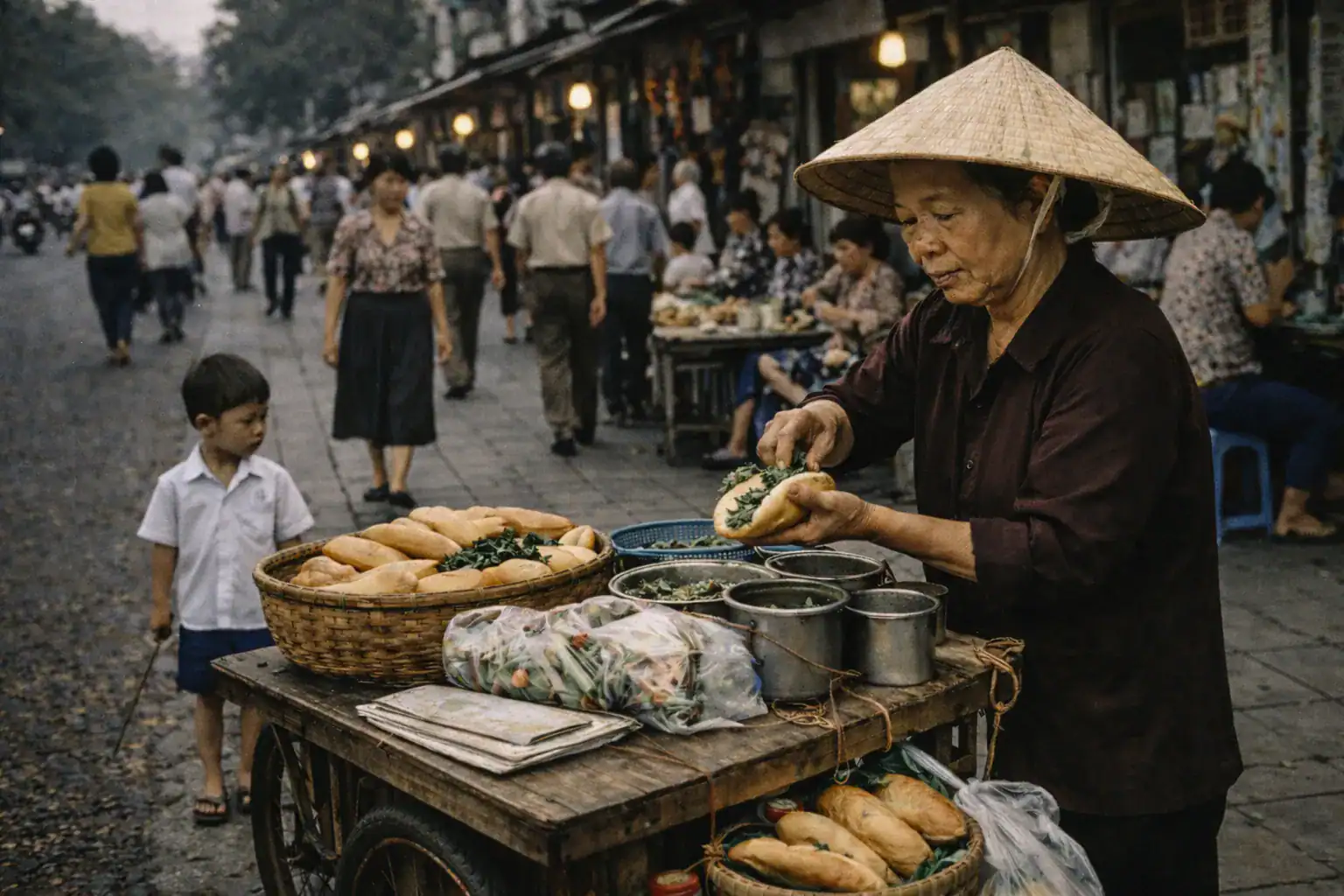
WHAT IS BÁNH MÌ
The bánh mì sandwich started on a wooden street cart in Sài Gòn. A vendor splits a baguette lengthwise, spreads pâté on the bottom, Vietnamese mayonnaise on both sides, layers cold cuts, pickled vegetables, fresh cilantro, and two slices of jalapeño. The whole process takes forty-five seconds. The result is one of the most precisely balanced things you can eat.
Bánh mì (pronounced “bun mee”) means bread in Vietnamese. In practice it refers to the sandwich. It is a Vietnamese sandwich built on a specific baguette, filled with a specific combination of ingredients, assembled in a specific order. It is not fusion food. It was invented on the streets of Vietnam and has not been improved upon since.
The bread is the first thing people notice. It is lighter than a French baguette, with a crust that shatters rather than chews. Vietnamese bakers in the 1950s changed the flour ratio, added rice flour to the mix, and produced a bread that holds fillings without overpowering them.
Inside the bread: pâté, mayonnaise, cold cuts or protein, pickled daikon and carrot, fresh cilantro, cucumber, and jalapeño. Every one of those ingredients has a job. None of them are decorative.
The bánh mì is one of the most perfectly balanced sandwiches ever made. That balance was not designed in a test kitchen. It was refined on wooden street carts in Hà Nội and Sài Gòn over decades. It shows.
[ WHERE IT COMES FROM ]
The story starts in 1859 when France began its colonial occupation of Vietnam. The French brought baguettes. They built bakeries, cafés, and a food culture built around bread, butter, and pâté. For nearly a century the baguette was the bread of the coloniser, eaten in establishments that were not built for Vietnamese people.
When the French left Indochina in 1954 they left behind the bread. Vietnamese bakers in Hà Nội and Sài Gòn took it and changed it. They swapped some of the wheat flour for rice flour. They adjusted the hydration. They made the crust thinner and more brittle. They made the crumb lighter. The result was a bread that looked like a baguette but behaved completely differently.
Then they filled it.
Pâté came from the French. Mayonnaise came from the French. The bread came from the French. Everything else came from Vietnamese street food culture. The pickled vegetables. The fresh herbs. The fish sauce. The balance of fat and acid and heat. The combination produced something neither culture had made before.
The bánh mì moved from white-tablecloth cafés to wooden street carts. The price dropped. The audience grew. By the time the French were gone the bánh mì belonged entirely to Vietnam.
The full history is on The Evolution page.
[ WHAT GOES IN A BÁNH MÌ ]
The classic bánh mì has five elements. Every authentic version has all five. Every version worth eating respects all five even when it breaks the rules.
The bread. A Vietnamese demi-baguette made with a blend of bread flour and rice flour. The rice flour changes how the outer layer sets in the oven. Instead of forming a thick chewy crust like a French baguette, it forms a thin brittle shell that shatters on the first bite. This is called the Glass Crust. It is not a French baguette. Do not substitute one.
The fat barrier. Vietnamese mayonnaise on both inner surfaces of the bread, pâté on the bottom half. The mayonnaise waterproofs the bread against the wet ingredients. The pâté adds a second fat layer and a deep savoury base note. Without both layers the bread goes soft within minutes.
The protein. In the classic version this is thịt nguội. Vietnamese cold cuts. Chả lụa (steamed pork sausage), chả bì (shredded pork skin), and head cheese layered in a specific order. Modern versions use grilled pork, chicken, tofu, or other proteins. The protein sits on top of the pâté.
The acid. Pickled daikon and carrot, known in Vietnamese as đồ chua. A 1:1 brine of rice vinegar and water with 25% sugar. Sharp enough to cut through the fat of the pâté and mayonnaise without overpowering the cold cuts. This is the element that keeps the sandwich from being too heavy. For a lighter, cooler variation, sliced pickled cucumber works beautifully alongside the đồ chua or on its own. See the Quick Pickled Cucumber recipe.
The finish. Fresh cilantro added whole, not chopped. Thin slices of jalapeño. A few drops of Maggi Seasoning Sauce. The cilantro lifts the whole sandwich. The jalapeño adds heat that arrives late. The Maggi adds a final layer of umami that ties everything together.
The complete breakdown of each element is on The Anatomy page.
[ WHY IT WORKS ]
Most sandwiches are built around a single dominant ingredient. A club sandwich is about the turkey. A Reuben is about the corned beef. The bread and the extras exist to support that one thing.
The bánh mì does not work that way. No single ingredient dominates. The pâté is rich but the pickles cut through it. The bread is light but the fat barrier keeps it from going soft. The jalapeño is hot but it arrives at the end of the bite, after everything else has landed.
Every ingredient is in balance with every other ingredient. Remove one and the whole thing shifts. Add too much of one and something else gets lost.
This is not an accident. It is the result of decades of refinement on street carts where the standard was set by what people would pay for and come back for. No test kitchen produces that kind of precision. The market does.
[ BÁNH MÌ TODAY ]
The bánh mì left Vietnam with the Vietnamese diaspora after 1975. It arrived in the United States, Australia, France, and Canada carried by refugees who opened sandwich shops and bakeries. In cities like San Jose, Houston, Sydney, and Paris the bánh mì became a fixture of Vietnamese communities long before it became trendy anywhere else.
Today the bánh mì appears on menus everywhere. Some versions are faithful to the original. Some use the bread and the structure but change the filling entirely. Duck confit. Pulled pork. Fried chicken. These variations work when they respect the five-element architecture. They fail when the bread is wrong or the balance is off.
The sandwich that outlasted a colonial empire is now one of the most eaten sandwiches in the world. It got there without a marketing budget or a celebrity chef. It got there because the balance was right from the beginning.
[ WHERE TO START ]
The banh mi bread is the foundation. Without the right bread the rest of the sandwich does not work. The Glass Crust Bánh Mì Baguette recipe on this site produces the correct bread at home.
The components come next. Vietnamese mayonnaise and pickled daikon and carrot can both be made in under 20 minutes and keep for two weeks in the refrigerator. Make them once and you can build any bánh mì on this site.
The Classic Bánh Mì Thịt Nguội is the sandwich that established the template. Start there.
The Vietnamese iced coffee pairing guide covers what goes alongside the sandwich. Cà phê sữa đá has been served next to bánh mì since the street cart era. The pairing is not a suggestion. It is the default.