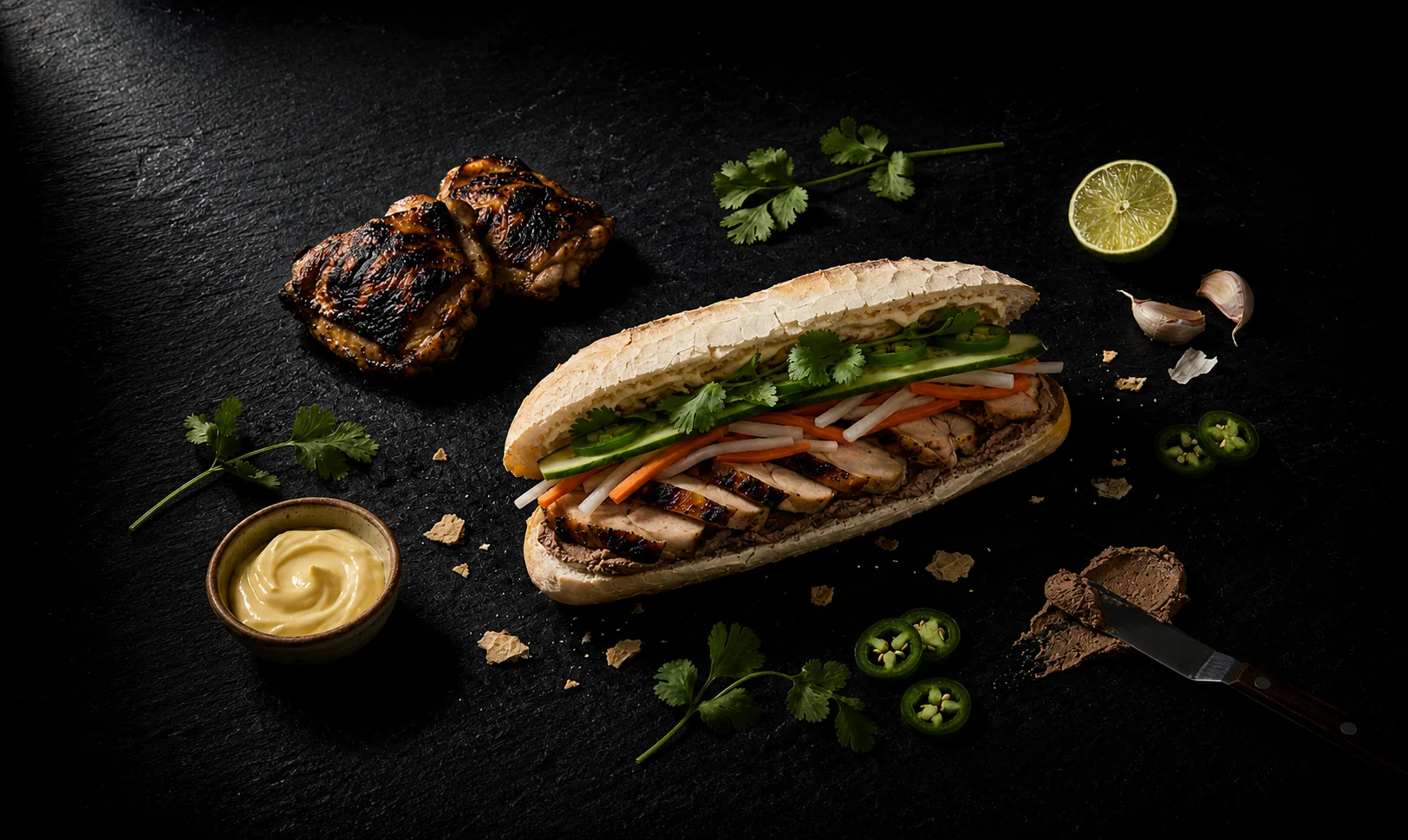
bánh mì gà nướng (Vietnamese grilled chicken bánh mì) with charred chicken thighs, đồ chua, cucumber, cilantro, and jalapeño on dark slate

BÁNH MÌ GÀ NƯỚNG (GRILLED CHICKEN BÁNH MÌ)

Bánh mì gà nướng is the grilled chicken thigh version. Bone-in skin-on chicken thighs are marinated in fish sauce, black pepper, lime juice, and garlic, then grilled over high heat until the skin renders and chars at the edges. The marinade has four ingredients. The flavor comes from the char, not the sauce.

The build follows the same five-element structure. Pork liver pâté on the bottom half, Vietnamese mayonnaise on the top, the sliced grilled chicken layered across, then đồ chua, cucumber, cilantro, and jalapeño. The clean savory char of the chicken carries through every bite without competing with the pickles.

This is the Hanoi version. Where the Saigon version loads the marinade with lemongrass, sugar, and aromatics, the Hanoi version removes everything that is not essential. Four ingredients. High heat. The chicken does the work.

bánh mì gà nướng (Vietnamese grilled chicken bánh mì) with charred chicken thighs, đồ chua, cucumber, cilantro, and jalapeño on dark slate
L. Nguyen

Bánh Mì Gà Nướng (Grilled Chicken Bánh Mì)

Bone-in skin-on chicken thighs marinated in fish sauce, black pepper, lime juice, and garlic, grilled over high heat until the skin chars and renders, then sliced and layered on a Glass Crust baguette with pâté, Vietnamese mayonnaise, đồ chua, cucumber, cilantro, and jalapeño. The Hanoi-style version. [ INTERMEDIATE ]
Prep Time 15 minutes
Cook Time 20 minutes
Marinating Time 1 hour
Total Time 1 hour 35 minutes
Servings: 4 bánh mì
Course: Sandwich
Cuisine: Vietnamese

Ingredients
  

The Chicken
  • 4 bone-in skin-on chicken thighs
  • 3 tbsp fish sauce
  • 1 tsp black pepper, freshly ground
  • 2 tbsp fresh lime juice
  • 3 garlic cloves, finely minced
  • 1 tbsp neutral oil, for grilling
The Assembly
  • 4 Vietnamese bánh mì baguettes (Glass Crust standard)
  • 60 g pork liver pâté
  • 60 g Vietnamese mayonnaise
  • 240 g đồ chua (pickled daikon and carrot), drained
  • 1 Persian cucumber, thinly sliced lengthwise
  • 1 bunch fresh cilantro, stems trimmed
  • 2 jalapeños, thinly sliced
  • Maggi Seasoning Sauce, for finishing

Equipment

  • Cast iron skillet
  • Bread knife
  • Pâté Spreader / Offset Spatula
  • Kitchen scale
  • Instant-read thermometer

Method
 

Marinate the Chicken
  1. Combine fish sauce, black pepper, lime juice, and garlic in a bowl. Add the chicken thighs and turn to coat completely. Cover and refrigerate for 1 hour. Overnight produces a deeper result. The fish sauce penetrates the meat during the marinating time and seasons it all the way through, not just on the surface.
  2. Remove the chicken from the refrigerator 15 minutes before cooking. Cold chicken straight from the refrigerator hits the hot pan and drops the surface temperature, which prevents proper charring and extends cooking time unevenly.
Grill the Chicken
  1. Heat a cast iron skillet over high heat until smoking. Brush with neutral oil.
  2. Place the chicken thighs skin side down. Do not move them. Cook for 7 to 8 minutes until the skin is deeply charred and the fat has fully rendered. Reduce to medium heat. Flipping too early pulls the skin from the meat and traps unrendered fat underneath.
  3. Flip and cook over medium heat for a further 8 to 10 minutes until the internal temperature reaches 82°C (180°F). Chicken thighs have more collagen than breast meat. The collagen converts to gelatin at higher temperatures and produces a juicier, more tender result than pulling the meat at the minimum safe temperature of 74°C (165°F).
  4. Remove from heat and rest for 10 minutes. Resting allows the juices to redistribute through the meat. Chicken sliced immediately loses moisture on the cutting board.
  5. Remove the bone and slice the chicken thinly against the grain. Each slice should show the charred skin on one edge and the moist interior across the cut surface.
Assemble
  1. Split each baguette lengthwise, cutting three-quarters of the way through. Do not cut completely. The hinge holds the sandwich together.
  2. Spread the pâté across the bottom half of each baguette. Cover the full surface. The pâté provides the savory base that the clean char of the chicken builds on.
  3. Spread the Vietnamese mayonnaise across the top half of each baguette.
  4. Layer the sliced chicken across the pâté. Arrange the slices to cover the full length of the bread.
  5. Add the đồ chua directly on top of the chicken. Drain it thoroughly. The acidity cuts through the richness of the rendered chicken fat.
  6. Add cucumber strips along the length of the sandwich.
  7. Add a small bundle of cilantro. Do not chop it. Whole sprigs only.
  8. Lay jalapeño slices across the top. Three drops of Maggi Seasoning Sauce along the length. No more. Close the sandwich, press down firmly with your palm, and serve immediately.

Notes

On the chicken cut: Bone-in skin-on thighs are essential for this recipe. The bone conducts heat into the thickest part of the meat and prevents the edges from overcooking before the center is done. The skin renders its fat into the meat during cooking and keeps it moist. Boneless skinless thighs cook faster but produce a drier result. Chicken breast produces a dry, chalky texture at the temperatures needed for proper charring. Do not use it.
On the marinade: Four ingredients is not a shortcut. It is the point. The Hanoi approach strips everything back to what the protein actually needs. Fish sauce seasons deeply. Black pepper adds heat that builds slowly. Lime juice cuts the intensity of the fish sauce and adds brightness. Garlic adds savory depth. Each ingredient has a function. Nothing is decorative.
On marinating time: One hour is the minimum. The fish sauce needs time to penetrate the muscle fiber. Less than one hour and the seasoning stays on the surface. Overnight is better.
On rendering the skin: The skin must be fully rendered before flipping. A fully rendered skin is flat against the meat, deeply golden, and pulls cleanly from the pan surface. If the skin sticks when you attempt to flip, it is not ready. Leave it another 2 minutes and try again.
On the char: The black edges on the chicken are not burnt. They are the flavor. The fish sauce sugars and proteins caramelize at high heat and produce the char. Do not try to avoid it.
On make-ahead: The marinated chicken can be refrigerated for up to 24 hours before cooking. The cooked chicken keeps refrigerated for up to 3 days. Reheat in a hot pan for 2 minutes per side before slicing and assembling.

[ THE SCIENCE ]

The char on bánh mì gà nướng comes from the Maillard reaction. When the proteins and sugars in the fish sauce marinade hit a very hot surface, they break down and recombine into hundreds of new flavor compounds. Think of it this way: the marinade is painting the surface of the chicken with fuel, and the hot pan ignites it. That is where the deep savory crust comes from. The same reaction is what makes seared steak taste different from boiled steak. The temperature has to be high enough to trigger it. A pan that is not hot enough produces steamed chicken with no crust, no char, and none of the flavor that defines this sandwich.

[ THE FAQ ]

What is the difference between bánh mì gà nướng and the lemongrass chicken bánh mì? Both use grilled chicken thighs. The lemongrass version is Saigon style, marinated in lemongrass, fish sauce, sugar, and aromatics. The result is sweet, fragrant, and complex. This version is Hanoi style, marinated in fish sauce, black pepper, lime juice, and garlic only. The result is clean, direct, and savory. The char is the dominant flavor, not the marinade.

Can I use boneless skinless chicken thighs? Yes, with adjustments. Reduce the cooking time to 5 to 6 minutes per side. The result will be less moist than the bone-in version and the skin will not be present to render its fat into the meat. The flavor is still correct. The texture inside the sandwich is slightly drier.

Can I grill this over charcoal? Yes. Charcoal produces additional smokiness that complements the fish sauce marinade. Cook over direct medium-high heat for the same time as the cast iron method. Watch the skin closely. The fish sauce sugars burn faster over charcoal than over a gas flame or cast iron.

Do I need to score the chicken skin before cooking? No. Scoring is sometimes recommended to help fat render faster. With bone-in thighs cooked skin side down over high heat, the weight of the bone presses the skin against the pan surface and the fat renders correctly without scoring.

How do I know when the skin is fully rendered? The skin will be flat against the meat rather than puffy, deeply golden to dark brown rather than pale, and it will release cleanly from the pan surface when you slide a spatula under it. If it resists, it needs more time.

Should I add scallion oil to this sandwich? It is optional but worth trying. Mỡ hành, Vietnamese scallion oil, is a common finishing touch on grilled meat bánh mì in southern Vietnam. A tablespoon spooned over the grilled chicken just before closing the sandwich adds fragrance and a thin layer of richness that works well with the char. The full recipe is on the Scallion Oil page.

[ THE EQUIPMENT ]

A cast iron skillet holds heat when the cold chicken hits the surface and maintains the temperature needed for proper skin rendering and char. A bread knife splits the baguette without crushing the Glass Crust. An offset spatula spreads the pâté and mayonnaise in a controlled, even layer. An instant-read thermometer confirms the internal temperature without cutting into the chicken.

The full equipment list with specific recommendations is on the Equipment page.

[ WHAT TO READ NEXT ]

Bánh mì gà is the lemongrass chicken version in the archive. Where gà nướng strips the marinade back to four ingredients, the lemongrass version builds a more complex aromatic profile with lemongrass, fish sauce, and sugar. Both use chicken thighs. Both use high heat. The flavor logic is completely different.

Bánh mì thịt nướng is the grilled pork version. The same high heat method applied to thinly sliced pork shoulder marinated in lemongrass and fish sauce. If the char on the chicken works for you, the char on the pork shoulder is worth comparing.

Bánh mì gà xé phay is the poached chicken version. Where gà nướng is built entirely around the char from high heat, gà xé phay uses no heat at the surface at all. Poached, shredded, dressed in fish sauce and lime. The same protein with no caramelization and no crust.

The Glass Crust baguette is the bread that holds this sandwich together. The recipe on this site covers the exact flour ratio, steam method, and baking technique that produces the thin shattering crust the sandwich depends on.