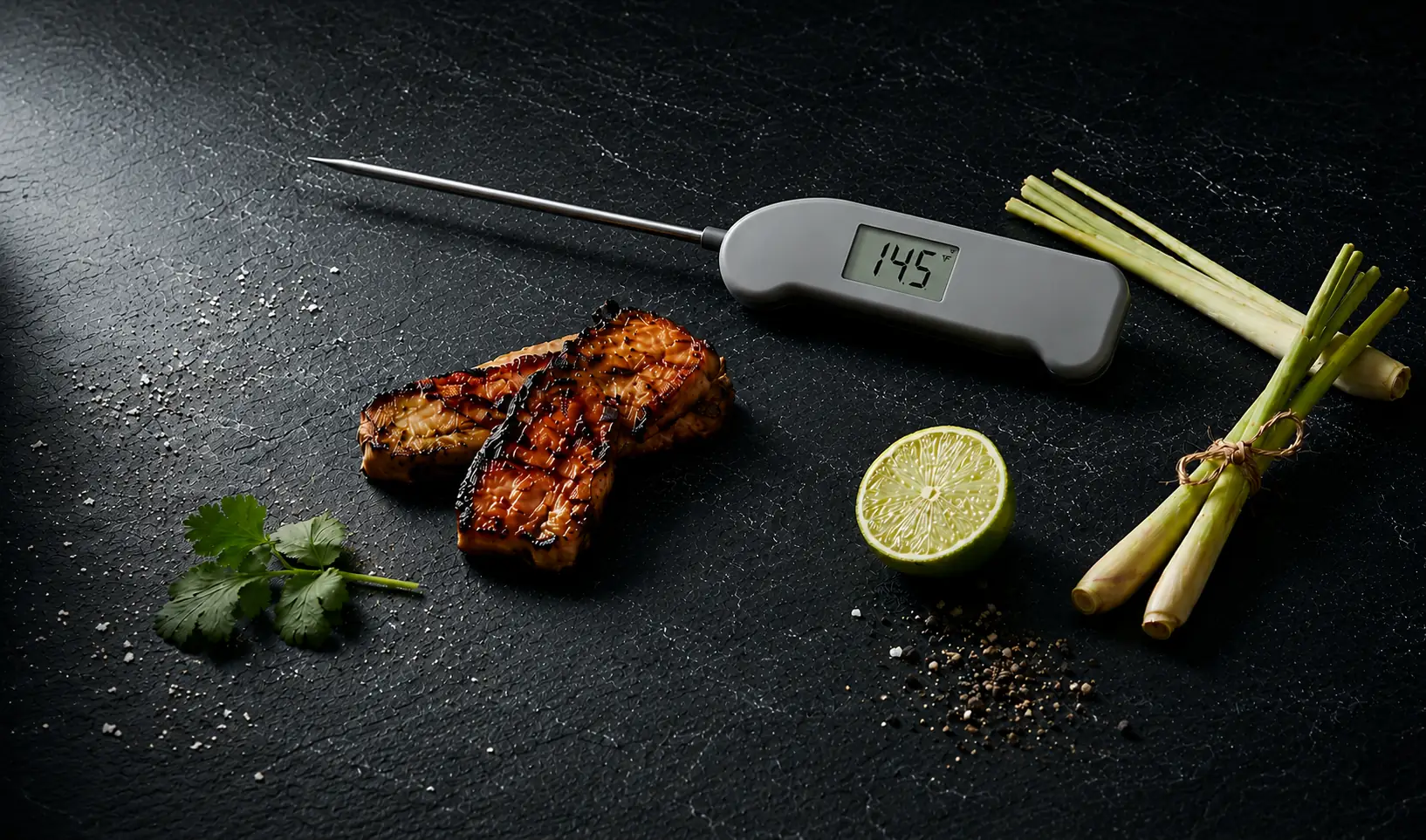
BEST INSTANT-READ THERMOMETER FOR BÁNH MÌ
The difference between a perfectly cooked bánh mì protein and an overcooked one is often a matter of 10 degrees. Pork cooked to the right temperature is juicy and carries the marinade through every bite. Pork pushed past it is dry and tastes like filler. You cannot tell the difference by pressing it, timing it, or cutting it open mid-cook.
An instant-read thermometer solves this with a single number. Insert the probe, read the temperature, pull the protein at the right moment. The bread can be perfect, the pickles can be perfect, the pâté can be perfect. Without the right temperature on the filling, none of it matters.
This page covers the three best instant-read thermometers for bánh mì at every price point, why read speed matters more than most cooks realize, and exactly what to look for when buying.
[ WHY THE THERMOMETER MATTERS FOR BÁNH MÌ SPECIFICALLY ]
The proteins in a bánh mì cook fast. Thịt nướng is thin-sliced pork over high heat. Bánh mì gà is chicken that needs to be cooked through without drying out. Both have a narrow window between correct and wrong, and that window is measured in degrees, not minutes.
Cooking by feel or timing alone does not work because no two pieces of protein are identical. Thickness varies. Starting temperature varies. Heat distribution across a cast iron surface varies. A thermometer removes all of those variables. It tells you what is actually happening inside the meat, not what should be happening based on a timer.
Read speed is the specification that separates thermometers in this category. A thermometer that takes 5 seconds to stabilize means holding a probe over a hot cast iron skillet for 5 seconds. That is an uncomfortable amount of time at searing temperature. A thermometer that reads in under 1 second gives you the number immediately and gets out of the way. For fast-cooking bánh mì proteins, that speed is not a luxury. It is the point.
[ THE RECOMMENDATION ]
The ThermoWorks Thermapen ONE is the correct thermometer for this job. It reads in under 1 second and is accurate to within 0.5°F. ThermoWorks builds thermometers for professional kitchens and food scientists. The Thermapen ONE is their flagship consumer product and it performs at a level that nothing else in its class matches.
The probe folds into the body when not in use and extends to activate the display automatically. No buttons to press mid-cook. Open it, insert the probe, and the number appears. At high heat over a cast iron skillet that simplicity matters more than it sounds.
At around $125 it is a significant investment for a single kitchen tool. It is also the last thermometer you will ever buy. The build quality is exceptional and ThermoWorks backs it with a two-year warranty. For anyone cooking bánh mì proteins regularly, the Thermapen ONE is the tool that makes every cook more precise and more confident.
[ THE THREE OPTIONS ]
[ BEST OVERALL ] ThermoWorks Thermapen ONE — around $125. The recommendation above. Under 1 second read time, accurate to 0.5°F, automatic activation, built to a professional standard. The correct tool for anyone serious about cooking bánh mì proteins correctly.
[ ALTERNATIVE ] Lavatools Javelin PRO — around $45. A serious thermometer at a fraction of the Thermapen price. The Javelin PRO reads in 2 to 3 seconds and is accurate to within 0.9°F. The magnetic back lets it attach to the side of the fridge or a steel prep surface, which is genuinely useful in a working kitchen. The display is large and backlit. The honest weakness is read speed: 2 to 3 seconds feels noticeably slower than the Thermapen when you are working over high heat. For most home cooks cooking bánh mì once or twice a week, it is more than sufficient.
[ BUDGET ] TempPro TP19H — around $15. The honest entry point. Waterproof, backlit display, gets the job done for someone just starting out. The honest weakness is build quality and read speed: the casing feels less solid than either option above and the 3 to 5 second read time requires patience over a hot pan. Buy it to start. Upgrade when cooking frequency justifies it.
[ THE SCIENCE ]
A thermometer probe works like a tiny electrical reporter. When the metal tip touches something hot, the heat changes the electrical resistance inside the probe. The thermometer measures that resistance and converts it into a temperature reading on the display. A faster thermometer has a thinner probe tip with less metal mass to heat up, so it reaches the temperature of the meat faster and reports back sooner. The Thermapen ONE probe tip is 1.1mm in diameter. That is thin enough to read the core temperature of a pork slice in under a second. A budget thermometer with a thicker probe tip takes longer simply because there is more metal to heat before the reading stabilizes.
[ THE FAQ ]
What temperature should bánh mì pork reach? Whole cuts of pork need to reach an internal temperature of 145°F and rest for 3 minutes. Thin-sliced thịt nướng cooks fast enough that carryover heat handles the rest. When in doubt, 155°F at the center is a reliable target for thin pork slices on a cast iron skillet.
What temperature should bánh mì chicken reach? Chicken needs to reach 165°F at the thickest point. For bánh mì gà that is usually the center of the thigh or breast slice. Pull it at 163°F and carryover heat brings it the rest of the way during the brief rest.
Can I use the same thermometer for bread? Yes. The Thermapen ONE and Javelin PRO both read up to 572°F, which covers bread baking comfortably. A properly baked bánh mì baguette has an internal crumb temperature of around 205°F to 210°F. One thermometer handles both jobs.
Do I need to calibrate my thermometer? The Thermapen ONE holds its factory calibration reliably over time. The Javelin PRO and TempPro can be checked against ice water at 32°F or boiling water at 212°F at sea level. If either reads more than 2°F off, recalibrate according to the manufacturer instructions or replace.
Where do I insert the probe for thin pork slices? Insert from the side of the slice rather than the top, aiming for the center of the meat. Inserting from the top on a thin slice risks hitting the pan surface and returning a false reading. Side insertion gives you the true core temperature every time.
[ WHAT TO READ NEXT ]
For the grilled pork recipe where this thermometer earns its place, see the Bánh Mì Thịt Nướng recipe, the filling where internal temperature determines everything.
The Bánh Mì Gà recipe covers the lemongrass chicken filling where reaching 165°F without drying the meat out is the entire challenge.
For the complete breakdown of every tool a serious bánh mì kitchen requires, see The Equipment page.