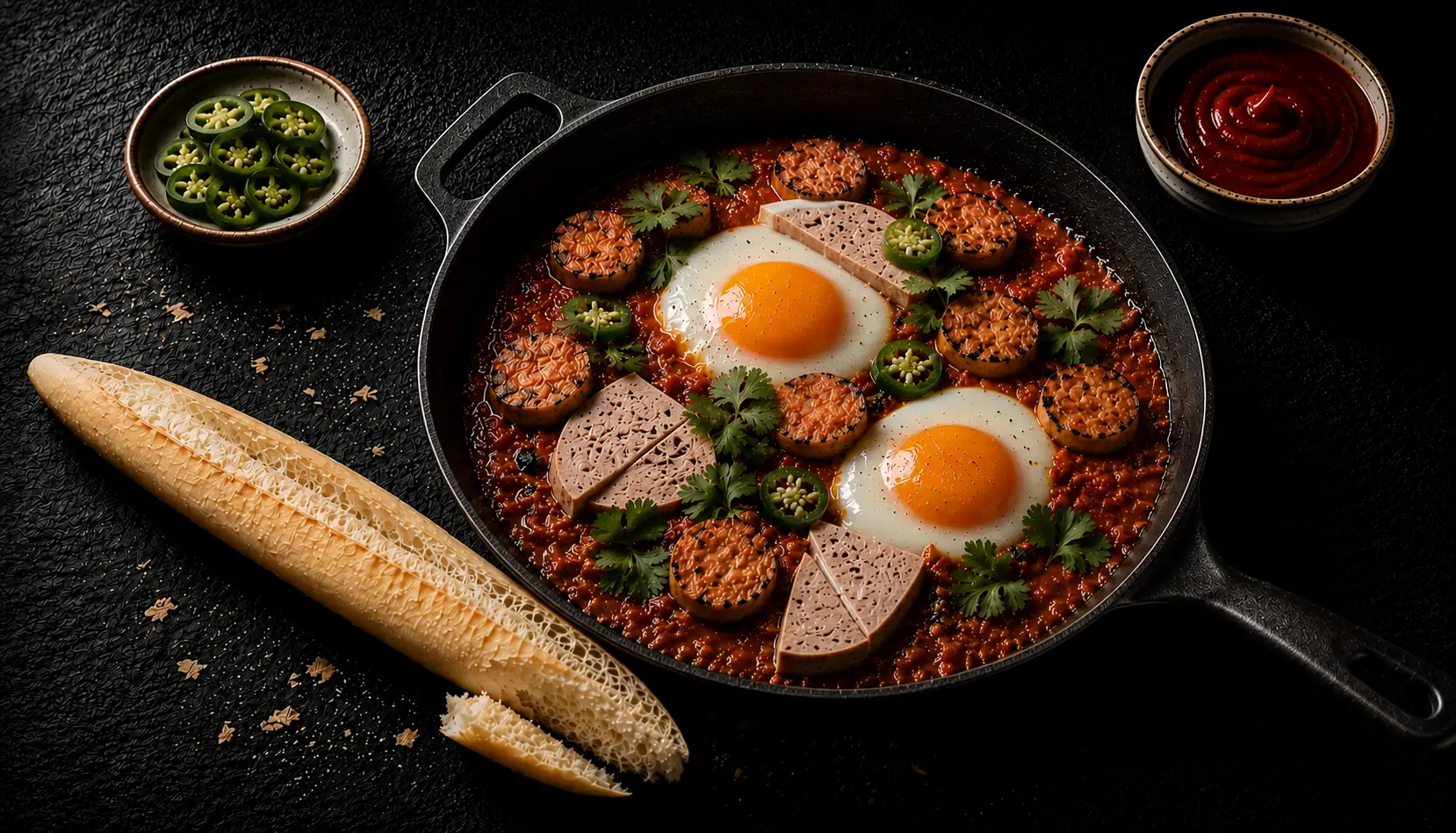
banh mi chao (Vietnamese breakfast skillet) with eggs, pork liver pâté, and Vietnamese sausage in cast iron skillet on dark slate

BÁNH MÌ CHẢO (VIETNAMESE BREAKFAST SKILLET)

Bánh mì chảo is not a sandwich. It is the pan version. All the fillings that would go inside a bánh mì are cooked together in a cast iron skillet and served sizzling at the table. The baguette comes on the side. You tear it, dip it, and use it to scoop everything from the pan.

The Hanoi version uses eggs cracked directly into the pan, pork liver pâté melted into a tomato sauce, Vietnamese sausage sliced and fried until the edges char, and chả lụa layered across. The tomato sauce is the defining element. It bubbles around everything, concentrates at the edges of the pan, and soaks into the bread from the outside rather than the inside.

Every sandwich in this archive puts the fillings inside the bread. This one puts the bread beside the pan.

banh mi chao (Vietnamese breakfast skillet) with eggs, pork liver pâté, and Vietnamese sausage in cast iron skillet on dark slate
L. Nguyen

Bánh Mì Chảo (Vietnamese Breakfast Skillet)

Eggs, pork liver pâté, Vietnamese sausage, and chả lụa cooked together in a cast iron skillet with a rich tomato sauce, served sizzling with a warm Glass Crust baguette on the side for dipping. The Hanoi breakfast version. [ BEGINNER ]
Prep Time 10 minutes
Cook Time 15 minutes
Total Time 25 minutes
Servings: 2 servings
Course: Breakfast
Cuisine: Vietnamese

Ingredients
  

The Tomato Sauce
  • 2 medium tomatoes, roughly chopped
  • 1 tbsp neutral oil
  • 1 tsp sugar
  • 1 tbsp oyster sauce
  • ½ tsp white pepper
  • 3 tbsp water
The Skillet
  • 4 large eggs
  • 60 g pork liver pâté
  • 150 g Vietnamese sausage (xúc xích), sliced on the bias
  • 100 g chả lụa, sliced 5mm thick
  • 1 tbsp neutral oil
  • Maggi Seasoning Sauce, for finishing
To Serve
  • 2 Vietnamese bánh mì baguettes (Glass Crust standard), warmed
  • fresh cilantro sprigs
  • sliced jalapeño or fresh red chili
  • freshly ground black pepper

Equipment

  • Cast iron skillet
  • Bread knife

Method
 

Make the Tomato Sauce
  1. Heat neutral oil in a small saucepan over medium heat. Add the chopped tomatoes and cook for 3 to 4 minutes, pressing them down with a spoon until they collapse and release their liquid. Add sugar, oyster sauce, white pepper, and water. Simmer for 2 minutes until the sauce thickens slightly. Remove from heat and set aside. The tomato sauce is the defining element of bánh mì chảo. It is not optional and it is not a garnish. It soaks into the bread, coats every ingredient in the pan, and provides the acidity that balances the richness of the pâté and egg yolk.
Build the Skillet
  1. Heat neutral oil in a cast iron skillet over medium-high heat. Add the sliced Vietnamese sausage in a single layer. Cook for 2 minutes without moving until the underside develops a golden char. Flip and cook for 1 minute. Push the sausage to the edges of the pan.
  2. Add the sliced chả lụa to the center of the pan. Cook for 1 minute per side until lightly colored. Push to the edges alongside the sausage.
  3. Add the pork liver pâté to the center of the pan. It will begin to melt immediately. Use a spoon to spread it across the base of the pan. The melted pâté mixes with the rendered fat from the sausage and creates the savory base the eggs will cook in.
  4. Pour the tomato sauce over everything in the pan. Let it bubble for 30 seconds.
  5. Crack the eggs directly into the pan over the sauce. Do not stir. Cook for 2 to 3 minutes until the whites are fully set and the yolks are still runny. A runny yolk is essential. It breaks when the bread is pressed into the pan and mixes with the tomato sauce and pâté into a rich, unified sauce. A fully cooked yolk loses this entirely.
  6. Remove from heat. Add three drops of Maggi Seasoning Sauce across the pan. Scatter fresh cilantro sprigs and sliced jalapeño across the top. Finish with freshly ground black pepper.
Serve
  1. Bring the pan directly to the table while it is still sizzling. Place the warm baguettes alongside. Tear the bread into pieces roughly 5cm wide. Press each piece flat side down into the pan to soak up the tomato sauce and yolk. Use the bread to scoop the egg, sausage, and pâté directly from the pan. Eat immediately while the pan is still hot.

Notes

On the tomato sauce: The tomato sauce is not decoration. It is the structural element that ties every ingredient in the pan together. Without it the dish becomes a loose collection of fried items. The sauce concentrates at the edges of the cast iron pan and caramelizes slightly, which deepens the flavor. Do not skip it and do not reduce it too far. It should be thick enough to coat a spoon but still flow freely in the pan.
On the eggs: Two eggs per person is the standard. Sunny side up with a runny yolk is correct for bánh mì chảo. The yolk breaks into the sauce when the bread presses into it and becomes part of the sauce. An overcooked yolk produces a dry, chalky result that does not mix. Watch the eggs closely. The residual heat in a cast iron pan continues to cook the eggs after you remove it from the heat.
On the sausage: Vietnamese xúc xích is available at most Asian grocery stores. It is a pre-cooked sausage with a mild, slightly sweet flavor. Regular cocktail sausages or frankfurters are a correct substitute. The key is slicing them on the bias and charring the cut surfaces in the pan before adding the other ingredients.
On serving in the pan: Bánh mì chảo is served in the pan it was cooked in, not plated. The cast iron retains heat and keeps the sauce bubbling at the table. A non-stick pan cools faster and produces a less dramatic result. The sizzle when the pan arrives at the table is part of the experience.
On the bread: The baguette is warmed before serving, not toasted. A warm baguette softens slightly on the outside and absorbs the sauce better than a cold one. Wrap it in foil and place in a 150°C oven for 5 minutes while the skillet cooks.
On scaling: This recipe serves 2 from one skillet. For 4 people, cook two skillets simultaneously. Do not double the ingredients into one pan. Eight eggs and doubled sauce in a single skillet will steam rather than fry and the sauce will not reduce correctly. Two pans, same timing, same result.
On make-ahead: The tomato sauce can be made up to 3 days ahead and refrigerated. Everything else cooks in under 10 minutes once the sauce is ready. This makes bánh mì chảo a practical weekday breakfast.

[ THE SCIENCE ]

The cast iron pan is doing something a regular non-stick pan cannot replicate. Cast iron holds heat at an extremely high and consistent level even when cold ingredients are added to it. When the eggs crack into the hot pan the whites set almost immediately at the edges while the center stays runny. Think of it this way: the cast iron is a heat reservoir, not just a cooking surface. It stores heat during the preheating stage and releases it slowly and evenly throughout the cook. A non-stick pan loses heat the moment the eggs hit it and the whites spread thin and pale instead of setting with defined edges. The sizzle when the pan arrives at the table is the cast iron releasing stored heat into the cold sauce, which keeps it bubbling for several minutes after it leaves the stove.

[ THE FAQ ]

What is the difference between bánh mì chảo and bò né? Both are Vietnamese skillet breakfast dishes served with baguette. Bò né always uses thinly marinated beef as the main protein and traditionally comes on a dramatic cow-shaped sizzling plate. It originated in the coastal cities of central and southern Vietnam. Bánh mì chảo is the Hanoi version. It uses eggs, pâté, sausage, and chả lụa in a tomato sauce. No beef is required. The tomato sauce is the defining difference between the northern and southern versions.

Can I add beef to bánh mì chảo? Yes. Thinly sliced beef marinated in fish sauce, garlic, and black pepper works well. Add it to the pan after the sausage and cook for 1 minute per side before adding the pâté and tomato sauce. This moves the dish toward bò né territory but both are correct.

Why must the yolk stay runny? The runny yolk is not a preference. It is a functional ingredient. When the bread presses into the pan the yolk breaks and mixes with the tomato sauce and melted pâté into a unified sauce that coats everything. A fully cooked yolk is dry and does not contribute to this. The dish is structurally different with an overcooked egg.

Can I use a regular frying pan instead of cast iron? A stainless steel pan works if fully preheated. A non-stick pan cannot reach the temperatures needed to char the sausage correctly and cools too quickly at the table. Cast iron is the correct tool for this recipe for the reasons described in the science section.

What type of bread works best for dipping? The Glass Crust baguette is correct. The thin shattering crust breaks cleanly when torn by hand and the airy crumb absorbs the sauce without becoming waterlogged. A thick-crusted French baguette resists tearing and a soft sandwich roll dissolves too quickly in the sauce.

[ THE EQUIPMENT ]

A cast iron skillet is the only correct pan for bánh mì chảo. It produces the char on the sausage, maintains the heat when the eggs and sauce are added, and keeps everything sizzling at the table. A bread knife splits the warm baguette cleanly for serving alongside.

The full equipment list with specific recommendations is on the Equipment page.

[ WHAT TO READ NEXT ]

Bánh mì trứng is the sandwich version of the fried egg. Where bánh mì chảo cracks the eggs directly into a sauced skillet and serves the bread on the side, bánh mì trứng fries a single egg in butter and layers it inside the baguette. Both are breakfast. The egg is the same. The logic is completely different.

Chả lụa is one of the proteins in the pan. The full recipe on this site shows how this smooth, dense steamed pork sausage is made from scratch and why it produces a different texture than every other pork preparation in the archive.

Pork Liver Pâté is the ingredient that defines the flavor of the pan. The full recipe covers the fat ratio and technique that produces the correct texture for melting into the sauce. Store-bought pâté works but the homemade version produces a noticeably richer result.

Bò né is the southern counterpart. Where bánh mì chảo is Hanoi, tomato-based, and shared from one large pan, bò né is from Phan Thiết, butter-based, and served in individual skillets. Both put the bread beside the pan. The flavor logic is completely different.