Ingredients
Equipment
Method
Assemble
- Split each baguette lengthwise, cutting three-quarters of the way through. Do not cut completely. The hinge holds the sandwich together.
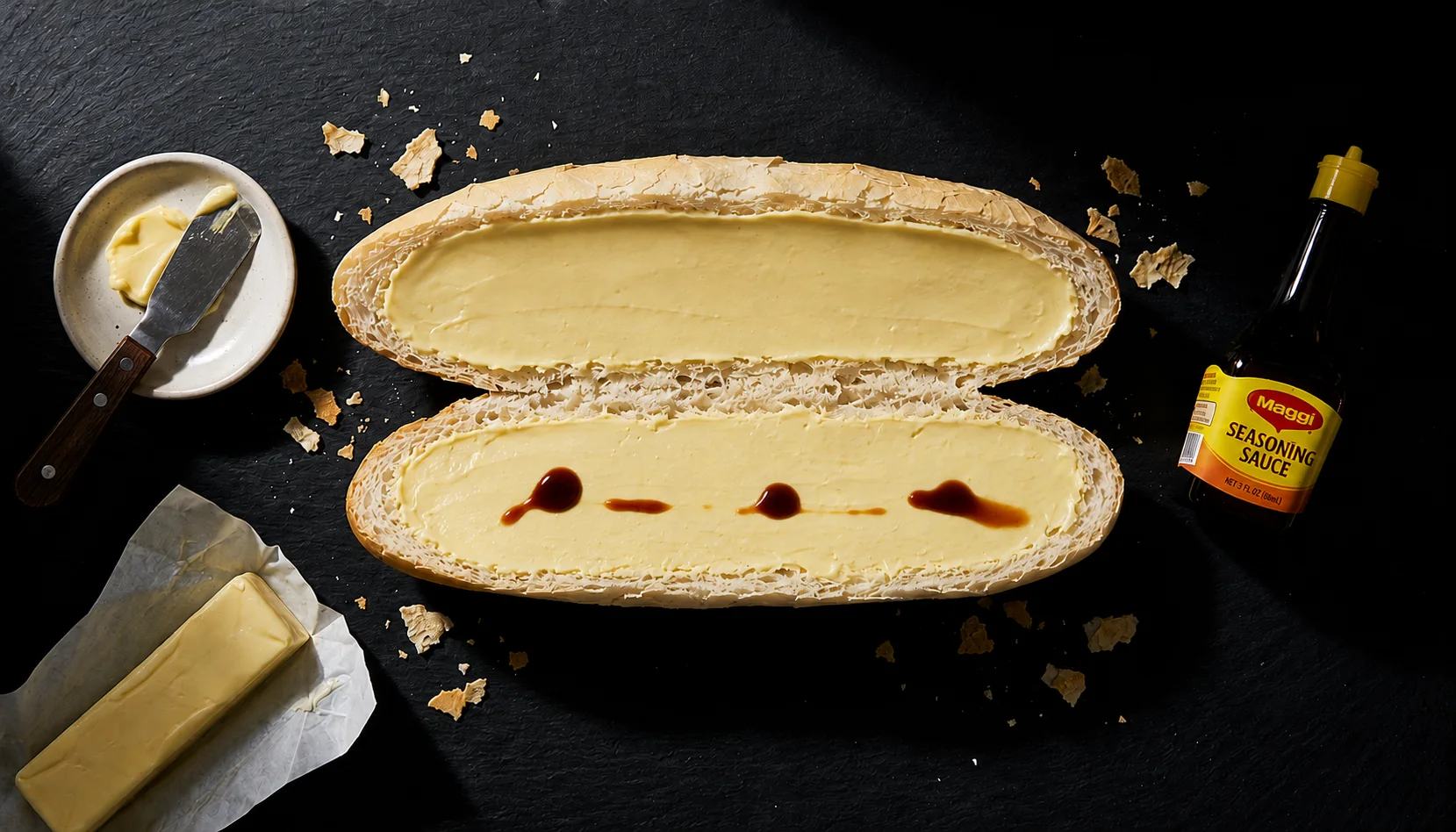
- Spread 1 tablespoon of softened butter across the bottom half of each baguette. Cover the full surface. The butter must be at room temperature. Cold butter tears the crumb. Melted butter soaks through immediately and the bread goes soggy. Softened butter spreads in a controlled layer and stays where you put it.
- Spread another tablespoon of softened butter across the top half of each baguette. One buttered surface produces an uneven bite. Both surfaces produce the correct result.
- Add three to four drops of Maggi Seasoning Sauce along the length of the bottom half. Do not exceed four drops. The Maggi is the salt and the umami. More than four drops and it overwhelms the butter. The balance is the point.
- Close the sandwich and press down firmly with your palm. Serve immediately. This sandwich does not hold. The butter softens the crust within minutes of assembly.
Notes
On the butter: Use unsalted butter only. Maggi Seasoning Sauce provides all the salt this sandwich needs. Salted butter combined with Maggi produces an oversalted result that loses the delicate balance the sandwich depends on. The butter must be softened to room temperature before spreading. Remove it from the refrigerator at least 30 minutes before assembling.
On the Maggi: Three to four drops is the correct amount for a standard bánh mì baguette. The Maggi does not function as a condiment here. It functions as a seasoning. The difference matters. A condiment is added to taste. A seasoning is applied at a precise amount to produce a specific result.
On the bread: This sandwich has no protein, no pickles, no herbs to carry it. The Glass Crust baguette is doing all the work. A standard French baguette or a soft sub roll will not produce the same result. The thin shattering crust and the cloud-light crumb are the entire point of this sandwich. If the bread is wrong, the sandwich is wrong.
On variations: Some vendors add a thin spread of pork liver pâté alongside the butter. This is the bánh mì bơ pâté variation and it is a legitimate variation. Spread the pâté directly on the bottom bread surface first. Then spread the butter over the pâté. The butter layer goes on top. The butter and pâté combination adds richness and depth without changing the fundamental character of the sandwich.
On serving: Bánh mì bơ is a breakfast sandwich. It is eaten immediately after assembly, often wrapped in a small piece of paper or plastic and eaten standing up. It does not improve with time.