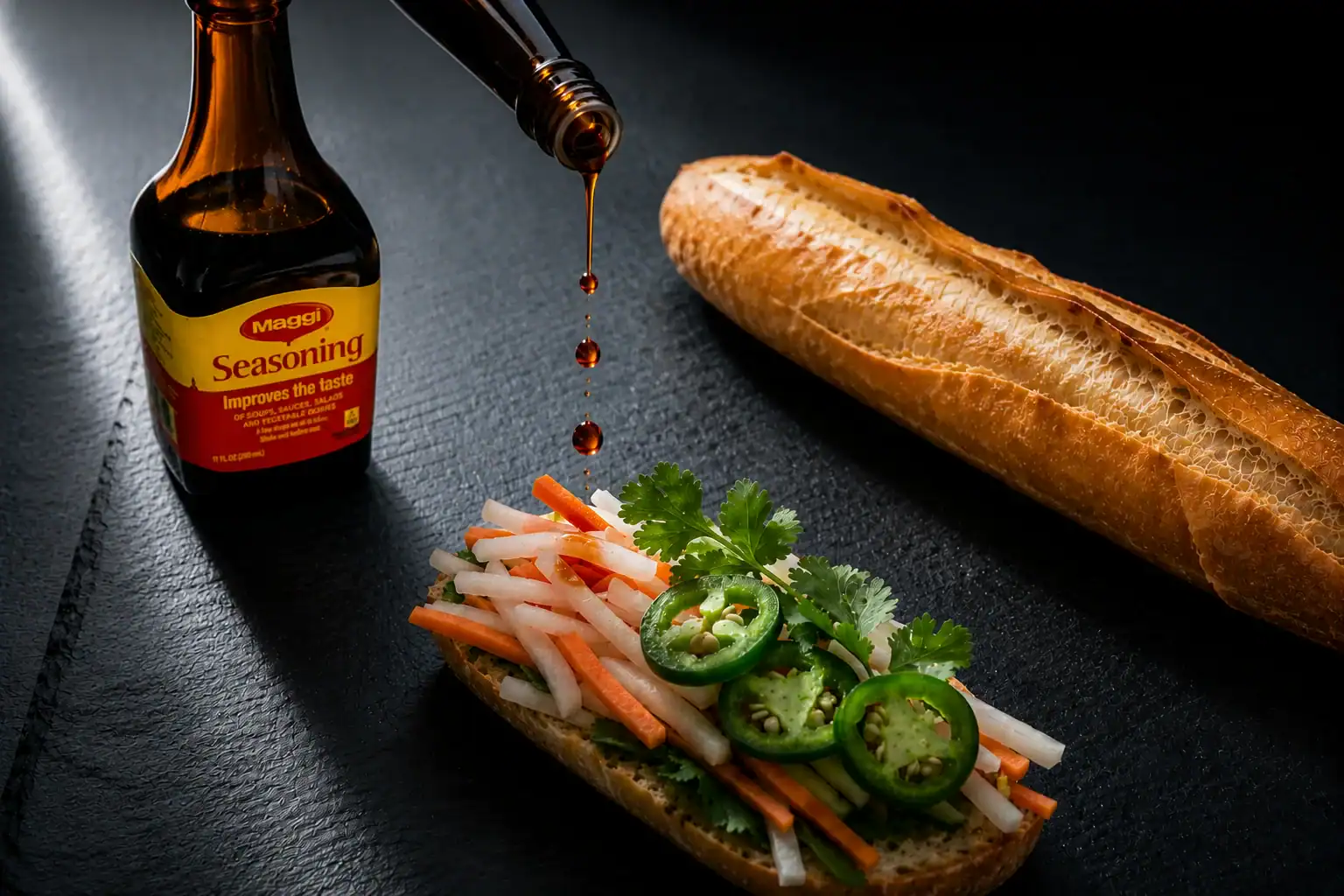
MAGGI SEASONING SAUCE FOR BÁNH MÌ
There is one ingredient in a bánh mì that most home cooks skip because it seems optional. Three drops of Maggi Seasoning Sauce directly onto the filling before closing the sandwich. Skip it and the sandwich tastes good. Add it and the sandwich tastes complete. That is not a small difference.
Maggi Seasoning Sauce is not soy sauce. It is not fish sauce. It is a wheat-fermented liquid condiment that adds depth without adding an identifiable flavor of its own. You do not taste Maggi in a bánh mì. You taste everything else more clearly because of it. Vietnamese street vendors have used it in bánh mì for decades. There is a reason it never left.
This page covers what Maggi Seasoning Sauce is, why it works in bánh mì specifically, and what to know before you buy.
[ WHY THIS INGREDIENT MATTERS ]
The bánh mì is a sandwich built on contrast. Fat from the pâté and Vietnamese mayonnaise against acid from the đồ chua. Heat from the jalapeño against the cool of the cucumber. The richness of the protein against the brightness of the cilantro. Every element is pulling in a different direction. The sandwich works because those directions are balanced.
Maggi Seasoning Sauce does not add another direction. It turns up the volume on every direction that is already there. The glutamates in Maggi amplify the savory signal across the whole sandwich, which means the pâté tastes richer, the cilantro tastes brighter, and the jalapeño heat arrives with more clarity. The sandwich snaps into focus in a way it simply does not without it.
Three drops is the correct amount. More than that and the flavor becomes identifiable as Maggi rather than invisible. Less than that and the effect is too subtle to register. This is not approximate. It is the ratio that Vietnamese street vendors landed on over decades of making this sandwich correctly.
[ WHAT TO KNOW BEFORE YOU BUY ]
Maggi Seasoning Sauce is one of the most available condiments in the world. You will find it at most Asian grocery stores, in the international aisle of most mainstream supermarkets, and on Amazon. The formula varies slightly by country of production but for bánh mì any bottle works correctly. The difference between regional formulas is negligible at three drops per sandwich.
The one thing worth knowing before you buy: do not substitute soy sauce. It is the most common swap and it does not work. Soy sauce has a stronger, more identifiable flavor that competes with the other ingredients rather than amplifying them. You will taste the soy sauce. You should not taste the Maggi. Fish sauce is closer in umami profile but adds a distinct fermented fish note that changes the character of the sandwich. Maggi is the correct ingredient. It costs around $4 and lasts through hundreds of sandwiches. Buy the real thing.
The 27oz bottle is the better value if you cook Vietnamese food regularly or use Maggi across multiple dishes. The 10oz bottle is correct for most home kitchens making bánh mì occasionally.
[ THE OPTIONS ]
Maggi Seasoning Sauce 6.7oz — around $5 The correct size for most home kitchens. At three drops per sandwich it will last through well over a hundred uses before needing replacement. Available at most Asian grocery stores and mainstream supermarkets. If you can find it locally, buy it there. If not, it is on Amazon.
Maggi Seasoning Sauce 27oz — around $15 The better value for households cooking Vietnamese food regularly. Same formula, larger bottle, lower cost per use. If Maggi starts appearing in your kitchen beyond just bánh mì, which it will once you start using it, this is the one to buy.
[ THE SCIENCE ]
Here is the simplest way to understand what Maggi does. Imagine every ingredient in the sandwich is a musician playing their part. The pâté is the bass. The cilantro is the lead. The jalapeño is the percussion that arrives late. They are all playing correctly. But the mix sounds slightly flat. Maggi is the sound engineer who turns up the gain on every channel at once. Nothing changes. Everything sounds better.
The technical reason is glutamates. Glutamate is a naturally occurring amino acid found in fermented and aged foods. It is the same compound that makes aged parmesan taste richer than fresh mozzarella and cured meat taste deeper than raw. When glutamates hit your taste receptors they trigger the umami response, which your brain reads as depth, richness, and complexity rather than a specific flavor.
Maggi is made by fermenting wheat until the proteins break down into amino acids including glutamate. The resulting liquid has a high free glutamate concentration with almost no additional flavor compounds to get in the way. That is what makes it work as an amplifier rather than an ingredient. Soy sauce and fish sauce also contain glutamates but they carry additional flavors that make their presence known. Maggi carries almost nothing except the signal.
Three drops lands the glutamates on the top layer of the filling where they interact with the fat from the pâté and mayonnaise below. Fat carries flavor compounds and holds them against your taste receptors longer than water does. The glutamates extend that contact time. The result is a finish that lingers after each bite in a way the sandwich does not achieve without them.
[ THE FAQ ]
What is Maggi Seasoning Sauce? Maggi is a wheat-fermented liquid condiment invented in Switzerland in 1886 and now produced globally. It has a high glutamate content that amplifies savory flavors without adding a strong identifiable taste of its own. It is used across Vietnamese, Mexican, and Southeast Asian cooking as a finishing condiment.
Can I substitute soy sauce for Maggi? Soy sauce is the most common substitute and it does not work correctly for bánh mì. It adds saltiness and some umami but its stronger flavor competes with the other ingredients rather than amplifying them. If you cannot find Maggi, leave the step out rather than substituting. The sandwich is still good without it.
How much Maggi should I use? Three drops directly onto the assembled filling before closing the sandwich. Not on the bread. Not mixed into any component. Three drops at the end of the build sequence. More than that and you will taste it. Less and you will not notice it.
Where do I add Maggi in the assembly sequence? After the jalapeño slices and before closing the sandwich. It is the last thing that goes on before the bread closes. The drops go directly onto the top layer of the filling.
Does Maggi contain MSG? The version commonly sold in the United States uses hydrolyzed wheat protein as its primary glutamate source rather than added monosodium glutamate. The umami effect is identical regardless of source. The distinction matters more for labeling than for cooking.
[ WHAT TO READ NEXT ]
Maggi is the final step in the assembly sequence. The Classic Bánh Mì Thịt Nguội recipe covers the complete build from bread to closing, including the exact point in the sequence where the three drops go and why the order of the final three elements matters.
The Maggi Dipping Sauce recipe shows a second application of Maggi beyond the sandwich itself. The same umami amplification principle applied to a dipping sauce that works alongside the bánh mì rather than inside it.
The Equipment page covers every tool required to build and serve bánh mì correctly at home, from the offset spatula to the bread knife to the mandoline slicer.