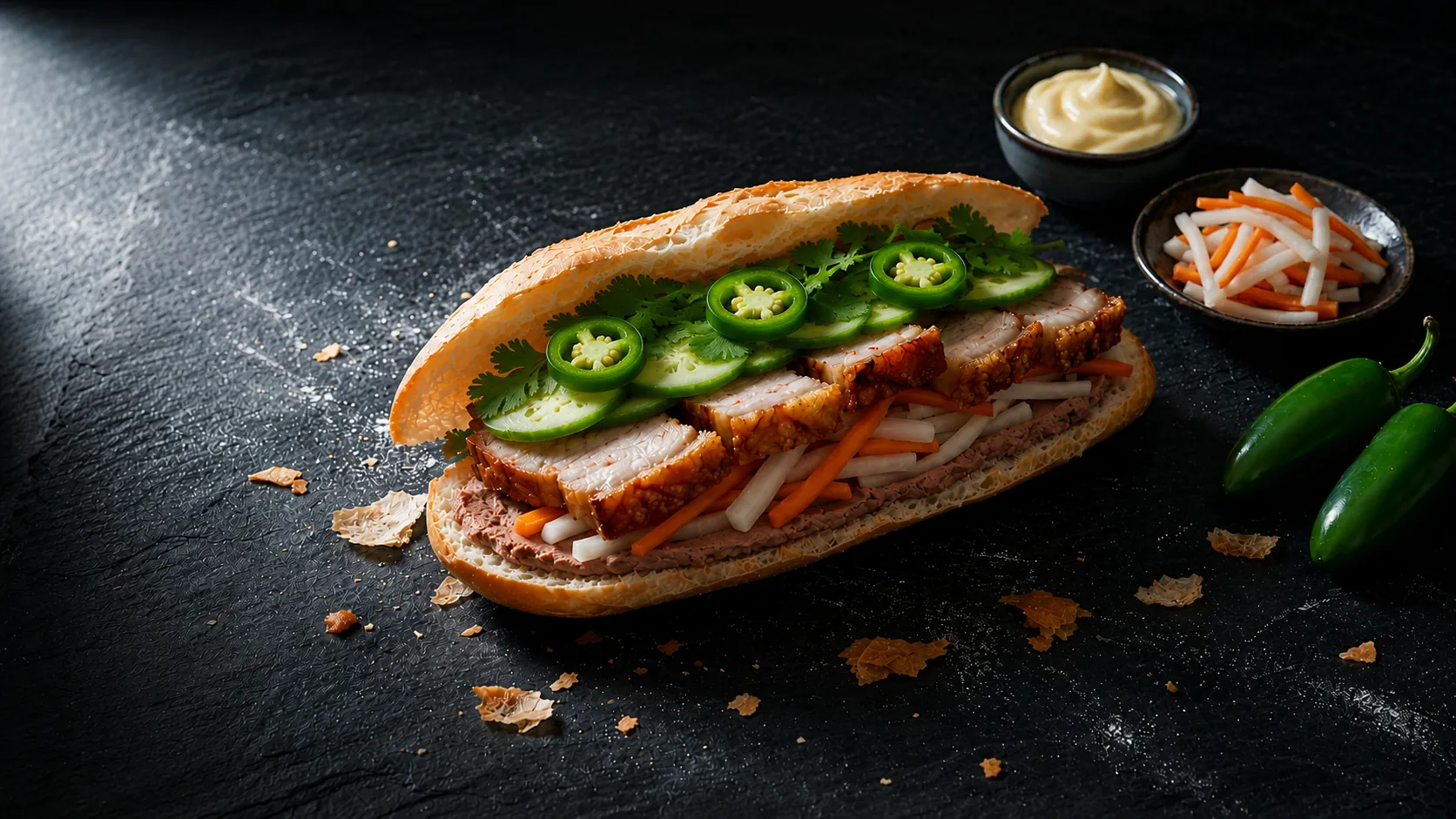
Bánh mì heo quay with roast pork belly crackling, pickled daikon carrot, cucumber, cilantro and jalapeño on glass crust baguette

BÁNH MÌ HEO QUAY (ROAST PORK BELLY BÁNH MÌ)

Bánh Mì Heo Quay is the roast pork belly version. The filling is built around heo quay, Vietnamese-style roast pork with crackling skin, layers of fat, and deeply seasoned meat. It is richer than the grilled pork version and slower to make, but the result is a different sandwich entirely.

The pork belly is seasoned, dried overnight, then roasted at high heat to blister the skin into crackling. That crackling is the point. It provides the textural contrast that the soft crumb, creamy spreads, and pickled vegetables need to work as a complete sandwich.

Bánh mì heo quay with roast pork belly crackling, pickled daikon carrot, cucumber, cilantro and jalapeño on glass crust baguette
L. Nguyen

Bánh Mì Heo Quay (Roast Pork Belly Bánh Mì)

Pork belly seasoned and roasted until the skin blisters into crackling, layered with Vietnamese mayonnaise, pâté, đồ chua, fresh cucumber, cilantro, and jalapeño on a Glass Crust baguette. Built around the contrast between the crisp crackling and the soft crumb. [ INTERMEDIATE ]
Prep Time 20 minutes
Cook Time 1 hour 30 minutes
Drying Time 8 hours
Total Time 9 hours 50 minutes
Servings: 4 bánh mì
Course: Sandwich
Cuisine: Vietnamese

Ingredients
  

The Pork
  • 600 g pork belly, skin on, in one piece
  • 1 tsp kosher salt
  • 1 tsp five spice powder
  • 1 tsp garlic powder
  • ½ tsp white pepper
  • 1 tsp neutral oil
  • 1 tbsp unseasoned rice vinegar, for the skin only
  • 1 tsp coarse salt, for the skin only
The Pickles
  • 200 g daikon radish, julienned 3mm wide
  • 200 g carrot, julienned 3mm wide
  • 120 ml unseasoned rice vinegar
  • 120 ml water
  • 30 g sugar
  • 8 g kosher salt
The Assembly
  • 4 Vietnamese bánh mì baguettes (Glass Crust standard)
  • 4 tbsp Vietnamese mayonnaise
  • 60 g pork liver pâté
  • 1 small cucumber, sliced lengthwise into thin strips
  • 1 bunch fresh cilantro, stems trimmed
  • 2 jalapeños, sliced thin on a bias
  • Maggi Seasoning Sauce, for finishing

Equipment

  • Cast iron skillet
  • Roasting pan with rack
  • Instant-read thermometer
  • Bread knife

Method
 

Dry the Pork
  1. Pat the pork belly completely dry with paper towels. Moisture is the enemy of crackling. Any water left on the skin will steam instead of blister.
  2. Score the skin in a crosshatch pattern at 1cm intervals. Do not cut into the fat layer. Cut through the skin only.
  3. Combine salt, five spice powder, garlic powder, and white pepper. Rub the mixture into the meat side only. Keep the skin completely clean of spices.
  4. Brush the skin with rice vinegar. Sprinkle coarse salt evenly across the skin. Place uncovered on a rack in the refrigerator for a minimum of 8 hours. Overnight produces the best result.
Make the Pickles
  1. Combine rice vinegar, water, sugar, and salt in a small saucepan over medium heat. Stir until sugar and salt dissolve completely, 2 to 3 minutes. Do not boil. Remove from heat and let cool to room temperature, 15 minutes.
  2. Pack daikon and carrot into a clean jar. Pour brine over vegetables. The brine should cover the vegetables completely. Seal and refrigerate for a minimum of 1 hour. Two hours produces a better result. The pickles will keep for 2 weeks refrigerated.
Roast the Pork
  1. Remove pork from the refrigerator 30 minutes before roasting. Cold pork straight from the refrigerator extends cooking time unevenly.
  2. Preheat oven to 425°F. Place pork belly skin side up on a rack set over a roasting pan. The rack keeps the skin away from the rendered fat.
  3. Roast at 425°F for 30 minutes. The skin will begin to bubble and blister. This is correct.
  4. Reduce heat to 350°F and continue roasting for 45 minutes. The internal temperature of the meat should reach 165°F.
  5. Increase heat to 475°F for the final 10 to 15 minutes. Watch the skin closely. It should blister into full crackling without burning. Remove from the oven the moment the skin is uniformly blistered.
  6. Rest the pork for 15 minutes before slicing. Resting allows the juices to redistribute. Do not skip this step.
  7. Slice into pieces approximately 5mm thick. Each slice should have a layer of crackling, fat, and meat.
Assemble
  1. Split each baguette lengthwise, cutting three-quarters through. Do not cut completely. The hinge holds the sandwich together.
  2. Open the bread. Apply Vietnamese mayonnaise to both cut surfaces. This is the fat barrier. It seals the bread against moisture from the vegetables and the pork.
  3. Spread pâté on the bottom half only.
  4. Layer pork belly slices on the pâté. Overlap them slightly. The crackling side faces up.
  5. Add cucumber strips across the pork.
  6. Add pickled daikon and carrot. Drain them first. Excess brine soaks the bread.
  7. Add cilantro in whole sprigs. Do not chop it.
  8. Finish with jalapeño slices. Two to three per sandwich is the correct amount.
  9. Three drops of Maggi Seasoning Sauce across the top. No more. Close the sandwich. Press down firmly with your palm. Serve immediately.

Notes

On the skin: The overnight drying step is not optional. A wet skin will not blister into crackling regardless of oven temperature. The salt draws moisture out of the skin during the drying period. Eight hours is the minimum. Twelve is better.
On the pork: Ask the butcher for a single piece of pork belly with the skin on and the bones removed. The skin must be intact. A piece without skin produces roast pork, not heo quay. They are not the same thing.
On Vietnamese mayonnaise: Vietnamese mayonnaise is the correct choice here. The recipe is on this site. If you do not have time to make it from scratch, Kewpie is the correct store-bought substitute. Do not use standard mayonnaise. The flavor profile is different enough to affect the finished sandwich.
On the pickles: The pickles in this recipe follow the same formula as the Đồ Chua recipe on this site. If you have a jar already made, use those. The brine in the ingredients list produces the correct result if you are making them fresh.
On make-ahead: The pork belly can be roasted up to 2 days ahead and refrigerated. Reheat in a 400°F oven for 10 minutes skin side up before slicing. Do not microwave it. The crackling goes soft.

[ THE SCIENCE ]

The crackling on heo quay is not just texture. It is a structural decision. Pork skin is made almost entirely of collagen, a dense protein that is tough and chewy when wet. When you dry the skin completely and expose it to high heat, two things happen simultaneously. The moisture that remains deep in the skin turns to steam and pushes outward, creating the bubbles and blisters. At the same time, the collagen proteins denature and harden in the heat, locking those bubbles in place as they dry out. Think of it like blowing up a tiny balloon and then freezing it solid. The salt draws the surface moisture out during the drying period so the steam has to travel from deeper in the skin, which produces larger, more uniform blisters. Skip the drying step and the surface steam escapes before the collagen can set around it. The skin stays flat and chewy instead of blistering into crackling.

[ THE FAQ ]

Why is my pork skin not crisping up? The most common cause is moisture. The skin was not dry enough before roasting. Pat it completely dry, apply the salt, and leave it uncovered in the refrigerator overnight. Even a small amount of surface moisture will prevent blistering. The second cause is oven temperature. The final blast at 475°F is what triggers the blistering. Do not skip it.

Can I use pork shoulder instead of pork belly? No. Pork shoulder does not have the skin and fat layer that produces crackling. It will produce a good roast pork but it is a different sandwich. For a faster version using pork shoulder, see the Bánh Mì Thịt Nướng recipe.

How thin should the pork be sliced? Around 5mm. Thinner than that and the slices lose structural integrity inside the sandwich. Thicker and the crackling to meat ratio shifts too far toward meat. Each slice should have a visible layer of crackling, fat, and meat.

Can I make this without an oven? Not correctly. The crackling requires dry, sustained high heat that only an oven can produce consistently. An air fryer can produce a reasonable approximation for a single portion. A stovetop cannot replicate it.

How do I keep the crackling crisp after slicing? Slice immediately before assembling. Crackling softens quickly once it is separated from the heat source and exposed to moisture from the other ingredients. Assemble and serve within 5 minutes of slicing.

[ THE EQUIPMENT ]

A rack set over a roasting pan keeps the skin elevated above the rendered fat during roasting. A cast iron skillet handles any stovetop finishing if needed. An instant-read thermometer confirms the internal temperature without cutting into the meat. A bread knife splits the baguette without crushing the Glass Crust.

The full equipment list with specific recommendations is on the Equipment page.

[ WHAT TO READ NEXT ]

The Bánh Mì Thịt Nướng recipe is the grilled pork version, faster to make, different flavor profile, built on the same five-element structure as this sandwich.

Bánh Mì Thịt Kho is the other pork belly sandwich in the archive. Same cut of meat, completely different result. Where heo quay builds texture through crackling, thịt kho builds depth through a long braise and a dark caramel reduction. Worth making both to understand what the cut is capable of.

Bánh Mì Vịt Quay is the roast duck version. Same lacquered skin logic, same overnight drying, same glaze technique. The flavor is completely different but the method is parallel. If you made heo quay, vịt quay is the natural next recipe to attempt.