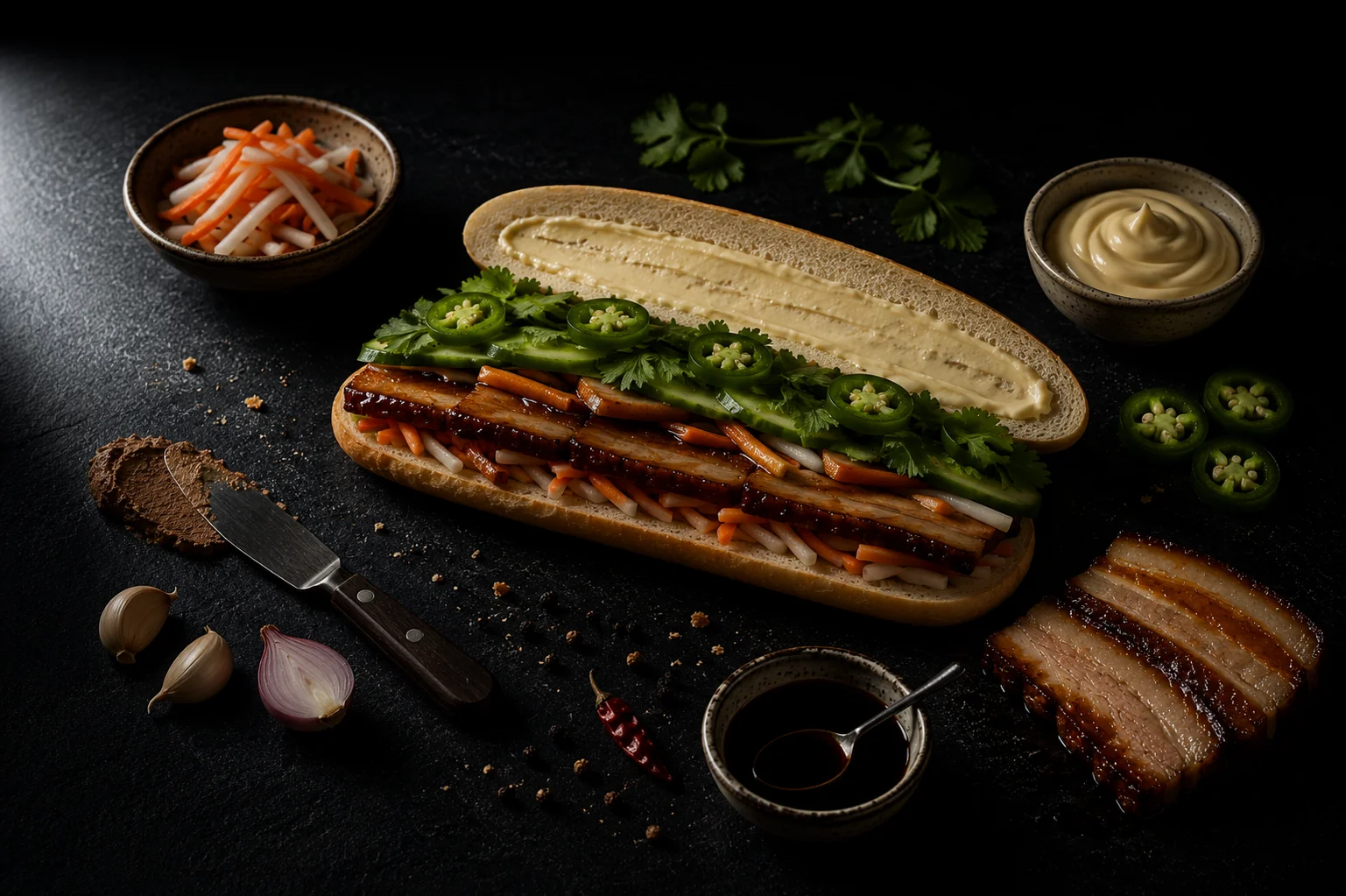
bánh mì thịt kho (Vietnamese braised pork belly bánh mì) with braised pork belly, đồ chua, cucumber, cilantro, and jalapeño on dark slate

Bánh Mì Thịt Kho (Braised Pork Belly Bánh Mì)

Bánh mì thịt kho is the braised pork belly version. Pork belly is simmered low and slow in fish sauce, coconut water, and sugar until the fat renders completely and the meat is tender enough to slice cleanly. The braising liquid reduces into a dark, glossy caramel that coats every slice. Heo quay gives you crackling and texture. Thịt kho gives you rendered fat, caramel, and braising liquid that soaks into the bread.

The build follows the same five-element structure. Pork liver pâté on the bottom half, Vietnamese mayonnaise on the top, the braised pork belly layered in with some of the reduced braising liquid spooned over, then đồ chua, cucumber, cilantro, and jalapeño. The acidity of the pickles does more work here than in any other sandwich in the archive.

bánh mì thịt kho (Vietnamese braised pork belly bánh mì) with braised pork belly, đồ chua, cucumber, cilantro, and jalapeño on dark slate
L. Nguyen

Bánh Mì Thịt Kho (Braised Pork Belly Bánh Mì)

Pork belly braised low and slow in fish sauce, coconut water, and sugar until the fat renders completely and the braising liquid reduces to a dark glossy caramel. Layered on a Glass Crust baguette with pâté, Vietnamese mayonnaise, đồ chua, cucumber, cilantro, and jalapeño. [ INTERMEDIATE ]
Prep Time 20 minutes
Cook Time 1 hour 30 minutes
Resting Time 15 minutes
Total Time 2 hours 5 minutes
Servings: 4 bánh mì
Course: Sandwich
Cuisine: Vietnamese

Ingredients
  

The Braised Pork
  • 600 g pork belly, skin on, cut into 4cm pieces
  • 3 tbsp fish sauce
  • 2 tbsp sugar
  • 1 tbsp neutral oil
  • 3 cloves garlic, minced
  • 2 shallots, minced
  • 240 ml coconut water
  • 120 ml water
  • 1 tsp white pepper
The Assembly
  • 4 Vietnamese bánh mì baguettes (Glass Crust standard)
  • 60 g pork liver pâté
  • 60 g Vietnamese mayonnaise
  • 240 g đồ chua (pickled daikon and carrot), drained
  • 1 Persian cucumber, thinly sliced lengthwise
  • 1 bunch fresh cilantro, stems trimmed
  • 2 jalapeños, thinly sliced
  • Maggi Seasoning Sauce, for finishing

Equipment

  • Large pot or Dutch oven
  • Bread knife
  • Pâté Spreader / Offset Spatula
  • Kitchen scale

Method
 

Braise the Pork
  1. Pat the pork belly completely dry with paper towels. Moisture on the surface prevents proper caramelization in the next step.
  2. Heat neutral oil in a large pot or Dutch oven over medium high heat. Add the pork belly pieces skin side down. Sear without moving for 3 minutes until the skin begins to color. Turn and sear the meat side for 2 minutes. Remove the pork and set aside. This step builds the base flavor of the braise.
  3. Add sugar to the pot. Stir constantly over medium heat until the sugar melts and turns a deep amber color, 3 to 4 minutes. Watch it closely. It goes from amber to burnt in seconds.
  4. Add garlic and shallots to the caramel. Stir for 1 minute until fragrant. The caramel will coat the aromatics and begin to smell complex and savory.
  5. Return the pork belly to the pot. Add fish sauce, coconut water, water, and white pepper. Stir to combine. The caramel will seize when the liquid hits it. Keep stirring until it dissolves back into the liquid.
  6. Bring to a boil, then reduce to a low simmer. Cover and cook for 1 hour. The pork should be tender but still holding its shape.
  7. Remove the lid and increase heat to medium. Simmer uncovered for 20 to 30 minutes until the braising liquid reduces to a thick, dark, glossy sauce that coats the back of a spoon. Stir occasionally to prevent burning.
  8. Remove from heat. Let the pork rest in the braising liquid for 15 minutes before slicing. Hot pork straight from the pot is too soft to slice cleanly. Resting firms the exterior and produces clean 5mm slices.
Assemble
  1. Slice the pork belly into pieces approximately 5mm thick. Each slice should have a visible layer of skin, fat, and meat.
  2. Split each baguette lengthwise, cutting three-quarters of the way through. Do not cut completely. The hinge holds the sandwich together.
  3. Spread the pâté across the bottom half of each baguette. Cover the full surface. The pâté seals the bread against moisture from the braising liquid above it.
  4. Spread the Vietnamese mayonnaise across the top half of each baguette.
  5. Layer the pork belly slices across the pâté. Spoon 1 to 2 teaspoons of the reduced braising liquid over the pork. Do not exceed 2 teaspoons per sandwich. The braising liquid is concentrated. More than that and the bread cannot hold the sandwich together.
  6. Add the đồ chua directly on top of the pork. Drain it thoroughly. The braising liquid is already rich. Excess pickle brine tips the sandwich past the point of balance.
  7. Add cucumber strips along the length of the sandwich.
  8. Add a small bundle of cilantro. Do not chop it. Whole sprigs only.
  9. Lay jalapeño slices across the top. Three drops of Maggi Seasoning Sauce along the length. No more. Close the sandwich, press down firmly with your palm, and serve immediately.

Notes

NOTES TAB
Paste all notes in one block:
On the pork cut: Skin-on pork belly is essential. The skin renders during the long braise and becomes soft and gelatinous rather than crispy. This is the correct texture for thịt kho. Ask the butcher for a single piece with the skin intact and the bones removed.
On coconut water: Use fresh or packaged unsweetened coconut water. Do not use coconut milk. Coconut milk produces a completely different flavor profile that is too rich and too sweet. Coconut water adds a subtle sweetness and helps the braising liquid develop its characteristic color.
On the caramel step: The sugar caramelization in step 3 is what gives thịt kho its deep color and complex flavor. Do not skip it or rush it. Pale caramel produces a flat, sweet braise. Dark amber produces depth. Burnt caramel produces bitterness that cannot be corrected.
On the eggs: Hard boiled eggs braised in the liquid alongside the pork are traditional in thịt kho. They absorb the braising liquid and turn a deep mahogany color. They are not used in the sandwich. Serve them alongside.
On make-ahead: The braised pork belly improves significantly the next day. The fat firms up overnight in the refrigerator, which makes slicing cleaner and easier. Reheat gently in the braising liquid before assembling. Do not microwave it. The texture changes.
On serving: Unlike cold cut sandwiches, bánh mì thịt kho is served warm. The pork goes in hot. Assemble and serve immediately.

[ THE SCIENCE ]

The braising liquid in thịt kho does something no marinade can. When pork belly simmers in fish sauce and caramelized sugar for 90 minutes, the collagen in the connective tissue breaks down into gelatin. Gelatin is what makes the braising liquid thick and glossy rather than thin and watery. Think of it like this: collagen is a tight coil of protein. Heat unwinds it slowly. By the time the pork is tender, those unwound proteins have dissolved into the liquid and turned it into something closer to a sauce than a broth. That glossy coating on every slice is not just flavor. It is the collagen from the pork itself, reduced and concentrated around the meat that produced it.

[ THE FAQ ]

What cut of pork works best for bánh mì thịt kho? Skin-on pork belly is the correct cut. The ratio of skin, fat, and meat in pork belly produces the right texture after a long braise. Pork shoulder produces a drier result with less gelatin. Pork loin is too lean and becomes tough. Skin-on pork belly only.

Can I use regular water instead of coconut water? Yes. The sandwich will still work. Coconut water adds a subtle sweetness and contributes to the deep color of the braising liquid. If coconut water is unavailable, plain water works. The braising liquid will be slightly less complex in flavor. Adding 1 extra teaspoon of sugar partially compensates but does not fully replicate the result.

How thick should the pork be sliced? 5mm is the standard. Thinner and the slices break apart inside the sandwich. Thicker and the ratio of pork to bread is wrong. Each slice should show a visible layer of skin, fat, and meat. Refrigerate the pork overnight before slicing for the cleanest cuts.

How long does the braised pork keep? Up to 4 days refrigerated in the braising liquid. The flavor improves over the first 2 days. Keep the pork submerged in the liquid and reheat gently before slicing and assembling.

Why is the đồ chua more important in this sandwich than others? Thịt kho is the richest sandwich in the archive. The fat content of braised pork belly, combined with the reduced caramel braising liquid and the pâté, is significantly higher than any cold cut version. The đồ chua is what cuts through that richness and resets the palate. Without enough acidity the sandwich becomes heavy after the first few bites. Do not reduce the pickle quantity in this recipe.

[ THE EQUIPMENT ]

A large pot or Dutch oven with a tight fitting lid is essential for the braise. The lid traps moisture during the first hour of cooking and keeps the liquid from reducing too fast. A bread knife splits the baguette without crushing the Glass Crust. An offset spatula spreads the pâté and mayonnaise in a controlled, even layer.

The full equipment list with specific recommendations is on the Equipment page.

[ WHAT TO READ NEXT ]

Bánh mì heo quay is the other pork belly sandwich in the archive. Where thịt kho gives you rendered fat and caramel depth, heo quay gives you crackling. They are built on the same cut of pork and produce completely different results. Worth understanding both.

The đồ chua does more work in this sandwich than in any other recipe on the site. The full Đồ Chua recipe covers the brine ratio and why the acidity level matters when the fat content is this high.

Bánh mì bò kho is the other braised sandwich in the archive. Where thịt kho uses pork belly, fish sauce, and caramelized sugar, bò kho uses beef shank, lemongrass, and warm spices. Both are served warm. Both depend on the braising liquid for their character. Worth making both to understand how the protein changes the sandwich.