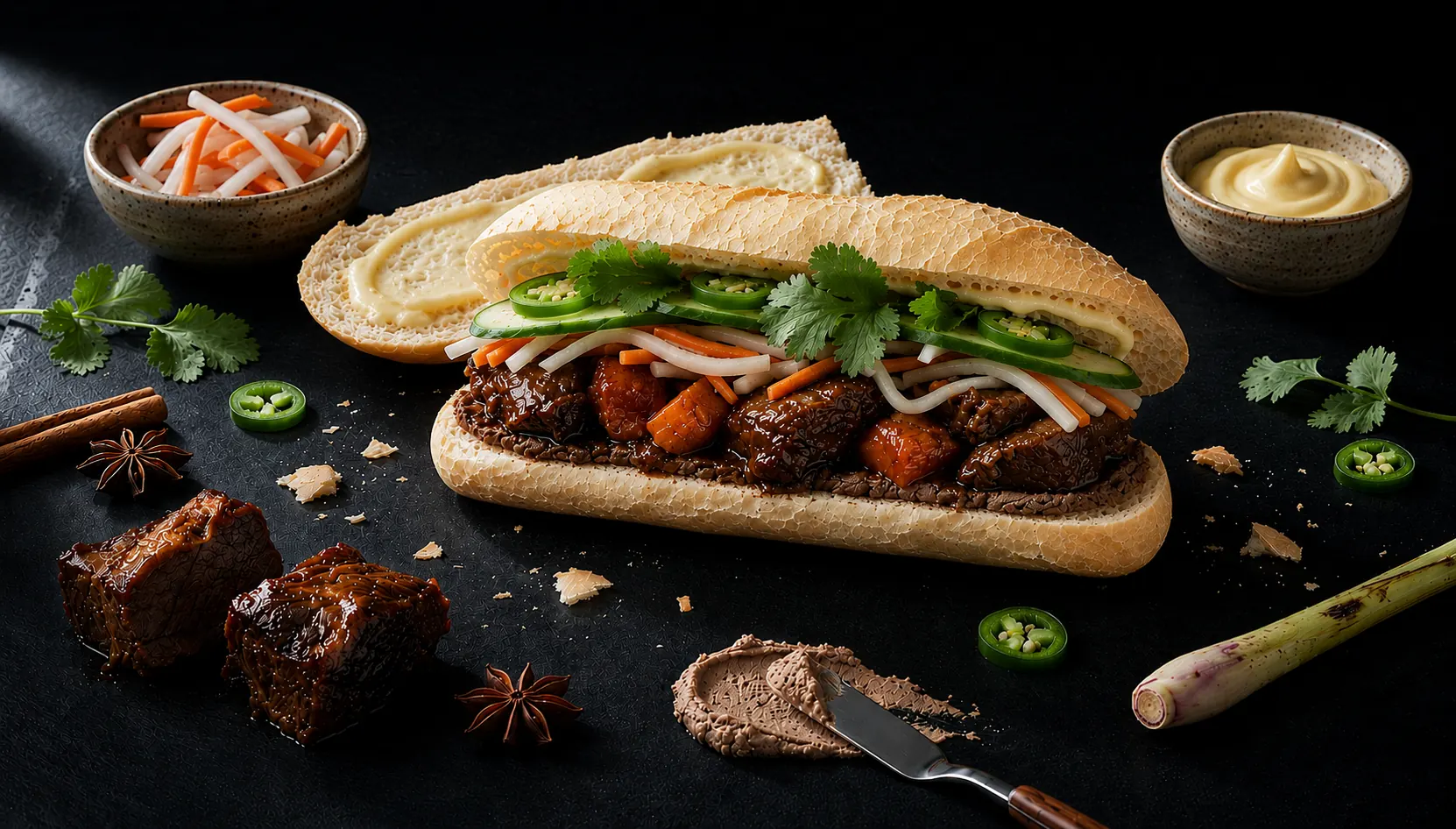
bánh mì bò kho (Vietnamese beef stew bánh mì) with braised beef shank, carrots, đồ chua, cucumber, cilantro, and jalapeño on dark slate

Bánh Mì Bò Kho (Vietnamese Beef Stew Bánh Mì)

Bánh mì bò kho is the Vietnamese beef stew version. Beef shank or brisket is braised low and slow in lemongrass, star anise, curry powder, and fish sauce until the meat is completely tender and the braising liquid reduces into a thick, deeply aromatic sauce. The stew is served warm, spooned directly into the bread. This is not a dry sandwich. The braising liquid soaks into the crumb. Assemble it and eat it immediately.

The build is different from every other sandwich in the archive. Pork liver pâté on the bottom half, Vietnamese mayonnaise on the top. The beef goes in hot with the braising liquid spooned over. Đồ chua, cucumber, cilantro, and jalapeño finish it. The acidity of the pickles cuts through the richness of the stew. Without them every bite tastes the same.

bánh mì bò kho (Vietnamese beef stew bánh mì) with braised beef shank, carrots, đồ chua, cucumber, cilantro, and jalapeño on dark slate
L. Nguyen

Bánh Mì Bò Kho (Vietnamese Beef Stew Bánh Mì)

Beef shank braised low and slow in lemongrass, star anise, curry powder, and fish sauce until completely tender, then spooned warm into a Glass Crust baguette with pâté, Vietnamese mayonnaise, đồ chua, cucumber, cilantro, and jalapeño. [ INTERMEDIATE ]
Prep Time 25 minutes
Cook Time 2 hours 30 minutes
Reducing Time 20 minutes
Total Time 3 hours 15 minutes
Servings: 4 bánh mì
Course: Sandwich
Cuisine: Vietnamese

Ingredients
  

The Beef Stew
  • 700 g beef shank or brisket, cut into 4cm pieces
  • 2 stalks lemongrass, white part only, bruised and cut into 5cm pieces
  • 3 cloves garlic, minced
  • 2 shallots, minced
  • 1 tbsp Vietnamese curry powder
  • ½ tsp five spice powder
  • 2 tbsp fish sauce
  • 1 tbsp tomato paste
  • 1 tbsp neutral oil
  • 2 tsp sugar
  • 1 tsp white pepper
  • 500 ml beef stock
  • 240 ml coconut water
  • 2 star anise
  • 1 cinnamon stick
  • 2 medium carrots, cut into 3cm pieces
The Assembly
  • 4 Vietnamese bánh mì baguettes (Glass Crust standard)
  • 60 g pork liver pâté
  • 60 g Vietnamese mayonnaise
  • 240 g đồ chua (pickled daikon and carrot), drained
  • 1 Persian cucumber, thinly sliced lengthwise
  • 1 bunch fresh cilantro, stems trimmed
  • 2 jalapeños, thinly sliced
  • Maggi Seasoning Sauce, for finishing

Equipment

  • Large pot or Dutch oven
  • Bread knife
  • Pâté Spreader / Offset Spatula
  • Kitchen scale

Method
 

Braise the Beef
  1. Pat the beef completely dry with paper towels. Moisture on the surface prevents proper searing in the next step.
  2. Heat neutral oil in a large pot or Dutch oven over high heat. Sear the beef in batches, without crowding, for 2 to 3 minutes per side until deeply browned on all sides. Remove and set aside. Do not skip this step. The sear builds the base flavor of the stew.
  3. Reduce heat to medium. Add garlic and shallots to the same pot. Cook until softened and fragrant, 2 minutes.
  4. Add curry powder, five spice powder, and tomato paste. Stir constantly for 1 minute. Cooking the spices in the oil before adding liquid blooms them and intensifies the flavor. Raw spices added directly to liquid produce a flat, underdeveloped stew.
  5. Return the beef to the pot. Add lemongrass, star anise, and cinnamon stick. Pour in fish sauce, sugar, beef stock, and coconut water. Stir to combine. Bring to a boil, then reduce to a low simmer. Cover and cook for 1 hour 30 minutes.
  6. Add the carrot pieces. Cover and continue cooking for 45 minutes until the carrots are tender and the beef yields completely when pressed with a spoon. If the beef is not yet tender, continue cooking in 15 minute increments until it is.
  7. Remove the lemongrass stalks, star anise, and cinnamon stick. Increase heat to medium and simmer uncovered for 20 minutes until the braising liquid reduces to a thick, glossy sauce that coats the back of a spoon. Stir occasionally to prevent burning.
  8. Remove from heat. The beef can be left in large pieces or broken into smaller chunks with a spoon. Both work. Smaller pieces distribute more evenly inside the sandwich.
Assemble
  1. Split each baguette lengthwise, cutting three-quarters of the way through. Do not cut completely. The hinge holds the sandwich together.
  2. Spread the pâté across the bottom half of each baguette. Cover the full surface. The pâté seals the bread against the braising liquid above it.
  3. Spread the Vietnamese mayonnaise across the top half of each baguette.
  4. Spoon the beef and carrots into the baguette. Add 1 to 2 teaspoons of the reduced braising liquid over the beef. Do not exceed 2 teaspoons per sandwich. The braising liquid is concentrated and rich. More than that and the bread cannot hold the sandwich together.
  5. Add the đồ chua directly on top of the beef. Drain it thoroughly. Excess pickle brine combined with the braising liquid will oversaturate the bread.
  6. Add cucumber strips along the length of the sandwich.
  7. Add a small bundle of cilantro. Do not chop it. Whole sprigs only.
  8. Lay jalapeño slices across the top. Three drops of Maggi Seasoning Sauce along the length. No more. Close the sandwich, press down firmly with your palm, and serve immediately.

Notes

On the beef cut: Beef shank is the best cut for bò kho. The connective tissue in shank breaks down during the long braise and produces a rich, gelatinous sauce. Brisket is a good alternative with a slightly different texture. Avoid lean cuts like sirloin, round, or tenderloin. They have no connective tissue to break down and become dry and tough after two hours of braising.
On the curry powder: Use Vietnamese curry powder if available. It is milder and more fragrant than Indian curry powder. If Vietnamese curry powder is unavailable, a mild Madras curry powder works. Do not use a hot or strong curry powder. The flavor should be aromatic and subtle, not dominant.
On the lemongrass: Bruise the stalks with the back of a knife before adding them to the pot. Bruising releases the essential oils. Cut them into pieces large enough to remove easily before assembling. Small pieces of lemongrass in the finished stew are unpleasant to eat.
On the carrots: The carrots in bò kho are not decoration. They absorb the braising liquid and become part of the filling. Cut them into 3cm pieces so they fit inside the baguette without falling out. Do not add them at the beginning of the braise. They will dissolve completely before the beef is tender.
On make-ahead: Bò kho improves significantly the next day. The flavors deepen overnight and the fat solidifies on the surface, making it easy to remove before reheating. Reheat gently over low heat before assembling. Do not microwave it.
On serving: This sandwich is served warm. The beef and braising liquid go in hot. Assemble and serve immediately.

[ THE SCIENCE ]

Bò kho gets its depth from the spices, but not in the way most people expect. Star anise, cinnamon, and curry powder contain volatile aromatic compounds that only release their full flavor when they are heated in fat or liquid at low temperature for an extended period. Think of it like this: the spices are locked boxes. The long, slow braise is the only key that opens them. A quick simmer extracts only a fraction of what they contain. Two and a half hours of low heat extracts everything. This is why bò kho made in 30 minutes tastes thin and one-dimensional. The same recipe made in two and a half hours tastes like something completely different.

[ THE FAQ ]

What cut of beef works best for bánh mì bò kho? Beef shank is the correct cut. The high collagen content breaks down into gelatin during the long braise and produces the thick, glossy sauce that defines bò kho. Brisket is a good alternative. Avoid lean cuts like sirloin, round, or tenderloin. They have no connective tissue to break down and become dry and tough after two hours of braising.

Can I use water instead of beef stock? Yes but the result will be thinner in flavor. Beef stock adds depth and body that water cannot replicate. If beef stock is unavailable, use chicken stock. If neither is available, add an extra tablespoon of fish sauce and an extra teaspoon of sugar to plain water to partially compensate.

Can I make bò kho in a slow cooker? Yes. Brown the beef and bloom the spices on the stovetop first. Transfer everything to the slow cooker and cook on low for 6 to 8 hours. Remove the lid for the last 30 minutes to reduce the sauce. The result is comparable to the stovetop method.

How long does bò kho keep? Up to 4 days refrigerated. The flavor improves over the first 2 days. The fat will solidify on the surface when cold. Skim it off before reheating for a cleaner sauce.

Why does the sandwich need pâté if the stew is already rich? The pâté is not adding more richness. It is creating a fat barrier between the bread and the braising liquid. Without it the liquid penetrates the bread immediately and the bottom half goes soggy before the sandwich reaches the table. The pâté seals the crumb. Every bánh mì on this site uses pâté for the same reason.

[ THE EQUIPMENT ]

A large pot or Dutch oven with a tight fitting lid is essential for the braise. The heavy base distributes heat evenly and prevents the bottom of the stew from scorching during the long cook. A bread knife splits the baguette without crushing the Glass Crust. An offset spatula spreads the pâté and mayonnaise in a controlled, even layer.

The full equipment list with specific recommendations is on the Equipment page.

[ WHAT TO READ NEXT ]

Bánh mì thịt kho is the other braised sandwich in the archive. Where bò kho uses beef, lemongrass, and warm spices, thịt kho uses pork belly, fish sauce, and caramelized sugar. Both are served warm. Both depend on the braising liquid for their character. Worth making both to understand how the protein changes the sandwich.

The đồ chua in this recipe is doing critical work. The acidity cuts through the richness of two and a half hours of slow-braised beef. The full Đồ Chua recipe covers the brine ratio and why getting it right matters more in rich sandwiches than anywhere else.

Pork liver pâté is the fat barrier that keeps this sandwich intact. Without it the braising liquid soaks through the bread before the sandwich is assembled. The full recipe is on this site.