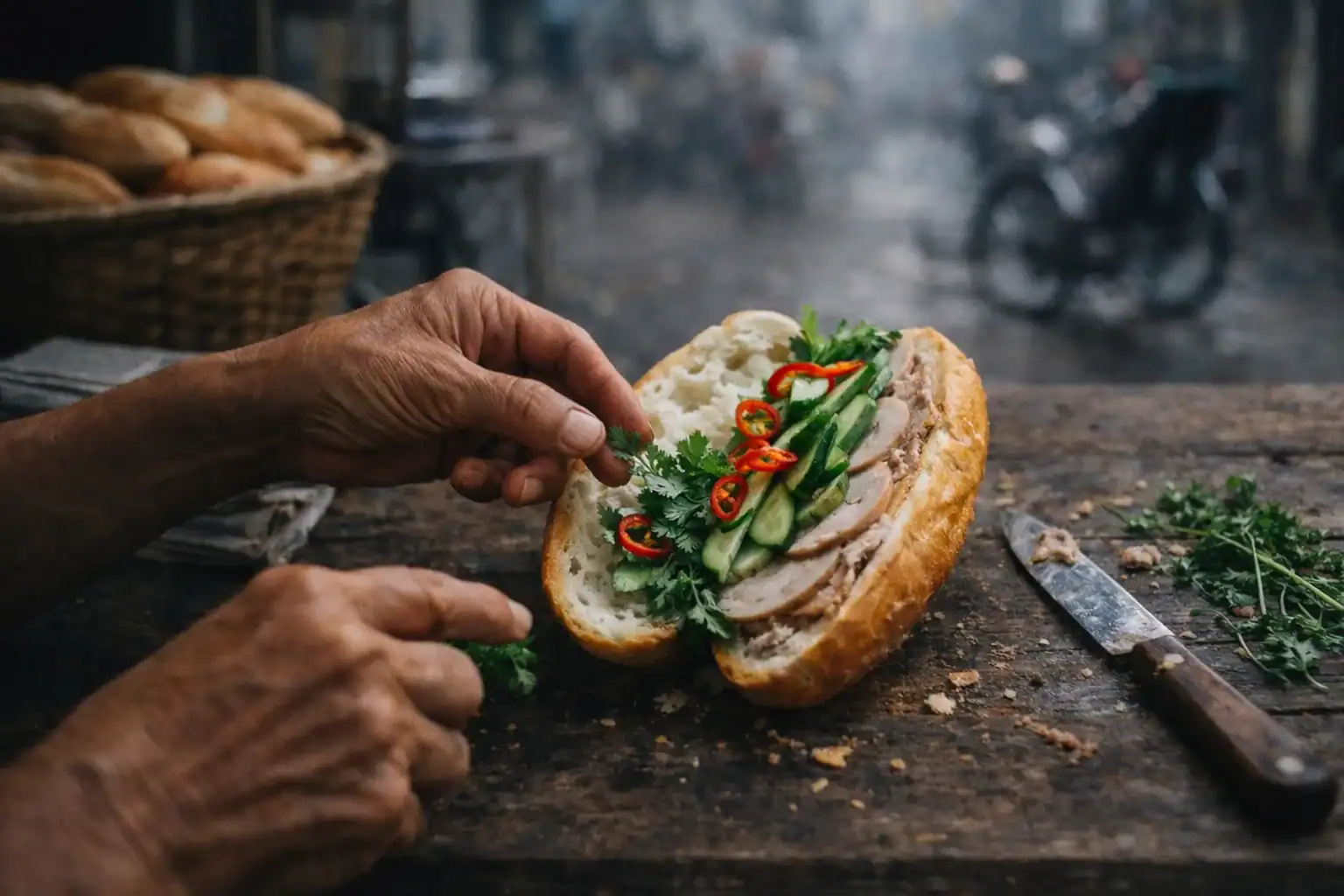
Hands assembling a classic bánh mì thịt nguội on a Hanoi street cart

CLASSIC BÁNH MÌ THỊT NGUỘI (VIETNAMESE COLD CUT BÁNH MÌ)

The bánh mì thịt nguội is the original. Before the grilled pork, before the tofu, before every variation that came after, there was this: a combination of Vietnamese cold cuts on a Glass Crust baguette, built according to a logic that has not changed in decades.

Thịt nguội means cold cuts. In a bánh mì, that means chả lụa, chả bì, and pâté, layered in a specific order on a specific bread, with pickled daikon and carrot, fresh cilantro, fresh cucumber, and jalapeño. Vietnamese mayonnaise on both sides. Pâté on the bottom. Maggi Seasoning Sauce at the end.

Every component has a function. None of them are decorative. This recipe builds the sandwich the way it is built at every street cart in Hà Nội and Sài Gòn that does it correctly.

Hands assembling a classic bánh mì thịt nguội on a Hanoi street cart
L. Nguyen

Classic Bánh Mì Thịt Nguội (Vietnamese Cold Cut Bánh Mì)

The definitive cold cut bánh mì. Chả lụa, chả bì, and pâté layered on a Glass Crust baguette with pickled daikon and carrot, fresh cilantro, and jalapeño. Every component has a job. [ INTERMEDIATE ]
Prep Time 30 minutes
Pickle Time 1 hour
Total Time 1 hour 30 minutes
Servings: 4 bánh mì
Course: Sandwich
Cuisine: Vietnamese

Ingredients
  

The Cold Cuts
  • 200 g chả lụa (Vietnamese pork roll) thinly sliced
  • 150 g chả bì (shredded pork skin sausage) thinly sliced
The Pickles
  • 200 g daikon radish, julienned 3mm wide
  • 200 g carrots, julienned 3mm wide
  • 120 ml unseasoned rice vinegar
  • 120 ml water
  • 30 g sugar
  • 8 g fine sea salt
The Assembly
  • 4 Vietnamese bánh mì baguettes (Glass Crust standard)
  • 60 g Vietnamese mayonnaise recipe on this site or Kewpie if using store-bought
  • 60 g pork liver pâté store-bought is fine
  • 1 English cucumber, thinly sliced lengthwise
  • 1 bunch fresh cilantro
  • 2 jalapeños, thinly sliced
  • Maggi Seasoning Sauce, for finishing

Equipment

  • Bread knife
  • Mandoline slicer
  • Mixing bowl
  • Kitchen scale

Method
 

Make the Pickles
  1. Combine the rice vinegar, water, sugar, and salt in a bowl and stir until the sugar and salt dissolve completely. Add the julienned daikon and carrot. Press them down so they are fully submerged. Leave at room temperature for at least 1 hour. The vegetables are ready when they have softened slightly and taste sharp and clean. They will keep in the refrigerator for up to 2 weeks.
Assemble
  1. Split each baguette lengthwise, cutting about three quarters of the way through. Do not cut all the way through. The hinge keeps the sandwich together. Open the bread and press it flat gently with your palm.
  2. Spread a thin, even layer of Vietnamese mayonnaise on both inner surfaces of the bread. Then spread the pâté on the bottom half only. The Vietnamese mayonnaise goes on both sides. The pâté stays on the bottom. The fat layers create a moisture barrier that keeps the bread from going soggy. Do not skip either one.
  3. Lay the chả lụa slices on the pâté layer first. Add the chả bì on top. The cold cuts should cover the full length of the bread without stacking too thick in any one spot.
  4. Lay the cucumber slices along the length of the sandwich. Add a generous amount of drained pickled daikon and carrot. The pickles should be piled slightly higher than you think is right. They compress when you close the sandwich.
  5. Add the cilantro sprigs whole. Do not chop them. Lay the jalapeño slices over the top. Add 3 to 4 drops of Maggi Seasoning Sauce directly onto the filling. Close the sandwich and press down firmly with your palm. Serve immediately.

Notes

On Vietnamese mayonnaise: Vietnamese mayonnaise is the correct choice here. The recipe is on this site. If you do not have time to make it from scratch, Kewpie is the correct store-bought substitute. Do not use standard mayonnaise. The flavor profile is different enough to affect the finished sandwich.
On the cold cuts: Chả lụa and chả bì are available at Vietnamese grocery stores and most Asian supermarkets. If unavailable, substitute with good quality mortadella for the chả lụa and roast pork for the chả bì.
On substitutions: If you are outside a major Vietnamese market, build the sandwich with chả lụa and pâté only. A two-component thịt nguội is still correct. A thịt nguội made with poor substitutes is not.
On the pickles: The brine in this recipe follows the same formula as the Đồ Chua recipe on this site. If you have a jar already made, use those. The pickle time is 1 hour minimum. Two hours produces a better result.
On the bread: The Glass Crust baguette is not interchangeable with a standard French baguette. A thick chewy crust compresses the fillings and fights the sandwich. The Vietnamese baguette yields. If you cannot source one locally, the Glass Crust Bánh Mì Baguette recipe on this site produces the correct bread at home.

[ THE SCIENCE ]

The pickle brine in this recipe is a 1:1 ratio of rice vinegar to water with 25% sugar by weight. That ratio produces pickles sharp enough to cut through the fat barrier without overpowering the cold cuts. Think of it as a volume dial. Turn the vinegar up and the sandwich becomes sour. Turn it down and the pickles taste flat. The balance is not approximate. It is specific.

The fat barrier is the other critical element. Vietnamese mayonnaise on both inner surfaces creates a waterproof layer between the bread and the wet ingredients. Pâté on the bottom half adds a second layer. Without both, the bread absorbs moisture from the pickles within minutes and goes soft. With both, the sandwich stays structurally sound for up to 30 minutes after assembly. That is why every bánh mì vendor in Vietnam wraps the sandwich and hands it to you immediately. The clock starts when the bread is cut.

[ THE FAQ ]

What is thịt nguội? Thịt nguội means cold cuts in Vietnamese. In a bánh mì, it refers to a combination of Vietnamese pork charcuterie: chả lụa, chả bì, and pâté, layered together on a single sandwich. It is the most common bánh mì filling and the one most people encounter first.

What is chả lụa? Chả lụa is a Vietnamese steamed pork sausage made from lean pork, fish sauce, and tapioca starch, wrapped and steamed in banana leaves. It has a smooth, dense texture and a clean pork flavor. It is the foundational cold cut in a thịt nguội bánh mì.

Can I make this ahead of time? The pickles can be made up to 2 weeks ahead. The cold cuts can be sliced the night before. The sandwich itself should be assembled immediately before eating. The bread softens after 30 minutes.

Where do I get Vietnamese cold cuts? Any Vietnamese grocery store will carry chả lụa and chả bì. In cities with large Vietnamese communities, these are standard grocery stock. If you cannot find them, substitute with good quality mortadella for the chả lụa and roast pork for the chả bì.

[ THE EQUIPMENT ]

A mandoline slicer produces the uniform julienned daikon and carrot that define the pickle texture. A bread knife with an offset handle cuts the baguette cleanly without crushing the Glass Crust. An offset spatula applies the pâté and Vietnamese mayonnaise in an even layer that waterproofs the bread before the fillings go in. A kitchen scale ensures the brine ratio is exact.

The full equipment list with specific recommendations is on the Equipment page.

[ WHAT TO READ NEXT ]

This sandwich starts with the bread. The Glass Crust Bánh Mì Baguette recipe covers the exact flour ratio and steam method that produces the baguette used here.

The fat barrier depends on the Vietnamese mayonnaise recipe. The emulsion technique and the reason the spread matters as much as any filling in the sandwich are covered there.

The cold cuts are the heart of this recipe. The Chả Lụa recipe covers the steamed pork sausage that defines the thịt nguội filling and separates an authentic bánh mì from every imitation.

Tương ớt (Vietnamese chili sauce) is the correct heat element for this sandwich. Not Sriracha. The full recipe covers the tomato component that rounds the heat, how to calibrate the spice level, and why the Vietnamese version is different from every other chili sauce on the market.