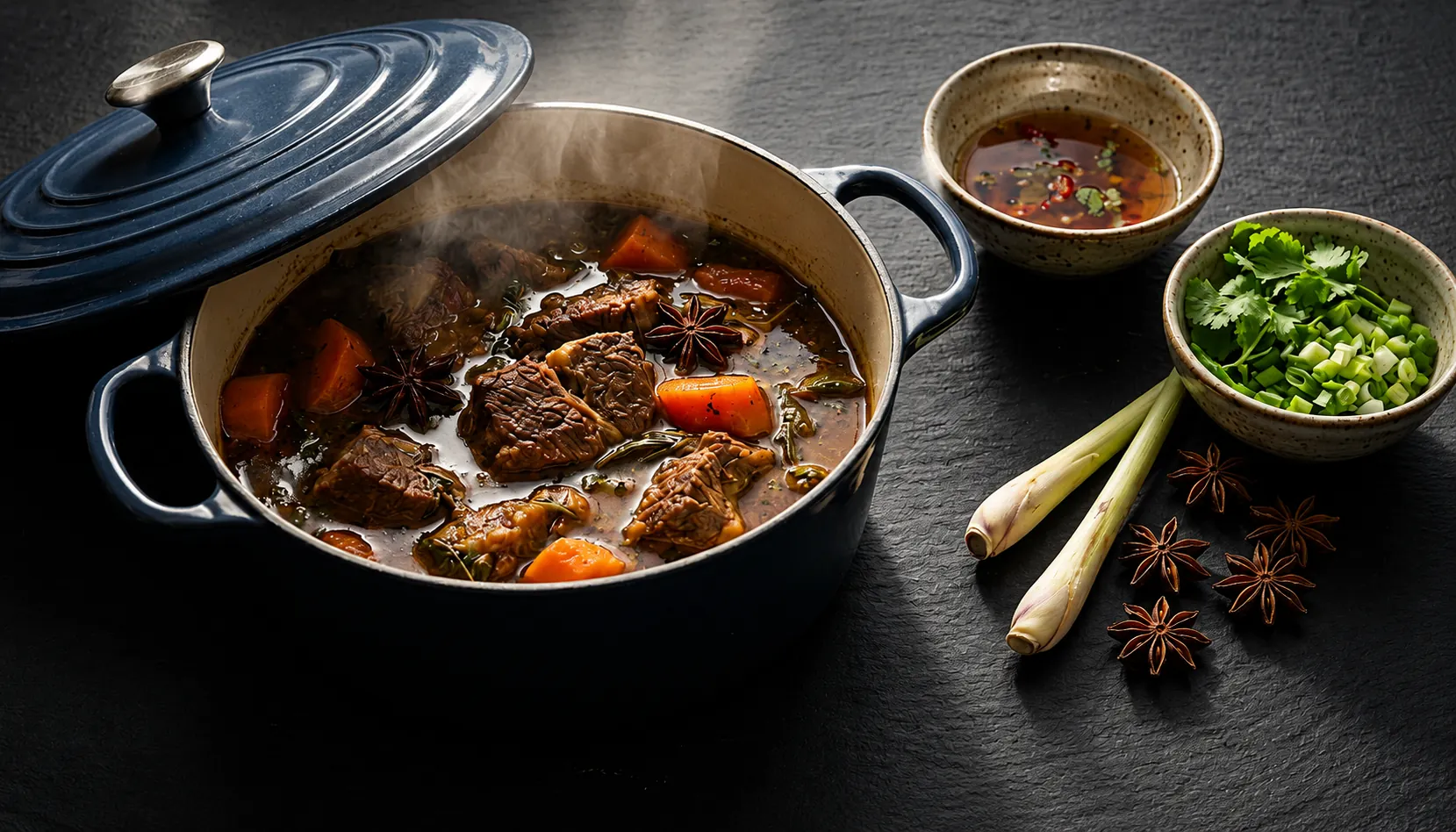
BEST LARGE POT OR DUTCH OVEN FOR BÁNH MÌ
A large pot or Dutch oven is not the first tool most people think about when building a bánh mì kitchen. It is not involved in the bread, the spreads, or the pickles. It is the tool that makes the braise-based fillings possible.
Bánh mì bò kho and bánh mì thịt kho are two of the most complex fillings in the archive. Both require long, slow cooking in a sealed, heavy vessel that holds heat evenly and does not react with the acidic ingredients in Vietnamese braises. Fish sauce, lemongrass, and tomato paste all interact with uncoated metal over long cook times. The wrong pot changes the flavor of the braise before it ever reaches the bread.
This page covers the three best Dutch ovens for bánh mì at every price point, why enamel coating matters more than most home cooks expect, and exactly what to look for when buying.
[ WHY THE DUTCH OVEN MATTERS FOR BÁNH MÌ SPECIFICALLY ]
Vietnamese braises are built on long cook times and layered aromatics. Bánh mì bò kho uses star anise, lemongrass, fish sauce, and tomato paste simmered together for two hours or more. That combination of acidic and fermented ingredients needs a vessel that will not interfere with the flavor development.
Bare cast iron reacts with acidic ingredients over long contact periods. The iron leaches into the braise and produces a metallic taste that dulls the aromatics. An enameled interior eliminates this entirely. The enamel creates a non-reactive surface that lets the fish sauce, lemongrass, and spices develop without interference.
Heat retention is the second requirement. A Dutch oven holds heat the way a heavy stone floor holds the warmth of the sun. The energy absorbs slowly and releases slowly. Once the braise reaches temperature, the pot maintains it with minimal adjustment. Thin stainless or aluminum pots cycle between hot and cool as the burner fires, which produces uneven cooking and tough protein. A heavy enameled Dutch oven keeps the braise at a steady simmer for the full cook time.
Capacity matters for bánh mì specifically because both bò kho and thịt kho are made in batches large enough to fill multiple sandwiches. A 6-quart pot handles a full batch without crowding the meat, which matters because crowded protein braises unevenly. Each piece needs enough liquid contact and enough space to cook through at the same rate.
[ THE RECOMMENDATION ]
The Lodge Essential Enamel 6-Quart Dutch Oven is the correct pot for this job. The enameled interior is non-reactive and handles fish sauce, citrus, and fermented ingredients without any flavor interference. The 6-quart capacity holds a full batch of bò kho or thịt kho without crowding. The lid fits tightly enough to trap steam and maintain the moisture level the braise needs over a two-hour cook.
The cast iron base distributes heat evenly across the bottom and up the sides, which means the braise cooks at the same rate throughout rather than scorching at the center while the edges lag behind. It moves from stovetop to oven without issue, which matters for recipes that start with a sear and finish with a low oven braise.
It is the pot that does exactly what Vietnamese braised fillings require at a price point that makes it the right choice for most home kitchens.
[ THE THREE OPTIONS ]
[ BEST OVERALL ] Lodge Essential Enamel 6-Quart Dutch Oven — around $90. The recommendation above. Enameled interior, 6-quart capacity, tight-fitting lid, stovetop to oven. The correct pot for anyone making Vietnamese braises regularly.
[ ALTERNATIVE ] Le Creuset 6.5-Quart Signature Deep Round Oven — around $290. Le Creuset is the standard against which all enameled cast iron is measured. The interior enamel is smoother and more resistant to staining than the Lodge, which matters after years of fish sauce and spice-heavy braises. The tighter lid seal retains more moisture over long cook times. The honest weakness is price: around $290 is a significant investment, and for occasional braises the Lodge performs the same job.
[ BUDGET ] Amazon Basics 6-Quart Enameled Cast Iron Dutch Oven — around $50. A fully enameled cast iron Dutch oven at an entry-level price. The honest weakness is enamel durability: the coating is thinner than either option above and shows wear faster with regular high-heat use. For someone starting out who wants a non-reactive pot for occasional braises, it is the honest entry point.
[ THE SCIENCE ]
Enamel coating is glass fused to cast iron at extremely high temperatures. The glass layer creates a surface that does not react chemically with acidic ingredients the way bare metal does. When fish sauce or lemongrass sits in contact with bare cast iron for two hours, the acid draws iron ions out of the metal and into the liquid. That is what produces the metallic taste that experienced cooks notice in braises made in the wrong pot. The enamel puts a chemically inert barrier between the metal and the food so the only flavors in the braise are the ones you put there.
[ THE FAQ ]
Can I use a regular stockpot instead of a Dutch oven for bánh mì braises? A stockpot has thinner walls and a less secure lid seal, which means it loses heat faster and allows more moisture to escape during the braise. The result is a thinner sauce that reduces too quickly and protein that dries out before it reaches the right texture. A Dutch oven is the correct tool for this specific application.
What size Dutch oven do I need for bánh mì? A 6 to 7-quart pot is the correct size for Vietnamese braise-based bánh mì fillings. Both bò kho and thịt kho are made in batches that fill six to eight sandwiches. A smaller pot crowds the meat and produces uneven cooking. A larger pot requires more liquid to cover the ingredients, which dilutes the braise.
Can I use my Dutch oven for other bánh mì recipes? Yes. A Dutch oven works for any recipe that requires long moist heat, including stocks, sauces, and braised vegetables. For the bánh mì kitchen specifically it is most essential for bò kho and thịt kho.
Does the color of the enamel matter? The exterior color is cosmetic. The interior color matters slightly. A light interior makes it easier to monitor the color of the fond developing on the bottom of the pot, which helps prevent burning. All three options on this list have light-colored interiors.
Can I use a Dutch oven on an induction cooktop? Yes. Cast iron is induction compatible. All three options on this list work on gas, electric, and induction stovetops and in the oven.
[ WHAT TO READ NEXT ]
The Bánh Mì Bò Kho recipe is the primary recipe this pot was built for. It is the Vietnamese beef stew that requires two hours of steady braising to reach the right texture and depth.
For the pork braise that uses the same vessel and the same technique, see the Bánh Mì Thịt Kho recipe, where the braise logic is identical but the flavor profile is completely different.
For the complete breakdown of every tool a serious bánh mì kitchen requires, see The Equipment page.
The How to Make Bánh Mì guide covers the full sandwich assembly where the braised filling this pot produces takes its place alongside the other components.