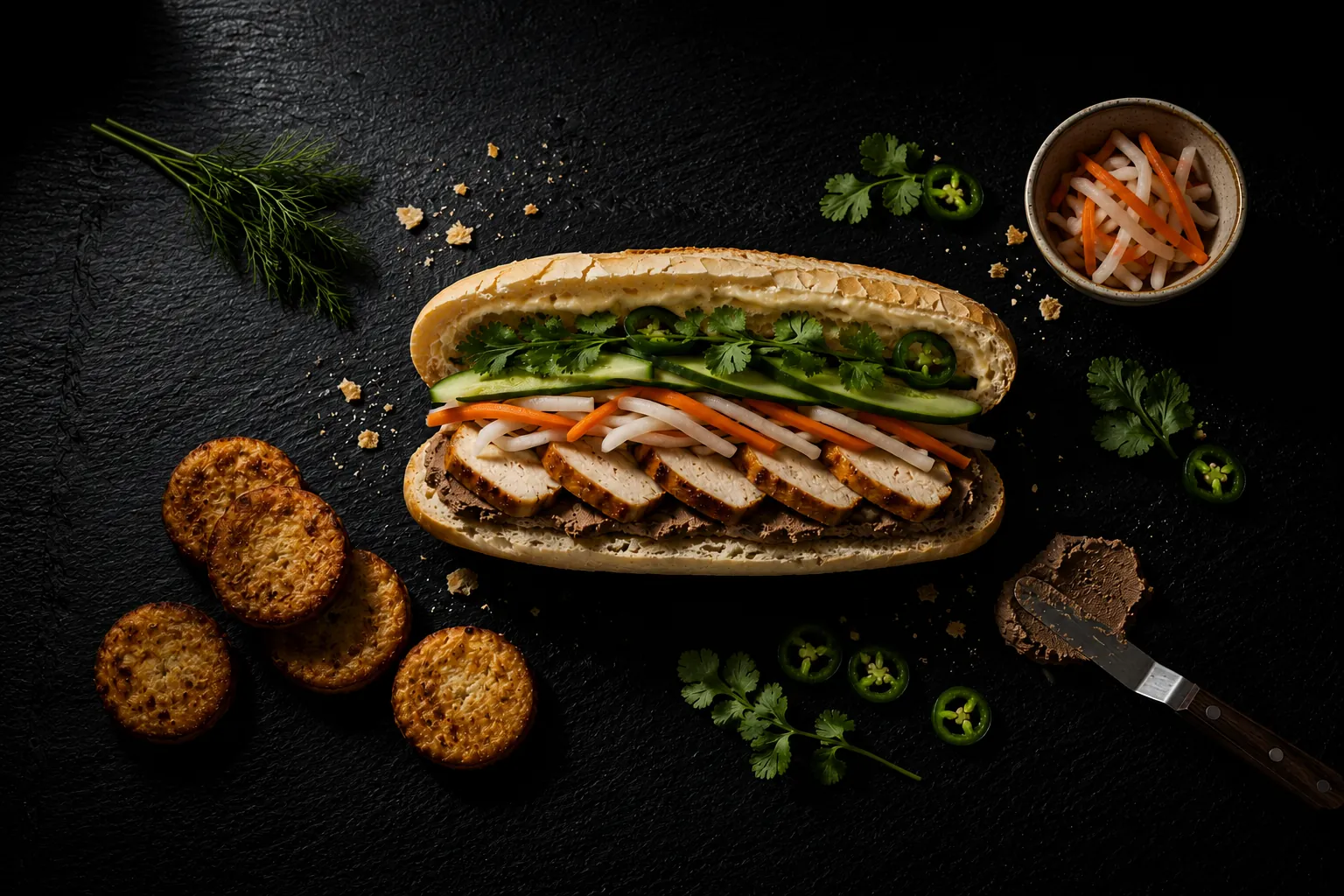
bánh mì chả cá (Vietnamese fish cake bánh mì) with golden fried fish cake, đồ chua, cucumber, cilantro, and jalapeño on dark slate

BÁNH MÌ CHẢ CÁ (FISH CAKE BÁNH MÌ)

Bánh mì chả cá is the fish cake version. White fish fillet is blended into a smooth paste with fish sauce, garlic, pepper, and dill, then formed into patties and pan-fried until golden on the outside and bouncy inside. The fish cake is sliced and layered into the sandwich warm.

The build follows the same five-element structure. Pork liver pâté on the bottom half, Vietnamese mayonnaise on the top, the sliced fish cakes layered across, then đồ chua, cucumber, cilantro, and jalapeño. The fish cake brings a clean, delicate savory flavor that is lighter than any of the pork versions in the archive. The pickles carry more weight in this sandwich because the protein does not compete with them.

Use tilapia, basa, or any firm white fish with mild flavor. The fish needs to be semi-frozen before blending. A warm fish paste does not develop the correct elastic texture.

bánh mì chả cá (Vietnamese fish cake bánh mì) with golden fried fish cake, đồ chua, cucumber, cilantro, and jalapeño on dark slate
L. Nguyen

Bánh Mì Chả Cá (Fish Cake Bánh Mì)

White fish blended into a smooth paste with fish sauce, garlic, pepper, and dill, formed into patties and pan-fried until golden and bouncy, then sliced and layered on a Glass Crust baguette with pâté, Vietnamese mayonnaise, đồ chua, cucumber, cilantro, and jalapeño. [ INTERMEDIATE ]
Prep Time 20 minutes
Cook Time 15 minutes
Freezing Time 1 hour
Total Time 1 hour 35 minutes
Servings: 4 bánh mì
Course: Sandwich
Cuisine: Vietnamese

Ingredients
  

The Fish Cake
  • 500 g white fish fillet, tilapia, basa, or mackerel
  • 2 tbsp fish sauce
  • 2 garlic cloves, finely minced
  • 1 tsp white pepper
  • 1 tsp sugar
  • 2 tbsp fresh dill, finely chopped
  • 2 tbsp neutral oil, for frying
The Assembly
  • 4 Vietnamese bánh mì baguettes (Glass Crust standard)
  • 60 g pork liver pâté
  • 60 g Vietnamese mayonnaise
  • 240 g đồ chua (pickled daikon and carrot), drained
  • 1 Persian cucumber, thinly sliced lengthwise
  • 1 bunch fresh cilantro, stems trimmed
  • 2 jalapeños, thinly sliced
  • Maggi Seasoning Sauce, for finishing

Equipment

  • Food processor
  • Cast iron skillet
  • Bread knife
  • Pâté Spreader / Offset Spatula
  • Kitchen scale

Method
 

Make the Fish Cake
  1. Cut the fish fillet into small chunks and place on a plate. Freeze for 1 hour until semi-frozen. The fish should be firm and cold but not solid. Semi-frozen fish blends into a smooth, elastic paste. Warm fish breaks down into a grainy texture that does not hold together in the pan.
  2. Place the semi-frozen fish in a food processor. Blend until a smooth paste forms, stopping every 2 minutes to scrape down the sides and check the temperature. The paste should be smooth, sticky, and cold throughout. If the paste feels warm, refrigerate for 10 minutes before continuing.
  3. Add fish sauce, garlic, white pepper, sugar, and dill. Pulse until fully combined. Do not over-process at this stage. The dill should be distributed through the paste but not completely pulverized.
  4. Divide the paste into 12 equal portions of approximately 40g each. Shape each portion into a flat round patty approximately 1.5cm thick. Wet your hands before shaping. The paste is sticky and wet hands prevent it from sticking to your palms.
Fry the Fish Cake
  1. Heat neutral oil in a cast iron skillet over medium heat. The oil should be hot but not smoking. Fish cake paste contains no fat to protect it from a very high heat surface. Medium heat produces a golden crust without burning the outside before the inside sets.
  2. Place the patties in a single layer. Do not crowd them. Cook for 4 to 5 minutes without moving until the underside is deep golden. Flip and cook for a further 3 to 4 minutes. The patties should be golden on both sides, firm to the touch, and bounce back when pressed lightly. The interior should be fully set with no translucent areas.
  3. Remove from heat and rest for 5 minutes. Slice each patty into 3 to 4 pieces on the bias.
Assemble
  1. Split each baguette lengthwise, cutting three-quarters of the way through. Do not cut completely. The hinge holds the sandwich together.
  2. Spread the pâté across the bottom half of each baguette. Cover the full surface. The pâté provides the savory depth that the delicate fish cake needs beneath it.
  3. Spread the Vietnamese mayonnaise across the top half of each baguette.
  4. Layer the sliced fish cake across the pâté. Arrange the pieces to cover the full length of the bread.
  5. Add the đồ chua directly on top of the fish cake. Drain it thoroughly. The acidity cuts through the richness of the pâté and lifts the clean flavor of the fish.
  6. Add cucumber strips along the length of the sandwich.
  7. Add a small bundle of cilantro. Do not chop it. Whole sprigs only.
  8. Lay jalapeño slices across the top. Three drops of Maggi Seasoning Sauce along the length. No more. Close the sandwich, press down firmly with your palm, and serve immediately.

Notes

On the fish: Tilapia is the most accessible option outside Vietnam and produces a clean, neutral flavor that lets the fish sauce and dill come through. Basa works equally well. Mackerel produces a stronger, oilier result that some prefer. Any firm white fish with mild flavor works. Avoid salmon and oily fish. The fat content is too high and the paste does not develop the correct elastic texture.
On the semi-freezing step: This is not optional. The fish paste needs to stay cold throughout blending to develop the elastic protein network that gives chả cá its characteristic bounce. Warm fish produces a paste that falls apart in the pan. One hour in the freezer is the minimum. The fish should be firm throughout but not frozen solid.
On the food processor: A strong food processor is essential. A weak machine struggles with semi-frozen fish and overheats the paste. Stop and check the paste temperature every 2 minutes. If it feels warm at any point, refrigerate it before continuing.
On dill: Dill is the traditional herb in Vietnamese fish cake. It provides a clean, slightly anise-forward flavor that works specifically with white fish. Do not substitute with cilantro or any other herb in the paste. Cilantro goes in the assembly, not the fish paste.
On pan temperature: Medium heat is correct for fish cake. High heat burns the outside before the paste sets inside. The patties need enough time in the pan to cook through completely. A patty that is golden outside but translucent inside will fall apart when sliced.
On make-ahead: The uncooked paste can be refrigerated for up to 24 hours. Shape the patties just before frying. Cooked fish cake keeps refrigerated for up to 2 days. Reheat in a hot pan for 2 minutes per side before slicing.

[ THE SCIENCE ]

The bounce in Vietnamese fish cake comes from the same protein network that gives nem nướng its springy texture. When fish is blended cold and thoroughly, the myosin proteins in the muscle fiber uncoil and form a sticky, elastic network throughout the paste. Think of it like this: the blending is knitting the proteins together into a net. When that net hits the heat of the pan, it sets in place and produces the firm, bouncy texture chả cá is known for. Keep the paste cold and blend it long enough and the net forms correctly. Let the paste warm up and the proteins relax before they can set, and the patty falls apart. The cold is doing the structural work before the heat finishes it.

[ THE FAQ ]

What fish works best for bánh mì chả cá? Tilapia and basa are the most accessible options outside Vietnam and both produce a clean, neutral result. Mackerel produces a stronger flavor and oilier texture. Any firm white fish with mild flavor works. Avoid salmon, tuna, and other oily fish. The fat content prevents the paste from developing the correct elastic texture.

Why does the fish need to be semi-frozen? The fish paste needs to stay cold throughout blending to develop the elastic protein network that gives chả cá its bounce. Warm fish breaks down into a grainy paste that falls apart during frying. Semi-frozen fish blends cleanly and stays cold enough throughout the process to set correctly.

Can I steam the fish cakes instead of frying them? Yes. Steamed fish cakes have a softer, more delicate texture than fried. They are less golden and produce less contrast with the bread. Frying is the correct method for bánh mì because the golden crust holds up inside the sandwich. Steamed patties soften quickly once assembled.

Can I use store-bought fish cake? Yes. Vietnamese fish cake is available at most Asian grocery stores in the refrigerated or frozen section. Slice it and pan-fry for 2 minutes per side to warm through and develop a light crust before assembling. The flavor will be less fresh than homemade but the result is correct.

Why is my fish cake falling apart in the pan? Three possible causes. The fish was not cold enough when blended and the paste warmed up before frying. The paste was not blended long enough to develop the protein network. Or the pan temperature was too high and the outside burned before the inside set. Start over with cold fish, blend longer, and reduce the heat.

[ THE EQUIPMENT ]

A food processor blends the semi-frozen fish into a smooth paste. A cast iron skillet produces an even golden crust across the full surface of each patty. A bread knife splits the baguette without crushing the Glass Crust. An offset spatula spreads the pâté and mayonnaise in a controlled, even layer.

The full equipment list with specific recommendations is on the Equipment page.

[ WHAT TO READ NEXT ]

Bánh mì nem nướng is the other ground protein sandwich in the archive. Where chả cá blends fish into a paste and fries it, nem nướng does the same with ground pork. The technique is identical. The flavor is completely different. Both depend on the same cold blending method to develop the correct bouncy texture.

Bánh mì chay is the vegetarian version in the archive. Where this recipe uses fish as the protein, chay uses lemongrass and soy marinated tofu. Both are lighter than the pork versions. Both let the pickles carry more weight in the flavor balance.

Bánh mì tôm is the other seafood sandwich in the archive. Where chả cá grinds white fish into a paste and fries it into patties, tôm uses whole shrimp marinated in lemongrass and sautéed until caramelized. Same seafood category, completely different preparation and texture.

Bánh mì cá mòi is the canned sardine version. Where chả cá makes the fish from scratch by processing fresh white fish into patties, cá mòi opens a tin and warms the sardines in their own tomato sauce. Both are seafood. The effort and the flavor logic are completely different.