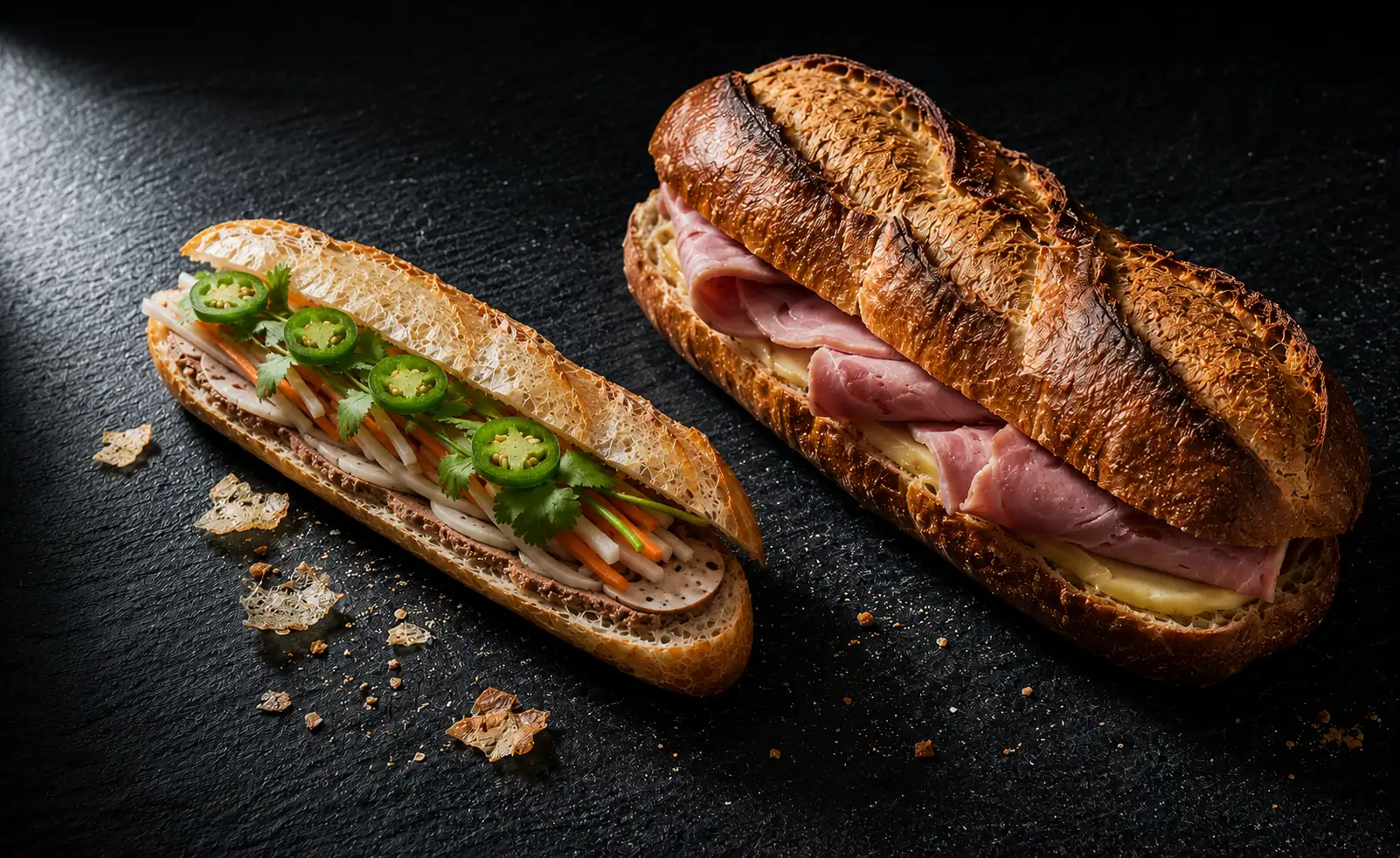
BÁNH MÌ VS FRENCH BAGUETTE SANDWICH
One inspired the other. They are not the same sandwich.
The French brought the baguette to Vietnam in the 19th century. Vietnamese bakers learned to make it, then took it apart and rebuilt it with different flour, different proportions, and a different purpose entirely. By the time the bánh mì became a street food staple in Sài Gòn, it had almost nothing in common with the sandwich that inspired it. Except the shape.
Here is exactly how they differ.
[ THE BREAD ]
Pick up a French baguette. Feel the weight. That thick, chewy crust is intentional. It is designed for resistance. To be torn apart at the table, eaten with butter and cheese, paired with something to drink. The chew is the point. The density is a feature.
Now pick up a Vietnamese bánh mì baguette. It is lighter. Noticeably lighter. The crust is thin, almost translucent at the edges. Press it gently and it cracks. Bite it and it shatters.
That difference comes down to one ingredient: rice flour. Vietnamese bakers reduced the wheat and added rice flour to the dough. Rice flour has no gluten. No gluten means no chew. The crust forms fast in the oven, sets thin, and breaks cleanly when you bite it.
Why does that matter? A thick chewy crust fights back. It competes with every filling inside the sandwich. A shattering crust yields. Every ingredient reaches your palate in sequence, cleanly, without the bread getting in the way.
The size matters too. A French baguette is a communal object. Two feet long, meant for a table. A Vietnamese bánh mì is personal. Sized for one person, one meal, eaten standing up at a street cart or walking to work.
Same ancestor. Built for completely different lives.
[ THE FILLINGS ]
The classic French baguette sandwich (jambon-beurre) has three ingredients. Ham, butter, and sometimes Dijon mustard. That is it. The logic is restraint. One protein, one fat, one condiment. The bread is the main event. Everything else is there to complement it.
The bánh mì inverts that logic entirely. The bread is the vessel. The fillings are the event.
A classic bánh mì has five distinct layers, each doing a specific job.
The fat barrier comes first. Vietnamese mayonnaise goes on both inner surfaces of the bread. Pâté goes on the bottom half only, on top of the Vietnamese mayonnaise. Two layers of fat between the bread and everything else. Without them, the brine from the pickles soaks into the bread within minutes and the whole sandwich falls apart.
The protein goes on top of the pâté. Chả lụa, thịt nguội, grilled chicken. Whatever the filling, it sits in the middle of the architecture, not on top of it.
The acid comes next. Đồ Chua goes on top of the protein. The brine ratio is specific: one part rice vinegar, one part water, sugar at 25% of the total liquid weight. That ratio produces a pickle sharp enough to cut through the fat without taking over.
The herb layer follows. Whole cilantro sprigs, never chopped. Laid flat across the length of the sandwich. Chopping cilantro releases the oils too fast. Whole sprigs release slowly, bite by bite.
Jalapeño goes on last. Three to four slices. It sits at the top where it hits the palate first. It does not compete with the other flavors. It finishes them.
A jambon-beurre has no such architecture because it does not need one. It is not trying to achieve balance across five layers. It is trying to achieve something perfect with three ingredients. Both approaches are correct. They are solving different problems.
[ THE FAT ]
Both sandwiches use fat. The difference is in what the fat is asked to do.
Butter in a French baguette sandwich is flavor. It is spread directly on the cut surfaces, adds richness, and sits alongside the ham as a co-star. In a good jambon-beurre, the butter is as important as the meat.
Vietnamese mayonnaise in a bánh mì is infrastructure. It is an emulsion. Fat and egg yolk beaten into a stable barrier that water cannot easily penetrate. It does not dominate the sandwich. It protects it. The pickles sit on the pâté. The pâté sits on the Vietnamese mayonnaise. The Vietnamese mayonnaise sits on the bread. The brine never reaches the crust directly.
That sequence is why a bánh mì stays structurally sound for up to thirty minutes after assembly. Street cart vendors in Sài Gòn figured this out decades ago. They were making hundreds of sandwiches a day, wrapping them immediately, handing them to people who might walk for twenty minutes before eating. The fat barrier was not a recipe choice. It was a practical solution to a real problem.
A buttered baguette sandwich goes soft in five minutes if the fillings are wet. The bánh mì was engineered to hold.
[ THE HISTORY ]
The French baguette sandwich arrived in Vietnam in the second half of the 19th century as colonial food. Eaten in cafés built for French administrators, soldiers, and settlers. The Vietnamese did not eat it at first. Bread was expensive. It required imported wheat. It was foreign food, served in foreign spaces, for people who were not planning to stay.
But bread requires bakers. The French needed local labor to produce it. Vietnamese bakers learned the craft in French kitchens. The fermentation, the shaping, the scoring, the steam. They learned it as employees.
What they did with that knowledge after the 1954 partition of Vietnam is the actual story.
Vietnamese bakers in Hà Nội and Sài Gòn did not try to preserve the French sandwich. They took the bread and rebuilt everything inside it. Cold cuts replaced ham. Pickled daikon and carrot replaced cornichons. Cilantro replaced dried herbs. Vietnamese mayonnaise replaced butter. Jalapeño added heat that French baking had never considered.
The baguette became a vessel. What went inside it had nothing to do with France.
This was not fusion. Fusion implies a meeting of equals, two cuisines blending together. What happened here was a takeover. Vietnamese cooks took a French object and made it unrecognizable to the people who introduced it. The result was not a Franco-Vietnamese sandwich. It was a Vietnamese sandwich that happened to use French bread as its starting point.
[ THE VERDICT ]
The French baguette sandwich is one of the great simple foods. Three ingredients, centuries of refinement, nothing wasted. There is a reason the jambon-beurre has not changed in over a hundred years. It does not need to.
The bánh mì took that simplicity and built a five-layer architecture on top of it. More complex, more precise, and significantly more demanding to make correctly. Get one layer wrong and the whole sandwich suffers. Get all five right and nothing else compares.
They share an ancestor. They are not the same sandwich. They were never trying to be.
[ FREQUENTLY ASKED QUESTIONS ]
Is bánh mì based on the French baguette? Yes, but only in the sense that the bread shares an origin. The Vietnamese baguette uses rice flour in addition to wheat flour, which produces a thinner, crispier crust that shatters when you bite it. The French baguette has a thick, chewy crust designed for tearing. The fillings have nothing in common. The bánh mì took the French bread format and rebuilt everything about it.
What is the difference between Vietnamese mayonnaise and butter in a baguette sandwich? Butter in a French baguette sandwich is a flavor component. Vietnamese mayonnaise in a bánh mì is structural. It forms a fat barrier on both inner surfaces of the bread that prevents the pickle brine from soaking into the crust. The sandwich stays intact for up to thirty minutes after assembly because of that barrier.
Why does a bánh mì stay fresh longer than a French baguette sandwich? The fat barrier absorbs moisture from the pickled vegetables before it can reach the bread. Street cart vendors in Sài Gòn developed this technique to handle high volume service. It was a practical solution, not a culinary one.
Can you make a bánh mì on a French baguette? Technically yes, but the result is a different sandwich. The thick crust of a French baguette will compete with the fillings and the balance that defines a bánh mì depends on a crust that shatters, not one that resists. The Vietnamese baguette is not interchangeable with its French counterpart.
[ WHAT TO READ NEXT ]
The bánh mì did not become what it is by accident. It took a specific bread, rebuilt over decades by Vietnamese bakers who understood exactly what they were trying to achieve. The Evolution traces that history from the first French bakeries in colonial Saigon to the street carts that changed everything.
The bread itself is the place to start if you want to make this sandwich correctly at home. The Glass Crust Bánh Mì Baguette recipe covers the rice flour ratio, the hydration, and the baking technique that produces the shattering crust the sandwich depends on.
And if you want to understand why every layer inside the sandwich is placed in a specific order, The Anatomy breaks down the logic behind each one.