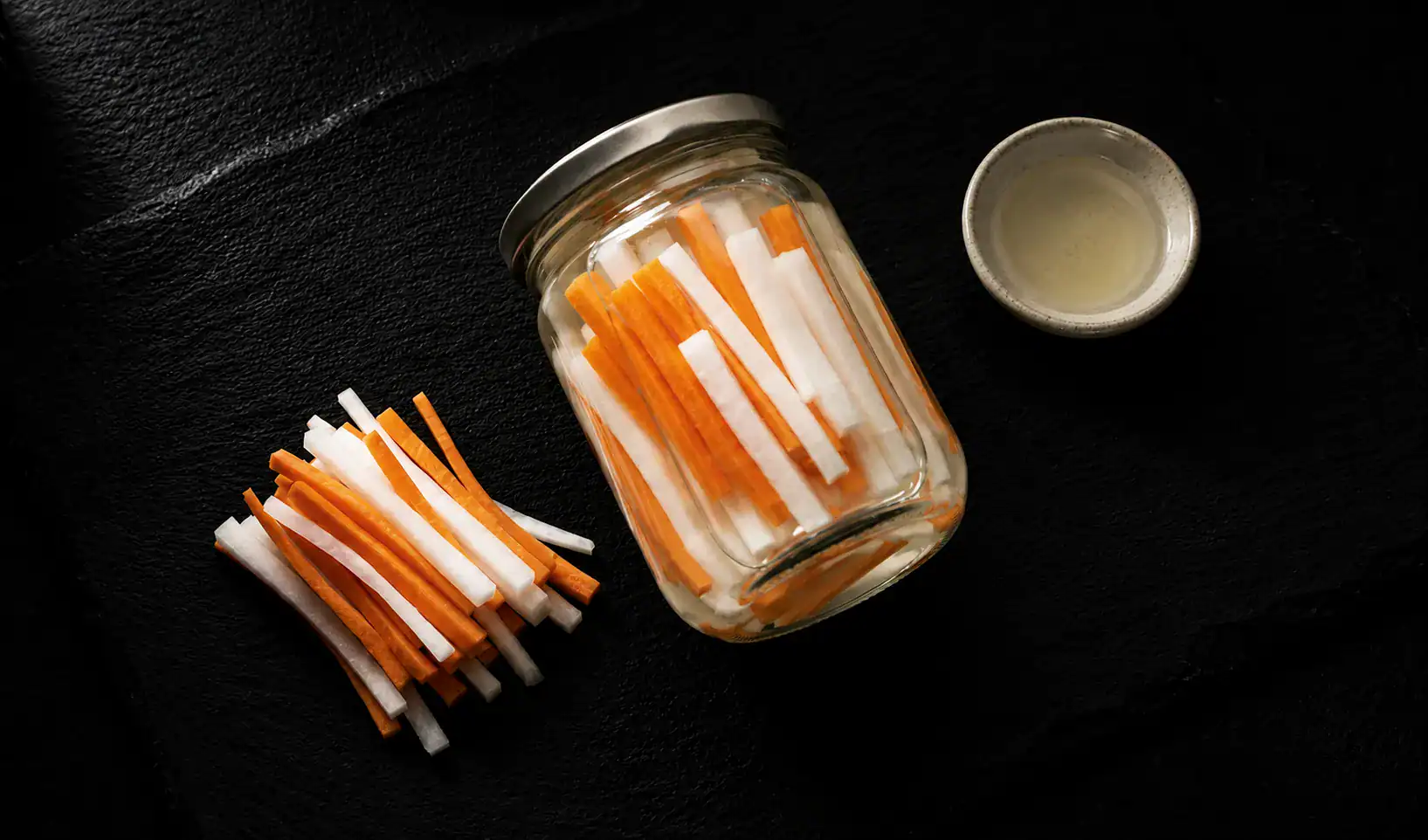
Vietnamese pickled daikon and carrot in a glass jar with rice vinegar on dark slate

ĐỒ CHUA: VIETNAMESE PICKLED DAIKON AND CARROT

Pickled daikon and carrot, known in Vietnamese as đồ chua, is the bánh mì pickle that makes the sandwich work. The pâté is rich. The cold cuts are dense. The Vietnamese mayonnaise adds another layer of fat. Without something sharp cutting through all of that, the sandwich becomes too heavy to eat past the first two bites.

The brine is a 1:1 ratio of rice vinegar to water with 25% sugar by weight. That ratio is not a suggestion. Too much vinegar and the pickles overpower the cold cuts. Too little and they taste flat. The sugar softens the acid without removing it. The result is a do chua pickle that is sharp enough to do its job without taking over the sandwich.

This recipe makes enough for eight to ten bánh mì. The pickles keep for two weeks refrigerated. Make them at least two hours before you need them. Make them the day before if you can.

L. Nguyen

Đồ Chua: Vietnamese Pickled Daikon and Carrot

The acid component every bánh mì depends on. A 1:1 brine of rice vinegar and water with 25% sugar. Sharp enough to cut through the fat without overpowering the sandwich. [ BEGINNER ]
Prep Time 15 minutes
Pickle Time 2 hours
Total Time 2 hours 15 minutes
Servings: 10 bánh mì
Course: Condiment
Cuisine: Vietnamese

Ingredients
  

The Vegetables
  • 200 g daikon radish, julienned 3mm wide
  • 200 g carrot, julienned 3mm wide
  • 1 tsp fine salt
  • 1 tsp sugar
The Brine
  • 240 ml unseasoned rice vinegar
  • 240 ml water
  • 60 g sugar
  • 8 g fine salt

Equipment

  • Mandoline slicer
  • Kitchen scale
  • Small saucepan
  • Clean jar or airtight container

Method
 

Prepare the Vegetables
  1. Peel the daikon and carrots. Cut them into matchsticks 3mm wide and 6 to 7cm long. Consistent size matters. Pieces cut at different widths pickle at different rates. Some will be sharp and fully pickled while others are still raw. A mandoline produces more consistent results. A sharp knife works but requires more time and attention to keep the width even.
  2. Place the julienned daikon and carrot in a bowl. Add 1 tsp salt and 1 tsp sugar. Toss to combine. Let sit for 10 minutes. The salt draws moisture out of the vegetables. You will see liquid pooling at the bottom of the bowl.
  3. After 10 minutes squeeze the vegetables firmly with your hands over the sink. Remove as much liquid as you can. Then rinse them under cold water and squeeze again. Dry them with a clean kitchen towel.
  4. This step is not optional. Removing the moisture first means the brine penetrates the vegetables faster and more evenly. Skip it and the pickles will take twice as long and taste diluted.
Make the Brine
  1. Combine the rice vinegar, water, sugar, and salt in a small saucepan over medium heat. Stir until the sugar and salt dissolve completely. This takes 2 to 3 minutes. Do not boil. Remove from heat and let cool to room temperature, about 15 minutes.
  2. Do not pour hot brine over the vegetables. Hot liquid cooks them slightly and produces a soft, limp pickle instead of a crisp one.
Pickle
  1. Pack the squeezed vegetables into a clean jar or container. Pour the cooled brine over them. Press the vegetables down so they are fully submerged. If they are not fully submerged add water in small increments until they are covered.
  2. Seal the container and refrigerate for a minimum of 2 hours. The pickles are ready when they taste sharp and clean with a slight crunch still present. Overnight is better. The flavour deepens and the texture settles into exactly what the sandwich needs.

Notes

The 1:1 brine ratio is not flexible. Too much vinegar and the pickles overpower the cold cuts. Too little and they taste flat. Measure by weight, not volume, for a consistent result every time.
These keep for two weeks refrigerated in a sealed container. After two weeks the vegetables begin to soften and the brine becomes overly sharp. Make a fresh batch.
Rice vinegar is the correct acid for this recipe. White wine vinegar is an acceptable substitute. Apple cider vinegar has too strong a flavour of its own. Distilled white vinegar is too harsh. If rice vinegar is unavailable white wine vinegar is the closest substitute.
The salt and sugar pre-treatment is not optional. Skipping it produces a diluted, slower pickle that never develops the same crispness or depth.
These pickles are used in every bánh mì recipe on this site. Make a full batch and keep them in the refrigerator. They are ready whenever you need them.

[ THE SCIENCE ]

The 1:1 ratio of rice vinegar to water is the foundation. Pure rice vinegar at full strength would produce pickles too sharp to eat alongside pâté and cold cuts. The water dilutes the acid to a level that cuts through fat without overwhelming the other fillings. The 25% sugar by weight softens the acidity further while adding a subtle sweetness that balances the jalapeño heat later in the sandwich.

The salt and sugar pre-treatment does two things. First it draws excess moisture out of the vegetables. You will see liquid pooling in the bowl within minutes. Less moisture in the vegetable means the brine gets in faster and the pickle develops more evenly.

Rice vinegar is the correct acid for this recipe. White wine vinegar is an acceptable substitute. Apple cider vinegar has too strong a flavour of its own and will be detectable in the finished pickle. Distilled white vinegar is too harsh. Rice vinegar is mild, clean, and does not compete with the other ingredients.

This is the brine that has been used on Vietnamese street carts for decades. The ratio has not changed because it does not need to. Đồ chua works.

[ THE FAQ ]

Q: How long do these keep? Five days refrigerated in a sealed container. After two weeks the vegetables begin to soften and the brine becomes overly sharp. Make a fresh batch. The 15 minutes of active work is worth it.

Q: Can I use a different vinegar? Rice vinegar is the correct choice. White wine vinegar works as a substitute. Apple cider vinegar has too assertive a flavour. Distilled white vinegar is too harsh and produces a one-dimensional pickle. If rice vinegar is unavailable white wine vinegar is the closest substitute.

Q: Do I have to do the salt and sugar pre-treatment? Yes. It is not an optional step. Skipping it produces a diluted, slower pickle that never develops the same crispness or depth. The 10 minutes it takes is part of the recipe.

Q: My pickles taste too sharp. What went wrong? The brine ratio is correct at 1:1 vinegar to water. If the pickles taste too sharp the most likely cause is the vegetables were not rinsed thoroughly after the salt treatment. Residual salt adds to the perceived sharpness. Always rinse and squeeze firmly after the salt step. If you measured the vinegar by volume rather than weight the ratio may also be slightly off. Use a scale.

Q: Can I make these ahead of time? Yes. They keep for two weeks. Making them the day before you need them produces a better result than making them two hours before. The flavour develops over time.

Q: What is the correct cut width? 3mm julienne. Thinner than that and the pickles go soft too quickly. Thicker and they do not pickle evenly and are too crunchy in the sandwich. 3mm is the width used on every street cart in Vietnam. It is correct.

[ THE EQUIPMENT ]

A mandoline slicer produces the consistent 3mm julienne this recipe requires.

A sharp knife works but takes more time and produces less consistent results.

A kitchen scale ensures the brine ratio is exact. Volume measurements are not precise enough for a recipe where the ratio matters this much.

The full equipment list with specific recommendations is on the Equipment page.

[ WHAT TO READ NEXT ]

The Vietnamese mayonnaise recipe is the other component that goes on every bánh mì on this site. Make both and the sandwich assembles in minutes.

The Classic Bánh Mì Thịt Nguội is the first recipe that uses these pickles. The brine ratio in that recipe was built around this exact formula.

The Glass Crust Bánh Mì Baguette is the bread that holds everything together.