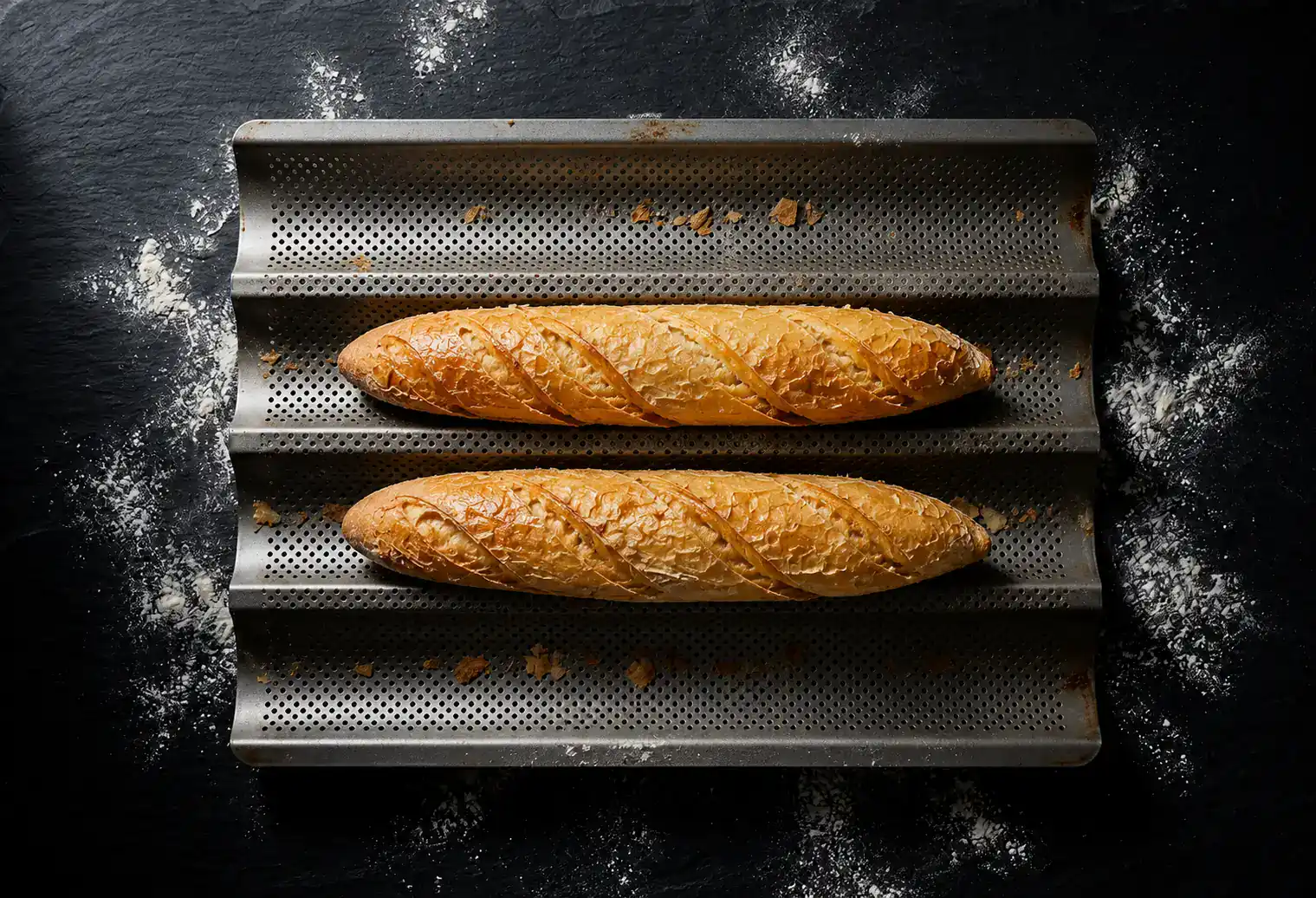
BEST BAGUETTE PAN FOR BÁNH MÌ
A bánh mì baguette is not a freeform loaf. It is a shaped dough that needs to hold its form during the final rise and the first minutes of baking. Without a pan, the dough spreads flat under its own weight. The crumb opens unevenly. The crust forms on a loaf that is too wide, too flat, and structurally wrong before it ever reaches the cutting board.
The fix is a demi-baguette pan with a perforated base. The channels hold the dough in shape through the final proof and into the oven. The perforations allow heat and airflow to reach the underside of the loaf, which prevents the pale, soft bottom crust that kills the Glass Crust on contact.
This page covers what to look for in a baguette pan for bánh mì, why channel width matters more than most buyers realize, and three options at every price point.
[ WHY IT MATTERS FOR BÁNH MÌ SPECIFICALLY ]
A standard French baguette is baked directly on a deck or stone. It holds its shape because the dough is firmer and the loaf is longer. A Vietnamese bánh mì baguette is shorter, lighter, and higher in hydration than most home bakers expect. That softer dough spreads without support. The result is a loaf that is wider than it is tall, with a crust that forms on the wrong geometry and a sandwich that falls apart when you cut it.
Channel width is the most overlooked spec when buying a baguette pan. A standard baguette pan is designed for a 400 to 500 gram French loaf. A demi-baguette pan for bánh mì holds a 150 to 200 gram portion in a narrower channel. Put a bánh mì dough in a full-size channel and it spreads to fill the space. The crust to crumb ratio changes. The sandwich loses its structure. The Chicago Metallic demi-baguette pan is sized correctly for this specific loaf.
The perforated base is not a feature. It is a requirement. A solid pan traps steam underneath the loaf during baking. The bottom crust stays soft and pale while the top colors. Perforations allow heat circulation from below, which means the bottom crust sets at the same rate as the top. For the Glass Crust to form correctly across the entire loaf, airflow underneath matters as much as the baking steel above it.
[ THE RECOMMENDATION ]
The Chicago Metallic Commercial II Demi-Baguette Pan is the correct pan for baking bánh mì at home. The channel width holds a standard bánh mì portion without spreading. The perforated base delivers the airflow the Glass Crust requires. The aluminized steel construction distributes heat evenly without hot spots and sits flat on a baking steel without rocking.
At around $25 it is the most impactful piece of baking equipment on this list relative to its price. The baking steel changes the crust. The baguette pan changes the shape. Both are required and neither works correctly without the other. See the Glass Crust Baguette recipe for the exact dough formula and baking method this pan was built for.
[ THE THREE OPTIONS ]
[ BUDGET ] Chicago Metallic Commercial II Demi-Baguette Pan — around $25 The recommended pick. Perforated base, correct channel width for bánh mì portions, aluminized steel construction that holds its shape through years of weekly baking. Used in commercial bakeries and home kitchens across the United States. Nothing at this price point performs better for this specific application. Buy this one.
[ MID-RANGE ] USA Pan Baguette and Demi-Baguette Pan — around $35 Heavier gauge steel with a non-stick coating that releases dough cleanly without flour or parchment. The corrugated surface improves airflow underneath the loaf and adds structural rigidity. A strong step up for bakers who want easier release and a pan that handles high-frequency baking without warping. The non-stick surface also makes cleanup significantly faster after a long bake session.
[ PREMIUM ] Emile Henry Baguette Baker — around $150 A lidded ceramic baker that creates its own steam environment inside the vessel. The lid traps moisture during the first phase of baking and removes for the final crust set. No separate steam injection needed. One limitation worth knowing: the ceramic construction retains heat differently than steel and the base does not work the same way on a baking steel as a perforated metal pan does. If you bake seriously and want a self-contained system, this is the investment. If the Glass Crust is the priority, the Chicago Metallic and a baking steel is the more reliable combination.
[ THE SCIENCE ]
Dough behaves differently at different hydration levels. A stiff dough holds its shape on a flat surface because the gluten network is tight enough to resist gravity. A wetter dough spreads because water loosens the gluten structure and the dough flows toward the path of least resistance. Vietnamese bánh mì dough sits at a hydration level that requires support during both the final proof and the early stages of baking. The demi-baguette pan provides that support at both stages.
The channel also controls how the loaf expands during oven spring. A loaf in a correctly sized channel can only expand upward. A loaf in an oversized channel expands outward first, which means the scoring opens sideways rather than straight up. The ear that forms along the score line, the thin flap of crust that lifts and browns during baking, only develops correctly when the dough is constrained to expand vertically. Channel width is not just about shape. It is about crust behavior.
The perforated base works with the baking steel rather than against it. The steel delivers heat from below. The perforations allow that heat to pass through the pan and reach the base of the dough directly. A solid pan acts as an insulator between the steel and the dough, reducing the thermal charge the dough receives in the critical first minutes of baking. Perforations preserve the effect of the steel and are what make the pan and steel combination work correctly together.
[ THE FAQ ]
Can I bake bánh mì without a baguette pan? Yes, and freeform baking on parchment produces a usable loaf. The result will be flatter and wider than a correctly shaped bánh mì, with a different crust to crumb ratio. If you are testing the recipe for the first time and do not yet have a pan, bake freeform first. Once you see the difference the pan makes, you will not bake without one again.
Does the pan need to be greased before use? A light dusting of flour before loading the dough is enough for the Chicago Metallic. The flour creates a barrier between the dough and the metal that releases cleanly after baking. Skipping this step on a non-coated pan causes the crust to stick along the base and tear when you lift the loaf. The USA Pan non-stick version releases without any preparation.
How many loaves does a demi-baguette pan hold? Most demi-baguette pans hold two to three loaves side by side. The Chicago Metallic holds two standard bánh mì portions. If you are regularly baking for more than two people, two pans running simultaneously is the most efficient setup.
Will the pan warp on a baking steel? A quality aluminized steel pan like the Chicago Metallic will not warp at standard home baking temperatures. Thin, cheap pans warp because the metal cannot handle the rapid temperature change when it contacts a preheated steel. Every pan on this list is rated for the temperatures required for the Glass Crust bake.
Can I use a baguette pan without a baking steel? Yes. The pan still holds the shape and the perforations still allow airflow. Without the steel the base of the loaf receives less direct heat, which means the bottom crust sets more slowly and the Glass Crust forms less evenly across the full surface. The pan and the steel are designed to work together. Using one without the other produces a partial result.
[ WHAT TO READ NEXT ]
The Glass Crust Baguette recipe covers the flour ratio, hydration level, steam injection method, and scoring technique that produces the correct result when this pan is in place, including the specific bake times that work with a preheated steel underneath.
The baguette pan is one part of a complete baking setup. The Equipment page covers every tool required to bake and serve bánh mì correctly at home, from the baking steel to the bread lame to the offset spatula.
The Best Baking Steel for Bánh Mì covers why the surface underneath the pan matters as much as the pan itself, and what to look for across three options at every price point.