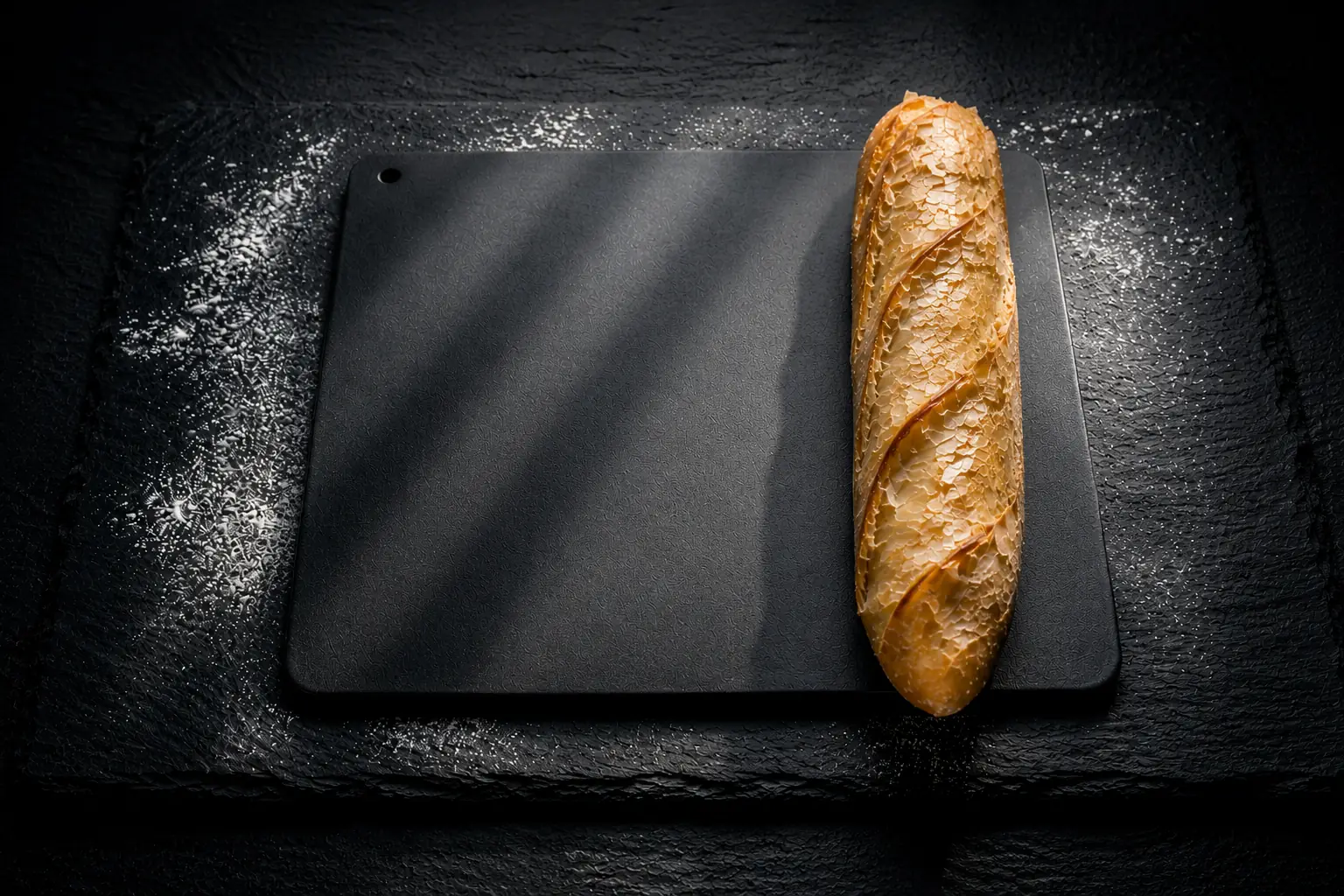
BEST BAKING STEEL FOR BÁNH MÌ
Most home bakers who attempt the Glass Crust fail at the same point. Not the dough. Not the shaping. Not the scoring. They fail because they put the dough into an oven that cannot deliver the one thing the Glass Crust requires: intense, immediate heat from below.
The thin, shattering exterior of an authentic Vietnamese baguette forms in the first four minutes of baking. The base of the dough needs to hit a surface hot enough to drive rapid moisture evaporation the moment it lands. A standard sheet pan reaches oven temperature and stops there. A baking steel stores heat for an hour and releases it all at once the moment cold dough makes contact. That is the difference between a soft crust and a Glass Crust.
If you have tried the Glass Crust Baguette recipe and the crust came out thick or chewy rather than thin and shattering, the baking surface is almost certainly the reason. This page covers how to fix that, what to look for in a baking steel, and three options at every price point.
[ WHY IT MATTERS FOR BÁNH MÌ SPECIFICALLY ]
A Vietnamese baguette behaves differently in the oven than a French one. The crust needs to form fast and set hard before the interior has fully risen. That rapid crust formation is what creates the thin, brittle shell that shatters on the first bite. To get there you need two things working together: steam in the oven for the first few minutes, and intense bottom heat from the moment the dough lands.
A regular sheet pan sits in the oven and reaches oven temperature. That is all it does. A baking steel preheats for 45 to 60 minutes and absorbs far more thermal energy than the air around it. When cold dough lands on a hot steel, the steel releases that stored heat directly into the base of the loaf in seconds. The base sets almost immediately. The steam keeps the top surface flexible long enough for the bread to expand fully. Then the steam vents, the surface dries, and the crust locks into place.
Without adequate bottom heat, the base of the baguette stays soft too long. The crust forms unevenly. The bottom stays pale and dense while the top colors. Every bite is wrong. The Glass Crust requires both surfaces to set at the same rate, and only a high-mass baking surface delivers the bottom heat to make that happen consistently.
[ THE RECOMMENDATION ]
The Brod and Taylor Bread Steel Max is the correct tool for baking bánh mì baguettes at home. At 0.15 inches thick it stores more thermal energy than any comparable steel at this size. It preheats evenly across the full surface, recovers quickly between bakes, and the dimensions fit a standard demi-baguette pan without overhang. The handles are machined directly into the steel rather than attached, which means nothing loosens or fails over years of use.
If there is one piece of equipment that changes your Glass Crust results more than anything else in the kitchen, this is it. Not the flour. Not the technique. The surface the bread bakes on.
[ THE THREE OPTIONS ]
[ BUDGET ] ThermiChef 16×16 Pizza Steel — around $70 Half-inch thick, Made in USA, and one of the best-selling baking steels on Amazon for good reason. The ThermiChef delivers serious bottom heat at a price that makes no argument against buying it. The surface is pre-seasoned and ready to use out of the box. For home bakers who want Glass Crust results without the premium price, this is the correct starting point. Buy this one.
[ MID-RANGE ] Brod and Taylor Bread Steel Max — around $90 The recommended pick. Designed specifically for bread baking rather than pizza, which matters for bánh mì. The 0.15 inch thickness stores more thermal energy than the standard version and the dimensions fit a demi-baguette pan without overhang. Even heat distribution across the full surface and fast recovery between bakes. If you bake regularly and want consistent Glass Crust results every time, this is the investment that delivers it.
[ PREMIUM ] The Original Baking Steel — around $130 Made in USA since 2012 and the steel that put baking steels on the map for serious home bakers. Quarter-inch thick, ultra-conductive, and built to last a lifetime. The surface develops a natural seasoning over time that improves with every bake. If you want the tool that established the category and has hundreds of five-star reviews from bakers who have used it for years, this is it.
[ THE SCIENCE ]
Heat transfer in baking happens three ways: convection through hot air, radiation from the oven walls, and conduction through direct contact with a surface. A standard home oven is good at the first two. It is poor at conduction because air is a weak conductor of heat. The baking steel solves the conduction problem entirely.
Steel has a thermal conductivity roughly 40 times higher than ceramic. When you preheat a steel for an hour at 500 degrees, it stores an enormous amount of thermal energy in its mass. The moment cold dough touches it, that energy transfers directly into the base of the loaf. Think of the difference between touching a metal railing and a wooden railing on a cold day. Both are the same temperature but the metal feels colder because it pulls heat away from your hand faster. The steel does exactly the same thing to your dough, but in reverse.
That rapid heat transfer is what drives the Glass Crust formation. The base of the baguette sets in under 90 seconds. The surface stays flexible due to steam, letting the loaf expand fully before the crust locks. Remove the steam after four minutes and the surface dries fast. The result is a crust that is thin, hard, and brittle rather than thick and chewy.
Baking stones work on the same principle but store and transfer heat less efficiently than steel. A cordierite stone preheated for the same time delivers less thermal energy to the base of the dough. The difference shows up directly in crust thickness and texture. For the Glass Crust specifically, steel is the correct material and the science is not close.
[ THE FAQ ]
Can I use a baking stone instead of a steel? A baking stone produces good results but not the same results. Stone stores less heat and transfers it less efficiently than steel. The base of the baguette sets more slowly, which produces a thicker, less brittle crust. For the Glass Crust, steel is the correct tool.
How long do I need to preheat the steel? 45 minutes minimum at the highest temperature your oven reaches. 60 minutes is better. The steel needs to be fully saturated with heat before the dough goes in. Rushing the preheat is the single most common reason home bakers get inconsistent Glass Crust results.
Does thickness matter? Yes. Thicker steel stores more thermal energy. Half-inch steel delivers a more sustained heat charge than quarter-inch steel. For a single baguette the difference is noticeable. For multiple loaves baked back to back, thicker steel recovers faster and delivers more consistent results across the session.
Will the steel warp in a hot oven? Quality baking steels do not warp at standard home oven temperatures. Every steel on this list is rated above 500 degrees Fahrenheit. Warping is a problem with thin, cheap steel, not with purpose-made baking steels.
Do I need to season a baking steel? Some steels come pre-seasoned. Others require an initial seasoning with flaxseed or vegetable oil before first use. Check the manufacturer instructions. Once seasoned, the steel needs minimal maintenance. Wipe it clean after use and store it dry.
Is a baking steel worth it if I only bake occasionally? Yes. The steel does not degrade between uses. Buy it once and it performs the same way on your tenth bake as it does on your first. If you are going to bake bánh mì at home even a handful of times a year, the steel is the piece of equipment that makes the effort worth it.
[ WHAT TO READ NEXT ]
The steel provides the heat. The bread needs the right structure to take advantage of it. The Glass Crust Baguette recipe covers the flour ratio, hydration level, and shaping technique that produces the correct dough for this baking method, including the steam injection step that works alongside the steel to set the crust correctly.
The baking steel works as part of a system. The Equipment page covers every tool required to bake and assemble bánh mì correctly at home, from the baguette pan to the bread lame to the offset spatula.
Bottom heat is only half the equation. The Best Baguette Pan for Bánh Mì covers how the pan shape and perforation pattern affect airflow around the base of the loaf and why the pan matters as much as the surface underneath it.