BEST MANDOLINE SLICER FOR BÁNH MÌ
The pickled vegetables in a bánh mì are not garnish. Đồ chua (Vietnamese pickled daikon and carrot) is a structural component. It needs to be cut thin enough to soften in the brine within two hours, uniform enough to layer flat inside the bread, and consistent enough that every bite carries the same acidity ratio. A knife cannot do that reliably. A mandoline does it in 90 seconds.
The problem is not the vegetable. It is the cut. Daikon is dense and wet. Carrot is firm and fibrous. Cut them unevenly and the brine penetrates at different rates. Some pieces go soft while others stay raw. The balance the sandwich depends on falls apart before the bread is even sliced.
You need an adjustable mandoline with a fine julienne blade. This page covers the three best options at every price point, why blade angle matters more than most people expect, and exactly what to look for when you are buying.
[ WHY IT MATTERS FOR BÁNH MÌ SPECIFICALLY ]
Most mandolines are designed for potato gratins and cucumber salads. The prep work for đồ chua is a different challenge. You are cutting two vegetables with completely different densities at the same thickness setting, against the clock, for a pickle that requires uniform penetration across every single piece. Inconsistent cuts do not just look wrong. They produce a filling where the acidity is uneven from one bite to the next.
A straight-edge knife fails this job for the same reason it fails on glass crust bread. It applies pressure before it cuts. On a wet, round vegetable that means the blade slides before it bites, and the thickness varies with every stroke. A sharp mandoline set to 1.5mm removes that variable entirely. Every slice is identical. The brine hits each piece at the same moment and the texture after two hours is uniform across the entire batch.
There is a second reason to own a mandoline for bánh mì. The quick-pickled cucumber used in lighter variations requires the same thin, consistent cut. A knife produces uneven wedges that distribute acid inconsistently. A mandoline produces flat slices that layer cleanly across the full length of the bread.
[ THE RECOMMENDATION ]
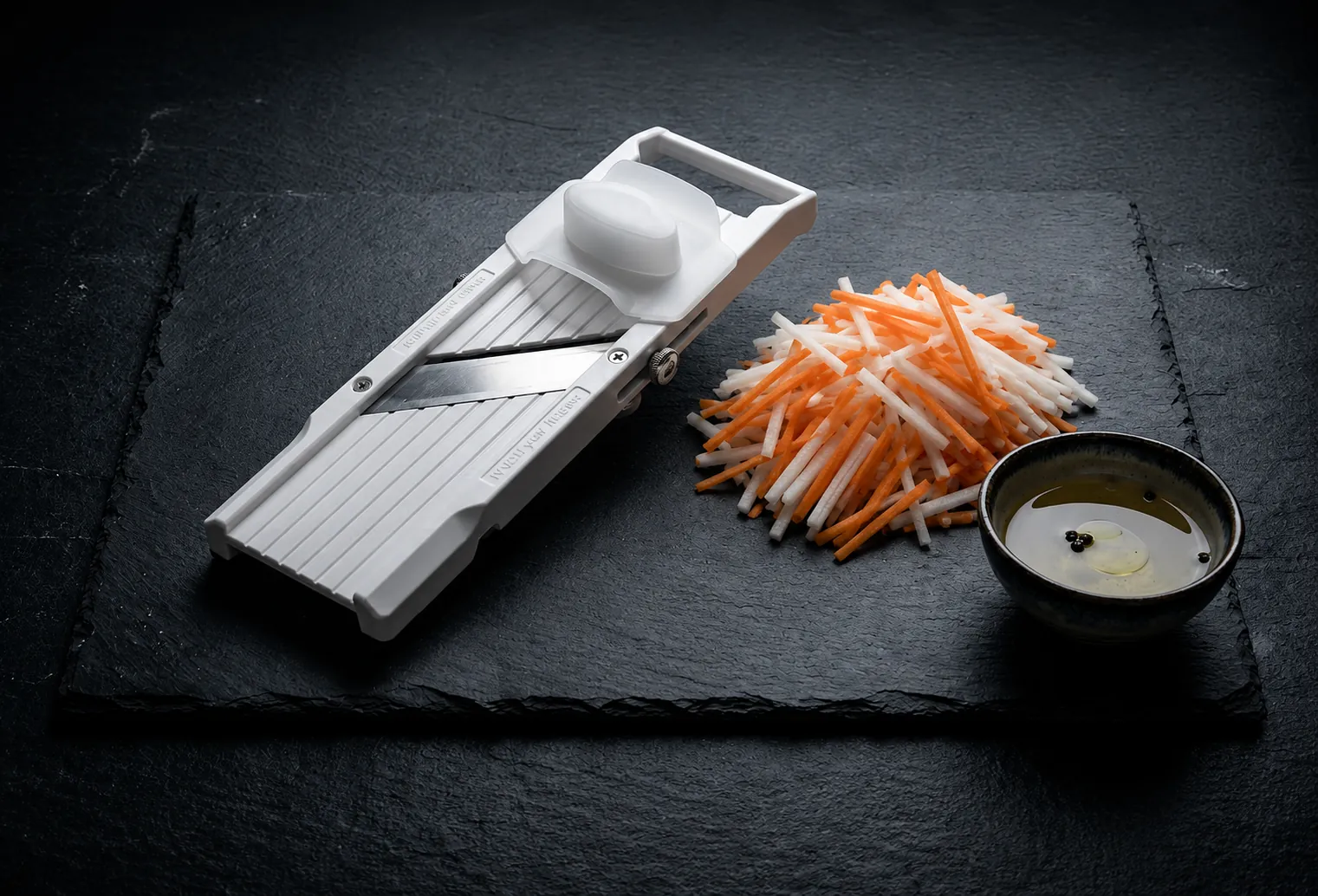
The Benriner Japanese Mandoline is the correct tool for this job. The blade is sharp enough to shave daikon at 1.5mm with no tearing, the narrow body gives you good control over a dense, wet root vegetable, and the fine julienne attachment produces the matchstick cut most đồ chua recipes call for. At around $50 it covers every cut this sandwich requires.
One thing to sort before your first use: the hand guard that ships with the Benriner does not grip well on wet vegetables. Replace it with a cut-resistant glove rated ANSI A4 or higher. This applies to every mandoline on this list. The blade will not forgive a slipped grip.
This is not a workaround. It is the tool that produces the correct cut for this specific job, and it will outlast every mandoline you have ever owned with basic care.
[ THE THREE OPTIONS ]
[ BUDGET ] Kyocera Advanced Ceramic Adjustable Mandoline — around $30 The simplest tool on this list. The ceramic blade does not react with acidic vegetables, so no metallic transfer and no discoloration on your daikon or carrot. Four thickness settings including 0.5mm for paper-thin work. One limitation worth knowing: there is no julienne attachment. If your đồ chua recipe calls for matchstick cuts, the Benriner is the better choice. For straight slicing only, buy this one.
[ MID-RANGE ] Benriner Japanese Mandoline — around $50 The recommended pick. Sharp, narrow, and built for exactly this kind of prep work. The fine julienne blade produces the matchstick cut required for đồ chua. The blade holds its edge well through regular home use and replacement blades are available when it eventually needs them. If you are making bánh mì seriously, this is the one to own.
[ PREMIUM ] OXO SteeLChef’s Mandoline Slicer 2.0 — around $110 The most complete mandoline on this list. Stainless steel body, angled Japanese steel blade, 21 cutting options including straight, wavy, julienne, and French fry cuts. The built-in hand guard is spring-loaded with a wide rim that keeps fingers clear even on wet vegetables. If you cook seriously across multiple cuisines and want one mandoline that handles everything, this is the investment.
[ THE SCIENCE ]
A mandoline blade does not cut the way a knife does. The blade is fixed at an angle and the vegetable is pushed across it under controlled pressure. That angle determines how the cell walls separate. A steep blade angle creates a clean shear that leaves the cell walls mostly intact. A shallow angle tears through the cells and releases moisture before the slice is complete.
The difference shows up in the pickle. A clean shear leaves a dry, slightly glossy surface on the daikon. That shine is the intact cell membrane holding the moisture inside. A torn surface is wet and matte. That moisture is cell fluid that has already escaped. Once it is gone the vegetable softens faster and loses its texture in the brine.
Blade sharpness matters more than blade material for đồ chua. A sharp steel blade on a fresh daikon produces a cleaner cut than a dull ceramic blade. The material is secondary. The edge is what does the work.
The 1.5mm thickness setting is not arbitrary. At that thickness daikon softens fully in a two-hour brine without going limp. Thicker slices stay crunchy but carry less acid. Thinner slices go soft within an hour and lose their structural role in the sandwich. 1.5mm is where texture and acidity line up at the same time.
[ THE FAQ ]
Can I just use a knife for đồ chua? A knife works if your knife skills are precise enough to cut consistent 1.5mm slices on a wet, round vegetable. Most home cooks cannot do that reliably across a full daikon. The mandoline removes the variable entirely and takes 90 seconds instead of 10 minutes.
What thickness setting should I use for đồ chua? 1.5mm for the straight slice. Use the fine julienne blade if your recipe calls for matchstick cuts. Both produce the correct texture after a two-hour brine.
Is the Benriner hand guard usable? The guard that ships with the Benriner is undersized and does not grip reliably on wet vegetables. Replace it with a cut-resistant glove rated ANSI A4 or higher before your first use.
Do I need a mandoline for anything else in bánh mì? Quick-pickled cucumber benefits from the same thin, uniform cut. The Đồ Chua recipe and the Quick Pickled Cucumber recipe both call for the same 1.5mm setting. Beyond that, the other components, pâté, chả lụa, and Vietnamese mayonnaise, do not require one.
Can I use a food processor instead? A food processor with a slicing disc produces usable results but not consistent ones. The disc thickness rarely matches the 1.5mm target and julienne discs cut too thick for fine đồ chua. The mandoline is the correct tool.
[ WHAT TO READ NEXT ]
The mandoline handles the cut. The brine handles the rest. The Đồ Chua recipe covers the exact salt and sugar ratios that produce the correct acidity without over-softening the vegetables, including timing for same-day pickles versus overnight batches.
Every tool on this site connects back to a specific technique. The Equipment page covers the full kit required to make bánh mì correctly at home, from the baguette pan to the bread knife to the offset spatula.
The bread knife and the mandoline solve opposite problems at opposite ends of the build. The Best Bread Knife for Bánh Mì covers why blade geometry matters as much on the serving end as it does on the prep end.