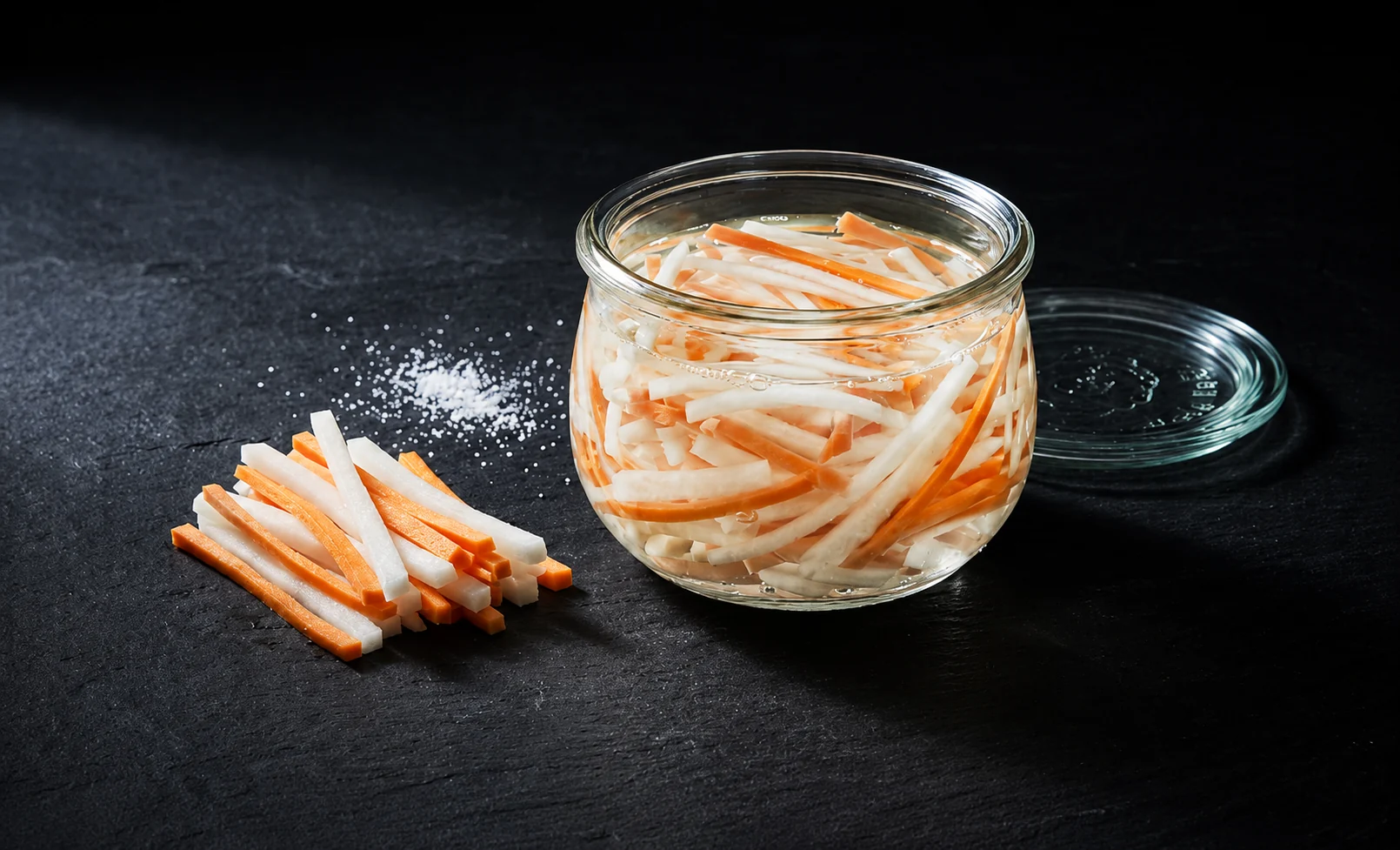
WHY DID MY PICKLED DAIKON AND CARROTS GO SOFT?
Soft đồ chua is always caused by one of four things: hot brine poured over the vegetables, skipping the salt and sugar pre-treatment, cutting the strips too thick, or leaving them in the brine too long. Every one of these has a fix. The crunch in đồ chua is not luck. It is the result of a specific sequence done correctly.
If your pickles went soft, something in the sequence broke down. This guide covers exactly where and exactly how to fix it.
[ THE FOUR CAUSES ]
1. You poured the brine in too hot.
This is the most common cause by a significant margin. The brine for đồ chua requires dissolving sugar and salt in water over heat. If that liquid goes onto the vegetables while still hot, it cooks them. The heat breaks down the cell walls in the daikon and carrot, and once that happens there is no recovering the crunch. The vegetables are soft before the pickling even begins.
The fix is simple. After dissolving the sugar and salt, remove the pan from the heat and allow about 15 minutes for the brine to reach room temperature. Do not rush this step. Pour it over the vegetables only when it is fully cool.
2. You skipped the salt and sugar pre-treatment.
Before the brine goes in, the đồ chua recipe on this site calls for tossing the julienned daikon and carrot with salt and sugar, leaving them for 10 minutes, then rinsing and squeezing out the excess moisture. This step draws water out of the vegetables through osmosis, firming up the cell walls in the process. It also removes the internal moisture that would otherwise dilute the brine and make the finished pickles watery and limp.
Skip this step and the vegetables go into the brine already full of water. The brine gets diluted, the pickling is uneven, and the texture is soft from the first day.
3. Your strips were too thick.
The correct cut for đồ chua is 3mm wide julienne, at least 6cm long. Strips thicker than this do not pickle evenly. The outside acidifies while the inside stays raw and dense, and the texture feels wrong throughout. Strips that are too thin go the other direction and turn soft within a day or two.
A mandoline slicer set to 3mm produces the correct result every time. Cutting by hand is possible but requires care. If the strips are uneven, the texture will be uneven.
4. They sat in the brine too long.
Đồ chua is at its best within the first week. The brine continues to work on the vegetables throughout the storage period. After about two weeks the acidity has broken down enough of the cell structure that the texture becomes noticeably softer. They are still safe to eat but they will not have the crunch of fresh pickles.
The recipe on this site keeps for up to two weeks refrigerated in the brine. For the best texture, use them within the first seven days.
[ THE PRE-TREATMENT EXPLAINED ]
The salt and sugar pre-treatment is the step most people skip because it seems like extra work. It is not optional.
Daikon and carrot both contain a large amount of internal water. When you toss them with salt and sugar and leave them for 10 minutes, the salt draws that water out through osmosis. You can see it pooling at the bottom of the bowl. After rinsing and squeezing, you are removing that water permanently.
This matters for two reasons. The cell walls of the vegetables firm up as moisture leaves them, which is the foundation of the crunch. And the removed water is water that would otherwise sit inside the vegetable and dilute the brine from within, producing a soft, watery result no matter how good the brine itself is.
Think of it like wringing out a wet sponge before putting it in a bucket of colored water. The drier it starts, the more evenly it absorbs what you put into it.
[ THE SCIENCE ]
The crunch in fresh daikon and carrot comes from turgor pressure. That is the force of water pushing outward against the cell walls from inside. When a vegetable is fresh and fully hydrated, that internal pressure keeps the cells rigid.
Heat destroys this. When hot brine hits the vegetables, it breaks down the pectin that holds the cell walls together. Pectin is the structural glue of plant cell walls. Once it softens, the cells collapse and the crunch is gone permanently. No amount of chilling or re-brining will bring it back. Think of it like cooking an egg. Once the heat sets it, there is no going back.
The salt and sugar pre-treatment works differently. Rather than destroying structure, it removes internal water before pickling begins. The cell walls firm up as they lose moisture, which is why properly treated daikon feels noticeably firmer before it even touches the brine.
[ THE FAQ ]
Can I fix soft đồ chua once it has gone soft? No. Once the cell structure has broken down, whether from hot brine or extended storage, the crunch cannot be recovered. Start a fresh batch using the correct sequence: salt and sugar pre-treatment first, cool brine, correct cut, and use within the first week.
How long should I let the brine cool before pouring it over the vegetables? Until it reaches room temperature, which takes about 15 minutes off the heat. If you are in a hurry, pour the brine into a wide bowl to speed up the cooling. Do not pour it over the vegetables until you can comfortably hold your hand near the surface without feeling heat.
My đồ chua is crunchy on the outside but soft in the middle. What happened? The strips were cut too thick. Thick strips acidify from the outside in. The surface pickles correctly while the interior stays raw and dense. Cut to 3mm wide and the brine reaches the center of each strip within the correct timeframe.
How long does đồ chua keep its crunch? Best within the first seven days. The brine continues working on the vegetables throughout storage. After two weeks the texture is noticeably softer. Still safe to eat, but no longer at its best.
Should I rinse the daikon and carrot after the pre-treatment? Yes. Rinse thoroughly under cold water and then squeeze firmly in batches to remove as much moisture as possible. If you skip the rinse, residual salt carries into the brine and throws off the balance of the finished pickle.
[ WHAT TO READ NEXT ]
The Đồ Chua recipe is the starting point. It covers the exact salt and sugar ratio, brine formula, and storage method that produces the correct result when the sequence is followed correctly.
The Glass Crust Bánh Mì Baguette recipe is the bread the pickles go into. Understanding the 20 to 30 minute assembly window explains why properly crunchy đồ chua matters so much. Soft pickles accelerate sogginess. Crunchy pickles slow it down.
Why Is My Bánh Mì Soggy covers the full assembly sequence and explains how the pickle drainage step fits into the wider system that keeps the sandwich together. Draining the pickles before they go in is the step that connects both guides.