BEST KITCHEN SCALE FOR BÁNH MÌ
Bread baking is a chemistry experiment. The ratio of flour to water to rice flour determines whether the baguette develops the Glass Crust or comes out soft and chewy like any other loaf. A cup measurement introduces enough variation that the ratio shifts every single time. A scale removes that variable entirely.
The same logic applies to the pickle brine. The balance of vinegar, sugar, and salt in đồ chua is precise. Too much sugar and the pickles are sweet instead of sharp. Too little salt and they do not draw moisture from the vegetables correctly. Measuring by weight gives you the same result every time you make them.
This page covers the three best kitchen scales for bánh mì at every price point, why weight measurement matters more than most home cooks realize, and exactly what to look for when buying.
[ WHY THE SCALE MATTERS FOR BÁNH MÌ SPECIFICALLY ]
Two recipes on this site demand a scale more than any others: the Glass Crust Baguette and the đồ chua pickle brine. Both are built on ratios, and ratios only work when the measurements are consistent.
The Glass Crust Baguette uses a specific ratio of bread flour to rice flour. That ratio is what creates the thin, shattering crust that defines an authentic bánh mì. Measure by volume and the ratio shifts depending on how tightly the flour is packed into the cup. Measure by weight and it is identical every time. The difference shows up in the crust. A scale is not optional for this recipe.
The đồ chua brine works the same way. The acidity, sweetness, and salt level need to be in balance for the pickles to cut through the fat of the pâté and mayonnaise correctly. Off by a few grams in either direction and the balance shifts. The sandwich loses its sharpest edge.
Beyond those two recipes, a scale makes everything faster. No measuring cups to wash. No leveling off flour with a knife. Weigh the ingredient directly into the bowl, zero the scale, weigh the next one. A good kitchen scale pays for itself in time saved within the first week of regular use.
[ THE RECOMMENDATION ]
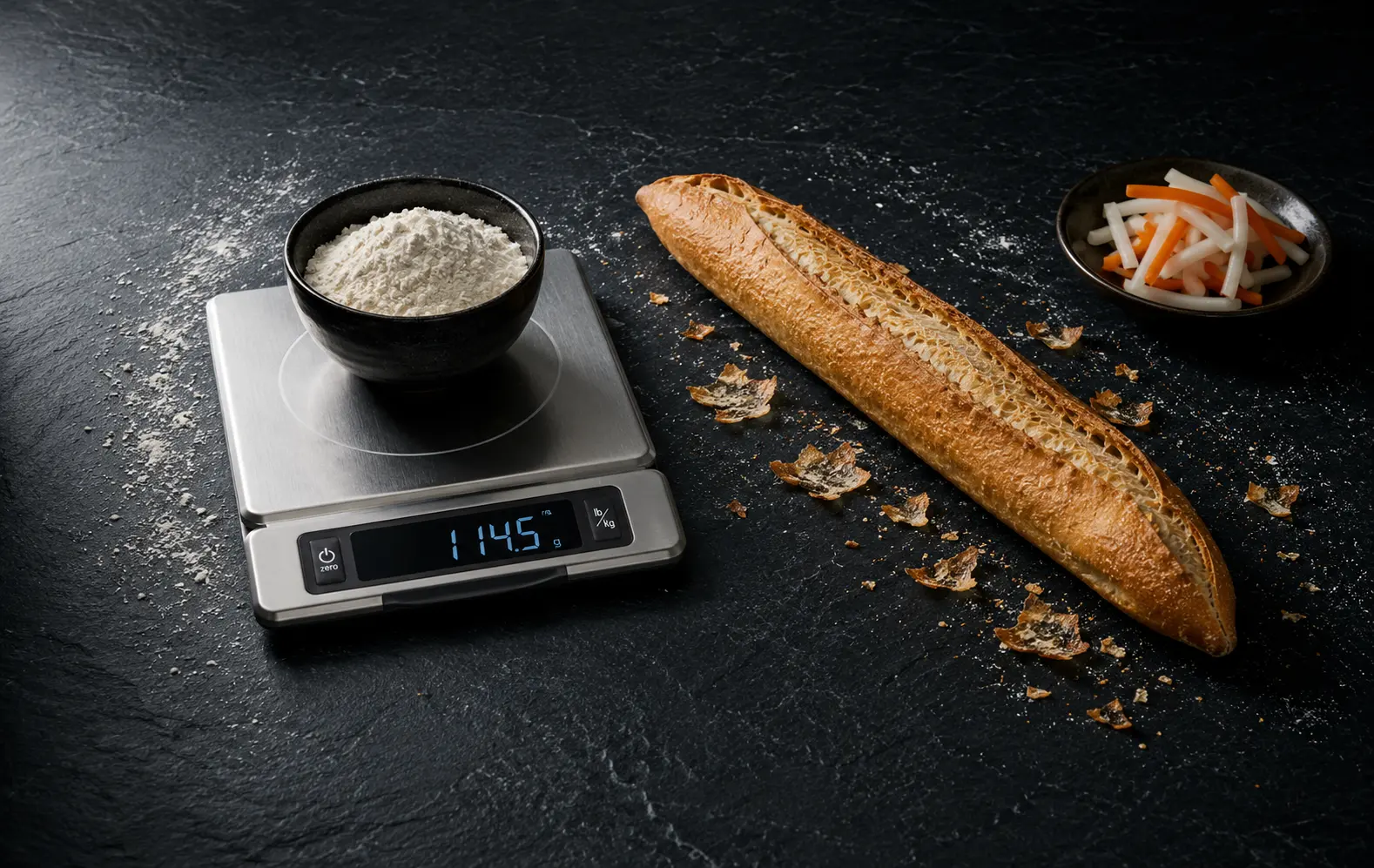
The OXO Good Grips 11-Pound Stainless Steel Kitchen Scale is the correct scale for this job. The platform is large enough to hold a full mixing bowl for baguette dough. The display pulls out from under the platform so you can read it even with a large bowl blocking the front. That detail sounds minor until the first time you try to read a display that is hidden under a 5-quart bowl.
The scale reads in 1-gram increments up to 11 pounds, which covers every bánh mì recipe on this site with room to spare. The stainless steel platform cleans easily and does not absorb odors from fish sauce or fermented ingredients. The tare function resets the weight between ingredients so you can measure everything into a single bowl without doing math.
It is also the one that will still be sitting on your counter in ten years working exactly as it did on day one.
[ THE THREE OPTIONS ]
[ BEST OVERALL ] OXO Good Grips 11-Pound Kitchen Scale — around $65. The recommendation above. Large platform, pull-out display, 1-gram precision, stainless steel surface. The correct scale for anyone baking Glass Crust baguettes or making pickle brine regularly.
[ ALTERNATIVE ] OXO Good Grips 5-Pound Kitchen Scale — around $40. Same pull-out display as the 11-pound version, same 1-gram precision, smaller platform and lower maximum capacity. The honest weakness is the 5-pound limit: a full batch of baguette dough with a heavy mixing bowl can push against that ceiling. For pickle brine, mayonnaise, and smaller recipe components it is more than sufficient. If you bake bread frequently, get the 11-pound version. If you are scaling recipes rather than baking full batches, the 5-pound is the smarter buy.
[ BUDGET ] Etekcity Digital Kitchen Scale — around $15. Accurate to 1 gram, handles up to 11 pounds, and gets the job done for someone starting out. The honest weakness is build quality: the platform is smaller than either OXO option and the display does not pull out, which makes it harder to read under a large bowl. For measuring pickle brine ingredients or portioning rice flour it works correctly. For full baguette dough batches the smaller platform is a real limitation.
[ THE SCIENCE ]
A kitchen scale works on a principle called strain gauge measurement. Inside the scale there is a small metal bar with a tiny electrical sensor attached to it. When you place something on the platform, the weight bends the metal bar by a microscopic amount. That bend changes the electrical resistance in the sensor, and the scale converts that change into a weight reading on the display. The reason a good scale matters for baking is precision: bread flour and rice flour have different densities, so the same volume of each weighs a different amount. A scale measures the actual mass of the ingredient regardless of how it is packed or sifted. That is the only way to get the Glass Crust ratio right consistently.
[ THE FAQ ]
Do I really need a scale for bánh mì recipes? For the Glass Crust Baguette, yes. The rice flour to bread flour ratio is specific enough that volume measurements introduce too much variation. For the pickle brine, a scale produces more consistent results than measuring cups. For assembled sandwich recipes where you are eyeballing fillings, a scale is not necessary.
What unit should I use when measuring bánh mì ingredients? Grams for everything. Grams are the smallest and most precise unit available on a kitchen scale. All recipes on this site list weights in grams for this reason.
Can I use a postal scale instead of a kitchen scale? A postal scale measures in heavier increments and is not designed for food contact. A kitchen scale reads in 1-gram increments and has a platform sized for bowls and containers. Use a kitchen scale for food.
How do I know if my scale is accurate? Place a known weight on the platform and check the reading. A nickel weighs exactly 5 grams. Five nickels should read 25 grams. If the reading is off by more than 1 gram, recalibrate or replace the scale.
Does the platform size matter? Yes. A small platform forces you to use smaller bowls, which limits batch size. For full baguette dough batches you need a platform large enough to hold a 5-quart mixing bowl stably. The OXO 11-pound platform handles this correctly. The Etekcity platform is smaller and less stable with large bowls.
[ WHAT TO READ NEXT ]
The Glass Crust Baguette recipe is where a kitchen scale earns its place, the recipe where the rice flour ratio determines everything about the final crust.
For the pickle brine that depends on the same precision, see the Đồ Chua recipe, where the balance of vinegar, sugar, and salt is what makes the pickles work inside the sandwich.
For the complete breakdown of every tool a serious bánh mì kitchen requires, see The Equipment page.