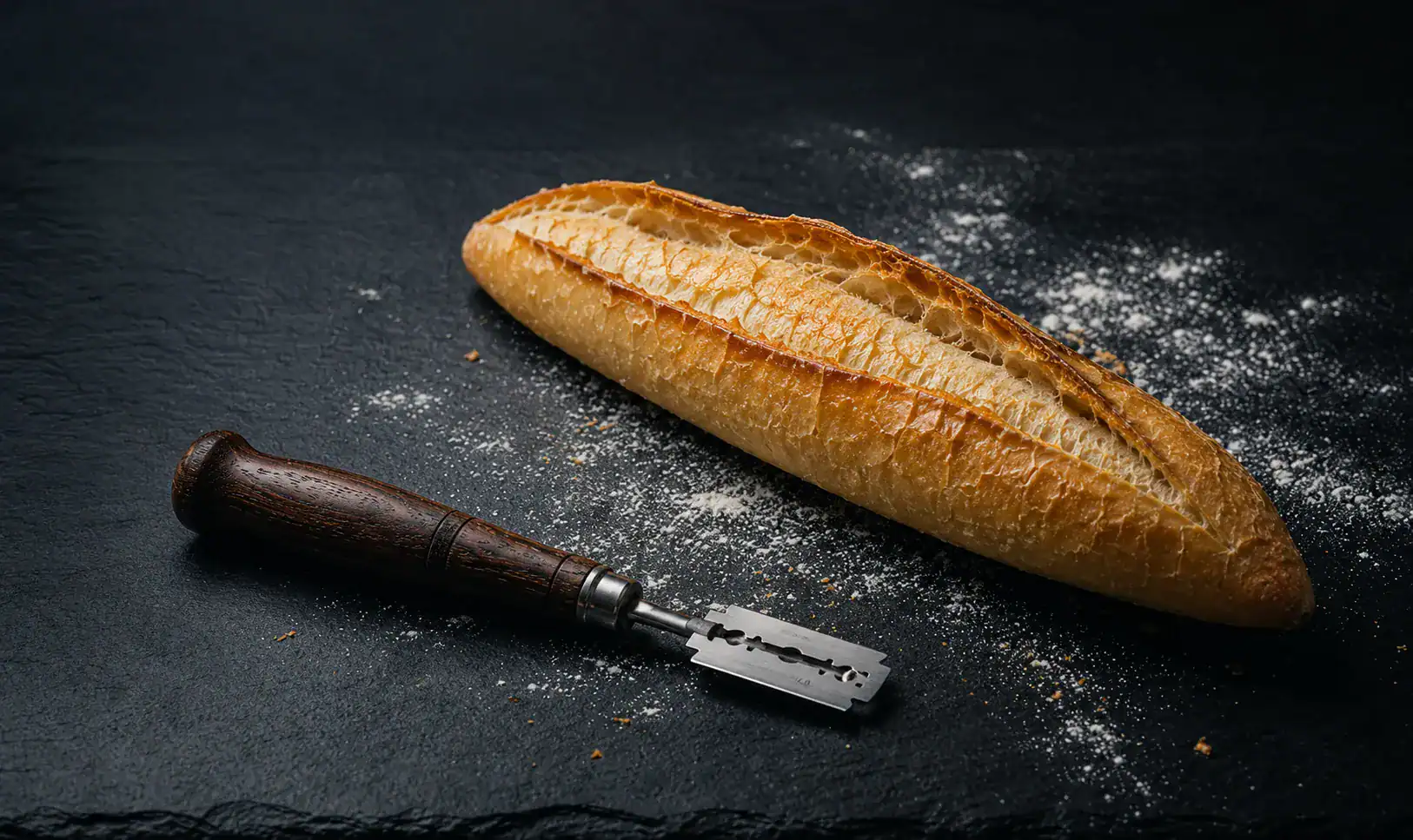
BEST BREAD LAME FOR BÁNH MÌ
Most home bakers who attempt the Glass Crust get the flour ratio right, the baking steel preheated, the steam timed correctly, and then drag a kitchen knife across the top of the dough and watch the whole thing collapse. Not because the dough was wrong. Because scoring a Vietnamese bánh mì baguette with the wrong tool undoes everything that came before it.
The Glass Crust is thin, brittle, and under tension before it ever goes into the oven. A dull or thick blade drags across the surface before it cuts. The dough deflates. The ear never forms. The crust tears rather than opening along the score line. One pass with a razor blade on a proper bread lame takes two seconds and fixes all of that.
This page covers why scoring matters more than most bakers realize, what to look for in a bread lame for bánh mì, and three options at every price point.
[ WHY IT MATTERS FOR BÁNH MÌ SPECIFICALLY ]
A Vietnamese bánh mì baguette is scored once, lengthwise, at a shallow angle along the top of the loaf. That single score has three jobs. It controls where the oven spring releases. It creates the ear that lifts and browns during baking. And it sets the geometry of the Glass Crust as the crust forms in the first four minutes of heat.
A standard kitchen knife fails this job immediately. The blade is too thick to pass through the surface tension of the dough without dragging. Dragging compresses the dough before it cuts, which deflates the gas cells underneath and produces a flat loaf with no ear, no lift, and a crust that forms on a loaf that has already given up. A razor blade on a lame is thin enough to slice through the surface tension in one clean motion with zero compression.
The angle matters as much as the blade. A lame held at a shallow angle of around 30 degrees produces an undercut that lifts one side of the score higher than the other. That lift is the ear. It is the visual indicator that the scoring was done correctly and the bread expanded the way it was supposed to. It is also what makes a properly scored bánh mì baguette look immediately different from one that was cut with a knife.
[ THE RECOMMENDATION ]
The Baker of Seville Bread Lame is the correct tool for scoring bánh mì baguettes at home. Over 3,000 bakers have used it and the rating reflects consistent performance across a wide range of bread styles. The ability to switch between straight and curved blade positions gives you control over the ear formation that a fixed-position lame does not. At around $22 it is still one of the least expensive tools on this site.
One maintenance note: replace the blade after every four to six baking sessions. A sharp blade scores in one clean pass. A dull blade drags. The difference is immediately visible in the finished loaf.
[ THE THREE OPTIONS ]
[ BUDGET ] RICCLE Bread Lame — under $10 The correct starting point for anyone new to scoring bread. Curved handle, standard razor blade compatible, and everything a home baker needs to score bánh mì correctly. Lightweight and comfortable for a single scoring pass. Replacement blades are included and cost almost nothing to replace. Buy this one if you are just getting started.
[ MID-RANGE ] Saint Germain Premium Hand Crafted Bread Lame — around $15 A hand crafted lame with a more substantial feel than the RICCLE. The handle provides better grip and the blade attachment is more secure. Over 7,000 reviews at 4.6 stars reflects consistent performance across a wide range of home bakers. A strong step up for bakers who want a more refined tool without the premium price.
[ PREMIUM ] Baker of Seville Bread Lame — around $22 The recommended pick. The ability to switch between straight and curved blade positions gives you control over ear formation that fixed-position lames do not offer. Over 3,000 reviews and the flexibility to score different bread styles correctly with the same tool. If you bake bread seriously and want one lame that handles everything, this is it.
[ THE SCIENCE ]
The surface of a proofed dough loaf is under tension. The gluten network has stretched to accommodate the gas produced during fermentation. That tension is what holds the loaf in shape. When you score the dough, you are releasing that tension in a controlled way, directing where the gas escapes and where the bread expands. For the Glass Crust specifically, that direction determines whether the crust sets thin and brittle or thick and uneven.
A razor blade is thin enough to slip through the surface tension without disturbing the gas cells underneath. The cut opens cleanly and the dough on either side of the score line separates rather than compresses. When the loaf hits the heat of the oven the gas expands rapidly and the bread springs upward through the score line. That rapid expansion is what lifts the ear and pulls the crust thin across the opening.
A dull blade applies pressure before it cuts. Think of dragging a butter knife across the surface of a balloon versus a pin. The butter knife pushes the surface inward before it breaks through. The pin passes through instantly. A dull scoring blade does what the butter knife does to your dough. The gas cells along the score line compress and deflate before the blade breaks through. The loaf loses volume. The ear does not form.
The curved handle on a lame holds the blade at a consistent shallow angle throughout the scoring pass without the baker needing to think about it. On a 30cm baguette, maintaining the correct angle manually from one end of the loaf to the other introduces variation that shows up in the finished crust. The curve removes that variable entirely.
[ THE FAQ ]
Can I use a sharp knife instead of a lame? A sharp knife is better than a dull one but still not the right tool. The blade is too thick to pass through the dough surface tension cleanly and will drag slightly even when sharp. That drag compresses the dough before cutting. A razor blade on a lame is the correct tool for bánh mì scoring.
How often should I replace the blade? After every four to six baking sessions. The blade dulls faster than most bakers expect and a dull blade drags instead of cuts. The difference shows up immediately in the ear formation and crust texture. Razor blades cost almost nothing. Replace them before you think you need to.
What angle should I hold the lame? Picture a clock face lying flat. Hold the lame so the blade is pointing at roughly 4 o’clock rather than straight down at 6. That shallow angle is what creates the undercut and lifts the ear. A steeper angle produces a more symmetrical opening without a pronounced ear. For bánh mì the shallow angle is correct.
Can I use a lame on other breads? Yes. A lame is useful for any bread that requires surface scoring before baking. Sourdough, ciabatta, and focaccia all benefit from correct scoring. The technique varies by bread style but the tool is the same.
How do I store a lame safely? The exposed razor blade requires careful storage. Either use the plastic blade cover that comes with most lames, store it in a dedicated section of a kitchen drawer where nothing else will contact the blade, or wrap the blade in a folded piece of cardboard between uses. A loose lame in a cluttered drawer is a serious cut risk.
[ WHAT TO READ NEXT ]
The lame scores the surface. The baguette pan holds the shape underneath it. The Best Baguette Pan for Bánh Mì covers the channel width and perforation pattern that gives the dough the correct geometry for the scoring to work properly.
The complete baking setup requires more than one tool. The Equipment page covers every piece of kit required to bake and serve bánh mì correctly at home, from the baking steel to the baguette pan to the offset spatula.
The Glass Crust Baguette recipe covers the exact scoring technique, blade angle, and timing that produces the correct ear and crust formation when this lame is in place, including the steam method that works alongside the score to set the crust correctly.