HOW TO STORE AND REHEAT BÁNH MÌ
A bánh mì does not store as a finished sandwich. The moment the bread is cut and filled, the clock starts. Vietnamese mayonnaise and pâté create a fat barrier that slows moisture moving into the bread, but they do not stop it. An assembled bánh mì holds its structure for 20 to 30 minutes at room temperature. After that, the Glass Crust softens and the bread begins absorbing moisture from the fillings.
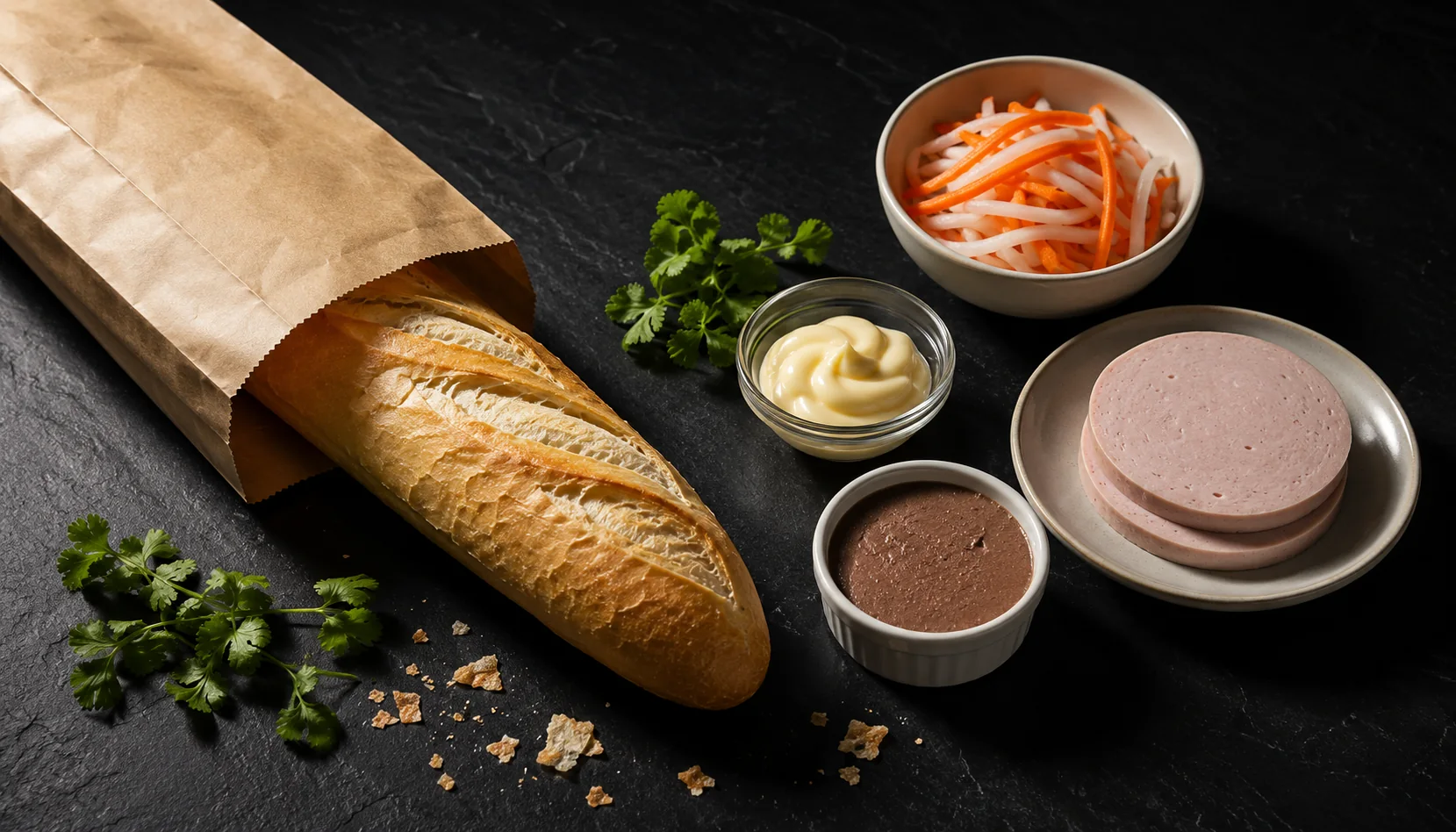
The correct approach is to store the components separately and assemble only when ready to eat. The bread keeps at room temperature for up to 2 days in a paper bag. The proteins, đồ chua, and Vietnamese mayonnaise keep refrigerated for several days in separate airtight containers. When you are ready to eat, reheat the bread in an oven or air fryer to restore the Glass Crust, then assemble fresh.
If you have an already assembled sandwich that needs to be reheated, it can be done. The result will not match a freshly assembled bánh mì, but with the right method it comes close.
[ WHY BÁNH MÌ DOES NOT STORE ASSEMBLED ]
The Glass Crust is the reason. An authentic Vietnamese baguette has a paper thin exterior with very few tiny holes or gaps in its surface. That thin crust is what gives the sandwich its structure and its characteristic shatter on the first bite. It is also extremely sensitive to moisture.
Once the bread is cut and filled, moisture from the đồ chua, cucumber, and protein begins moving into the bread. The fat barrier from the Vietnamese mayonnaise and pâté slows this process but does not prevent it. At room temperature the window is 20 to 30 minutes. In the refrigerator the cold air accelerates staling and the crust goes soft within an hour.
This is not a flaw in the sandwich. It is a feature of the bread. The same thin crust that shatters on the first bite is the same thin crust that cannot survive prolonged contact with wet ingredients. Vietnamese street vendors understand this. They assemble each sandwich to order and hand it directly to the customer. The paper wrapper is not packaging. It is a brief moisture barrier that buys a few extra minutes.
[ HOW TO STORE THE COMPONENTS ]
Storing the components separately is the only method that preserves quality.
The bread. Keep uncut baguettes at room temperature in a paper bag for up to 2 days. Do not use plastic wrap or an airtight container. The Glass Crust needs airflow to stay crisp. Plastic traps moisture and softens the crust within hours. If you need to store the bread beyond 2 days, freeze it unwrapped until solid, then wrap tightly in two layers of aluminum foil. Frozen baguettes keep for up to 2 months.
Vietnamese mayonnaise. Keeps refrigerated in an airtight container for up to 1 week. Press a layer of plastic wrap directly onto the surface before sealing to prevent oxidation.
Pork liver pâté. Keeps refrigerated in an airtight container for up to 5 days. Store-bought pâté follows the date on the packaging once opened.
The cold cuts. Chả lụa and chả bì keep refrigerated for 4 to 5 days in an airtight container. Slice only what you need and keep the remainder whole.
Đồ chua. Keeps refrigerated in its brine for up to 2 weeks. The longer it sits in the brine the more the vegetables soften, so use within the first week for the best texture.
Grilled proteins. Grilled pork, grilled chicken, and similar proteins keep refrigerated for 3 to 4 days in an airtight container. Reheat before assembling.
Fresh vegetables and herbs. Persian cucumber, cilantro, and jalapeño keep refrigerated for 3 to 5 days. Store them dry and unwashed. Wash only when ready to use.
[ HOW TO REHEAT THE BREAD ]
Reheating the bread correctly is the most important step. The goal is to drive out the moisture that has softened the crust and restore the Glass Crust texture. High dry heat does this. Steam and microwave heat do the opposite.
Oven method (best result). Preheat the oven to 375F. Place the baguette directly on the oven rack with no foil. Heat for 5 to 7 minutes until the crust is firm and crisp when tapped. It should sound hollow, not dull. Remove and assemble immediately. Do not wrap in foil. Foil traps steam and softens the crust.
Air fryer method (fastest). Preheat the air fryer to 350F. Place the baguette in the basket. Heat for 3 to 4 minutes. The circulating hot air restores the crust faster than a conventional oven and produces a result very close to fresh-baked. This is the best method if you have an air fryer.
Toaster oven method. Preheat to 375F. Place the baguette directly on the rack. Heat for 5 to 7 minutes. Works well for a single baguette. Check at 5 minutes to avoid over-crisping the ends.
Microwave method (last resort). The microwave cannot restore the Glass Crust. It heats with steam, which softens rather than crisps the exterior. If the microwave is the only option, heat the protein separately in the microwave and toast the bread in a dry skillet over medium heat for 2 minutes per side. Assemble immediately.
[ HOW TO REHEAT AN ASSEMBLED SANDWICH ]
If the sandwich is already assembled and the components cannot be separated, the oven method gives the best result.
Remove the cilantro, fresh cucumber, and any fresh herbs before reheating. These wilt under heat and cannot be revived. Set them aside to add back after reheating.
Wrap the sandwich loosely in aluminum foil, leaving a small opening at one end to allow steam to escape. Do not seal it completely. Place in an oven preheated to 350F for 8 to 10 minutes. Remove the foil for the final 2 minutes to allow the crust to crisp slightly.
Remove from the oven, add the fresh vegetables and herbs back, and eat immediately.
The result will not match a freshly assembled bánh mì. The đồ chua will have warmed and lost some of its sharp acidity. The Vietnamese mayonnaise will have melted into the bread. The crust will be somewhat crisp but not at Glass Crust standard. It is a workable second option, not an equivalent one.
[ THE FAQ ]
Can you refrigerate a bánh mì overnight? You can refrigerate the components overnight but not the assembled sandwich. A fully assembled bánh mì left in the refrigerator overnight will have a soft, stale crust and waterlogged bread by morning. Separate the components before refrigerating and assemble fresh the next day with reheated bread.
How long does bánh mì last in the fridge? The assembled sandwich lasts 1 day in the refrigerator before the texture becomes unacceptable. The components last much longer. Đồ chua keeps for up to 2 weeks. Vietnamese mayonnaise keeps for 1 week. Cold cuts keep for 4 to 5 days. Grilled proteins keep for 3 to 4 days. Store each component separately and assemble only when ready to eat.
Can you freeze bánh mì? You can freeze the uncut baguettes for up to 2 months. Wrap tightly in two layers of aluminum foil after the bread has cooled completely. Reheat from frozen in a 375F oven for 10 to 12 minutes directly on the rack. Do not freeze an assembled sandwich. The đồ chua, Vietnamese mayonnaise, and fresh vegetables do not survive freezing.
What is the best way to reheat bánh mì bread? The air fryer at 350F for 3 to 4 minutes gives the closest result to fresh-baked. The oven at 375F for 5 to 7 minutes is the best result without an air fryer. Both methods use dry circulating heat which drives out moisture and restores the Glass Crust. Never use foil when reheating bread on its own. Foil traps steam and defeats the purpose.
Why does my bánh mì go soggy in the fridge? Two reasons. First, refrigerator air is humid and cold, which accelerates staling in the bread and softens the crust. Second, the moisture from the đồ chua, cucumber, and protein continues moving into the bread even when cold. The fat barrier from the Vietnamese mayonnaise and pâté slows this but does not stop it. The only fix is to store the components separately.
Can you make bánh mì ahead of time for a party? Yes, with preparation. Make all the components ahead of time and refrigerate separately. On the day, reheat the baguettes in the oven or air fryer just before serving. Set up the components in bowls and let people assemble their own sandwiches. This is the correct way to serve bánh mì for a group. Pre-assembled sandwiches sitting on a platter will be soft and soggy within 30 minutes.
[ WHAT TO READ NEXT ]
Why Is My Bánh Mì Soggy covers the four causes of a soft sandwich in detail, including the fat barrier sequence and the correct assembly order. If the storage and reheating information on this page is useful, that page explains the underlying science behind why each step matters.
The Glass Crust Bánh Mì Baguette recipe covers the bread itself. Understanding how the rice flour and bread flour ratio produces the thin shattering crust explains why that crust is so sensitive to moisture and why reheating with dry heat is the only method that works.
The Classic Bánh Mì Thịt Nguội recipe is the sandwich all the storage timelines on this page are built around. The components section at the bottom of that recipe covers make-ahead options for each individual element.