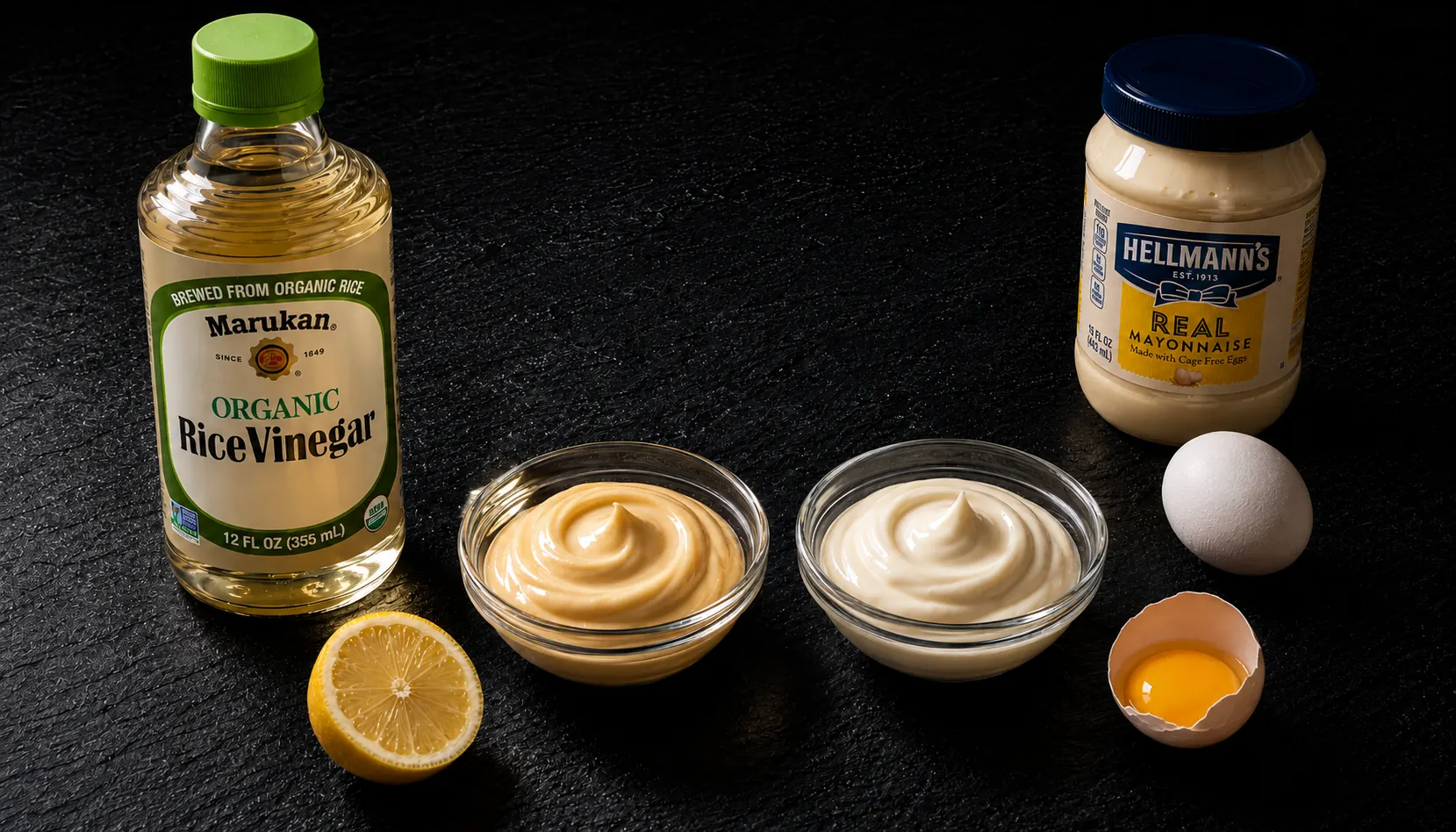
VIETNAMESE MAYONNAISE VS REGULAR MAYONNAISE
Vietnamese mayonnaise and regular mayonnaise share the same basic structure. Both are emulsions of egg and oil. The differences are in the acid, the oil, and what gets left out. Vietnamese mayonnaise uses rice vinegar and a small amount of fresh lemon juice as the acid components. Regular commercial mayonnaise uses distilled vinegar and adds more sugar, stabilizers, and preservatives to extend shelf life.
The result is a condiment that is richer, cleaner, and less sharp than anything from a jar. On a bánh mì it does a specific job. It waterproofs the bread against the wet fillings and provides the fat base that holds the sandwich together. Regular commercial mayonnaise can do that job in an emergency but the flavor profile is noticeably different. The acid is sharper, the texture is thinner, and the additives give it a processed aftertaste that works against the fresh ingredients in the sandwich.
[ THE INGREDIENTS SIDE BY SIDE ]
The recipe on this site uses one whole egg, one egg yolk, neutral oil, rice vinegar, fresh lemon juice, sugar, and salt. That is the complete ingredient list. Seven ingredients, all of them recognizable, none of them chemical.
A standard jar of commercial American mayonnaise contains whole eggs or egg yolks, soybean oil, water, distilled vinegar, salt, sugar, natural flavors, lemon juice concentrate, and calcium disodium EDTA, a chemical preservative that prevents the oil from going rancid. The exact formulation varies by brand but the core additions are consistent: acid from distilled vinegar, sugar for sweetness, and chemical preservatives for shelf life.
The differences break down to four things.
The acid. Vietnamese mayonnaise uses rice vinegar and a small amount of fresh lemon juice. Rice vinegar has a mild, clean acidity with almost no sharpness. The lemon juice adds brightness without dominance. Distilled vinegar, used in most commercial American mayonnaise, is significantly sharper and more assertive. That sharpness is noticeable in the finished sandwich, especially when the mayonnaise is paired with the already acidic đồ chua. Two sharp acid sources in the same sandwich compete with each other. Rice vinegar and đồ chua work together.
The oil. Vietnamese mayonnaise uses a neutral oil with no flavor of its own, vegetable, canola, or sunflower. Not olive oil. Commercial mayonnaise uses soybean oil, which has a subtle but distinct flavor that contributes to the processed taste of jar mayonnaise. The neutral oil in Vietnamese mayonnaise lets the egg flavor come forward.
The additives. Commercial mayonnaise contains preservatives and stabilizers that Vietnamese mayonnaise does not. It also contains significantly more sugar per serving. The recipe on this site uses a small amount of sugar to balance the acid, the same function as in commercial versions, but in a much smaller quantity and without the chemical preservatives that give jar mayonnaise its processed aftertaste.
The egg. The recipe on this site uses one whole egg and one egg yolk. The whole egg brings egg white, which is mostly water. That extra water makes the emulsion slightly looser and lighter, exactly what you want for a mayonnaise that needs to spread thinly across both inner surfaces of the bread without competing with the pâté or the pickles. A yolk-only mayonnaise sits too heavy on the bread.
[ WHY IT MATTERS FOR BÁNH MÌ ]
The mayonnaise in a bánh mì is not a flavor ingredient. It is a structural one. It goes on both inner surfaces of the bread immediately after cutting, before any other ingredient goes in. Its job is to waterproof the bread against the moisture in the đồ chua, cucumber, and protein.
Fat and water do not mix. Think of salad dressing left to sit. The oil always floats to the top and the water sinks to the bottom. That separation is what protects the bread. The mayonnaise coats the inner surface with a layer that moisture cannot easily cross. The recipe on this site applies it to both inner surfaces edge to edge. One side is not enough. The fat barrier has to be complete.
Commercial mayonnaise can perform this function but less effectively for two reasons. First, the thinner consistency means it does not coat the bread surface as completely. Second, the water content in commercial mayonnaise is higher than in the homemade version, which means it adds moisture to the bread rather than protecting it. Vietnamese mayonnaise made from scratch has almost no free water. It is almost entirely egg and oil, which is exactly what the fat barrier needs to be.
[ KEWPIE AS A SUBSTITUTE ]
Kewpie is the correct store-bought substitute when Vietnamese mayonnaise is not available. It is the recommendation on this site for that reason.
Kewpie is a Japanese mayonnaise made with egg yolks only and rice vinegar. The yolk-only formula produces a richer, more golden mayonnaise than whole egg versions. The rice vinegar keeps the acidity mild and clean. The original Japanese formula contains MSG, which adds umami and gives it a savory depth that regular mayonnaise does not have. The US version does not contain MSG.
Kewpie is not identical to Vietnamese mayonnaise but it is the closest commercially available product. The acid is correct, the richness is close, and the flavor profile works with the other ingredients in the sandwich. Regular American commercial mayonnaise is a more distant substitute. It functions as a fat barrier but the flavor is noticeably different.
[ THE FAQ ]
Can I use regular mayonnaise in bánh mì? Yes, as a substitute. Regular commercial mayonnaise will provide the fat barrier that protects the bread from the wet fillings. The flavor will be noticeably different. The sharper acid from distilled vinegar competes with the đồ chua rather than complementing it, and the sugar and additives give the sandwich a slightly processed quality that works against the fresh ingredients. It is a workable substitute, not an equivalent one.
What is the best store-bought substitute for Vietnamese mayonnaise? Kewpie. It uses egg yolks and rice vinegar, which is the closest commercial formulation to Vietnamese mayonnaise. It is available at most Asian grocery stores and increasingly at mainstream supermarkets. Use it in the same quantity as Vietnamese mayonnaise.
Why is Vietnamese mayonnaise more yellow than regular mayonnaise? The recipe on this site uses one whole egg and one egg yolk, which produces a warm pale golden ivory color. Recipes that use only egg yolks produce a deeper golden yellow. Commercial American mayonnaise uses whole eggs or pasteurized egg products which produces a lighter, creamier white color. The yellow comes from the egg yolk. The more yolks relative to whites, the deeper the color.
Does Vietnamese mayonnaise taste different from regular mayonnaise? Yes, noticeably. Vietnamese mayonnaise is richer and cleaner with a mild acidity from the rice vinegar and lemon juice. Regular commercial mayonnaise has a sharper, slightly sweet flavor from the distilled vinegar and added sugar. The texture is also different. Vietnamese mayonnaise made from scratch is denser and more spreadable. Commercial mayonnaise is thinner with a higher water content.
How long does Vietnamese mayonnaise last? The recipe on this site keeps refrigerated in a sealed airtight container for 5 days. Label the container with the date you made it. After five days discard and make a fresh batch. Do not freeze it. Freezing breaks the emulsion permanently. Commercial mayonnaise lasts much longer because of the preservatives. Vietnamese mayonnaise has none of those, which is exactly why it tastes better.
Can I make Vietnamese mayonnaise without a blender? Yes, but a stick blender is the recommended method. It takes two minutes and produces a consistent result with almost no risk of the emulsion breaking. A food processor works using the same method. A stand mixer with the whisk attachment also works but takes longer and requires streaming the oil in very slowly. By hand with a whisk requires 10 to 15 minutes of continuous whisking. The stick blender is faster and more reliable than any of these alternatives.
[ WHAT TO READ NEXT ]
The Vietnamese Mayonnaise recipe on this site covers the full method, the whole egg technique, and the rice vinegar ratio that produces the correct consistency for bánh mì. It is the starting point for anyone making the sandwich from scratch.
Why Is My Bánh Mì Soggy explains the fat barrier in detail, including why the mayonnaise must go on both inner surfaces before any other ingredient and what happens when it is skipped or applied incorrectly.
The Classic Bánh Mì Thịt Nguội recipe is the sandwich that uses Vietnamese mayonnaise as a structural component. Seeing it in context makes the function of the mayonnaise clear.