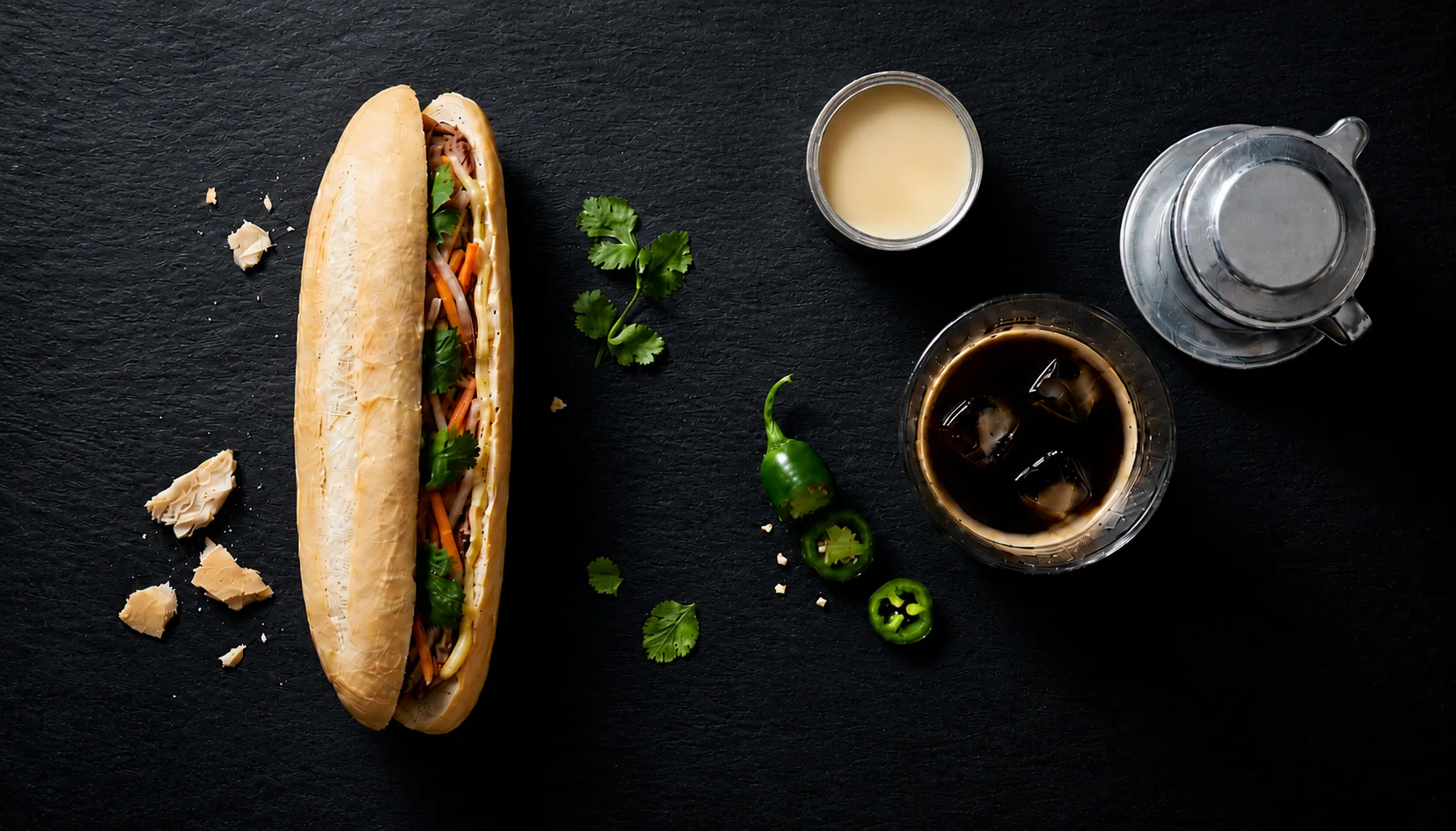
BÁNH MÌ AND VIETNAMESE ICED COFFEE: THE ORIGINAL PAIRING
Bánh mì and cà phê sữa đá (Vietnamese iced coffee) are the original pairing. Both came from the same colonial moment, both were transformed by the same hands, and both ended up as something entirely different from what the French originally brought. The sandwich rebuilt the baguette from the inside out. The coffee replaced café au lait’s fresh milk with sweetened condensed milk and moved the whole ritual from white-tablecloth cafés to street-side plastic stools. Neither stayed French. Both became Vietnamese.
The pairing works for specific mechanical reasons. The robusta-based coffee is intensely bitter and high in caffeine. The condensed milk pulls it back toward sweet and creamy. That push and pull of bitter and sweet mirrors what the bánh mì does internally: sharp pickled daikon and carrot cutting through rich pâté and Vietnamese mayonnaise. One drink, one sandwich, the same underlying logic operating in both.
In Vietnam, this combination is not a trend or a recommendation. It is simply the default. Street vendors serve cà phê sữa đá alongside bánh mì at the same cart or the next cart over. The pairing predates any food media coverage by decades.
[ WHY THIS PAIRING WORKS ]
The bánh mì is built on contrast. Rich pâté, fatty Vietnamese mayonnaise, and savory proteins on one side. Sharp pickled daikon and carrot, fresh cilantro, and sliced jalapeño on the other. The bread holds all of it together without resolving the tension. Every bite contains that back-and-forth between fat and acid, salt and heat.
Cà phê sữa đá operates the same way inside the glass. Robusta coffee is more bitter and higher in caffeine than the arabica most Western drinkers know. Brewed slow through a phin filter, a small metal drip device that sits directly on top of a glass and lets gravity do the work, it drips dark and concentrated into a base of sweetened condensed milk. The contrast between those two elements is deliberate. The bitterness of the coffee cuts through the fat in the sandwich’s filling. The sweetness of the condensed milk resets the palate between bites. Neither element overwhelms the other because neither element in the pairing overwhelms the other.
There is also a textural component. The bánh mì’s Glass Crust baguette shatters. The cold coffee, poured over ice, delivers a physical contrast in temperature. Hot, just-baked bread alongside a glass that sweats in humid morning air is a sensory combination specific to the street food context the pairing grew from.
The bread matters more than it might seem. Robusta coffee is strong enough to leave a dry, coating sensation in your mouth after a few sips. The baguette’s crumb absorbs it, clearing the palate so the next sip does not compound on the last. In Vietnam, the standard practice is to eat and drink together, alternating bites and sips rather than finishing the sandwich before touching the coffee.
[ THE HISTORY BEHIND BOTH ]
The French brought coffee to Vietnam in 1857, when a Catholic priest introduced arabica plants to the northern highlands. By the 1880s, plantations spread across the Central Highlands, with colonists establishing cafés in Hanoi and Saigon modeled on Parisian café culture. The baguette followed the same route. Both were tools of colonial life, designed to recreate France in Southeast Asia.
The problem with café au lait in tropical Vietnam was the milk. Fresh dairy spoiled quickly in the heat. The journey from France to Indochina was long enough that fresh milk never survived it reliably. The solution was sweetened condensed milk, shelf-stable, imported in cans, and long-lasting. When mixed with the strong dark coffee the French had planted in Vietnamese soil, it created something with its own character. The bitterness of robusta and the dense sweetness of condensed milk produced a balance that café au lait never had.
The baguette underwent a parallel transformation. Vietnamese bakers introduced rice flour into the dough, thinned the crust, lightened the crumb, and loaded the inside with ingredients no French baker would have recognized. By the time the French left Indochina in 1954, both the bread and the coffee had already been rebuilt from the inside out.
What the French departure did was remove the cafés that had controlled coffee’s social context. Vietnamese coffee culture moved to the street. Small plastic stools. Metal phin filters. Ice sourced from neighborhood vendors. The drink became accessible, cheap, and public. The bánh mì made the same move at the same time, off white-tablecloth menus and onto wooden carts at the same intersections. The two ended up together not because someone designed a pairing but because they were part of the same daily rhythm, available at the same hour, from the same street, at the same price.
[ HOW TO MAKE CÀ PHÊ SỮA ĐÁ ]
The core of cà phê sữa đá is a phin filter, Vietnamese dark-roast robusta coffee, sweetened condensed milk, and ice. The phin is a small metal drip filter that sits on top of a glass. It brews slowly, producing a concentrated coffee that rivals espresso in strength. Where espresso uses high pressure to force extraction in under a minute, the phin uses gravity and time. The result is a different kind of intensity: less sharp, slightly thicker, and more forgiving when ice starts to melt into it.
The ratio that works: 2 to 3 tablespoons of sweetened condensed milk in the bottom of the glass, 2 to 3 tablespoons of coarsely ground dark-roast robusta in the phin filter, hot water just off the boil poured in two stages, first a short bloom pour of about 30ml, then a full pour of around 100ml once the grounds have absorbed the first pour. Drip time runs four to six minutes. Pour the finished coffee over the condensed milk, stir until fully combined, then pour over ice.
The phin is not optional if the goal is the authentic texture and concentration. It is inexpensive, reusable, and widely available. Vietnamese coffee brands like Trung Nguyen and Café du Monde are the standard starting points. Café du Monde, originally a New Orleans chicory coffee, became the default for Vietnamese immigrants in the United States when authentic Vietnamese beans were hard to find, and its roast profile is close enough that many Vietnamese American households still use it today.
[ THE SCIENCE ]
Robusta coffee contains nearly twice the caffeine of arabica, around 2.7% versus 1.5% by weight. It also contains more of the naturally occurring bitter compounds that heat transforms during roasting. In arabica, those compounds are present in smaller amounts and the roast typically smooths them out. In robusta, they survive in higher quantities and the result is a coffee that tastes sharper and more aggressive on its own. That is not a flaw. Think of it like salt in baking: too little and the sweetness is flat, too much and the whole thing is wrong, but in the right amount it makes every other flavor sharper. The condensed milk does the same thing to the coffee’s bitterness, not eliminating it but giving it a frame that makes it taste intentional.
[ THE FAQ ]
What is cà phê sữa đá? Cà phê sữa đá is Vietnamese iced coffee made with dark-roast robusta coffee brewed through a phin filter over sweetened condensed milk, then poured over ice. The name translates directly: cà phê is coffee, sữa is milk, đá is ice.
Why do Vietnamese people use sweetened condensed milk instead of regular milk? Fresh milk was difficult to obtain and quick to spoil in Vietnam’s tropical climate, particularly during the French colonial period when café au lait was the model being adapted. Sweetened condensed milk was shelf-stable, inexpensive, and available. It also turned out to create a better drink than fresh milk would have, with the dense sweetness balancing the bitterness of robusta in a way that regular milk does not.
What makes Vietnamese coffee different from regular iced coffee? The bean and the brewing method. Vietnamese coffee uses robusta beans, which are more bitter and contain nearly double the caffeine of the arabica beans in most Western iced coffees. The phin filter brews a concentrated drip coffee with a silkier texture than cold brew or espresso. The combination of robusta’s intensity and condensed milk’s sweetness produces a flavor profile that has no close equivalent in other iced coffee traditions.
Do I need a phin filter to make cà phê sữa đá? A phin produces the most authentic result, and it costs very little. A French press set to a high coffee-to-water ratio can approximate the concentration, but the texture will be slightly different. Cold brew made with Vietnamese robusta is another option that works well for large batches.
How does cà phê sữa đá pair with specific bánh mì varieties? The pairing holds across most bánh mì types. The coffee’s bitterness cuts through high-fat fillings like pâté and Vietnamese mayonnaise. The condensed milk’s sweetness provides contrast against the pickled daikon and carrot’s acidity. For bánh mì with strong caramelized flavors, like bánh mì thịt nướng (grilled pork) or bánh mì xá xíu (Vietnamese BBQ pork), the coffee’s roast notes reinforce the char on the meat. For lighter fillings like bánh mì trứng (fried egg), the sweetness in the coffee takes a more prominent role.
Is there a hot version of this pairing? Yes. Cà phê sữa nóng, the hot version of the same drink, works just as well. The logic of the pairing does not change with temperature. What changes is the pace. Iced coffee holds its temperature and slows the meal down. Hot coffee moves with the heat of the bread.
[ WHAT TO READ NEXT ]
If this pairing guide is your entry point into the site, the what is bánh mì guide is the right next step. It covers where the sandwich came from, how every element inside it works, and why the balance that makes the coffee pairing possible did not happen by accident.
The pickled daikon and carrot are doing the same job inside the sandwich that the coffee’s bitterness does from outside: cutting through fat and resetting the palate. The đồ chua recipe covers the cut size and brine ratio that most recipes get wrong.
The FAQ on this page calls out bánh mì thịt nướng as one of the strongest specific pairings with cà phê sữa đá. The bánh mì thịt nướng recipe covers the marinade, the char, and why the grilled pork version holds up against the coffee better than almost any other filling.
The bánh mì đặc biệt is the sandwich most commonly eaten alongside cà phê sữa đá in Vietnamese street food culture. All three proteins together in a single sandwich. It is the most complete expression of everything this pairing guide is about.